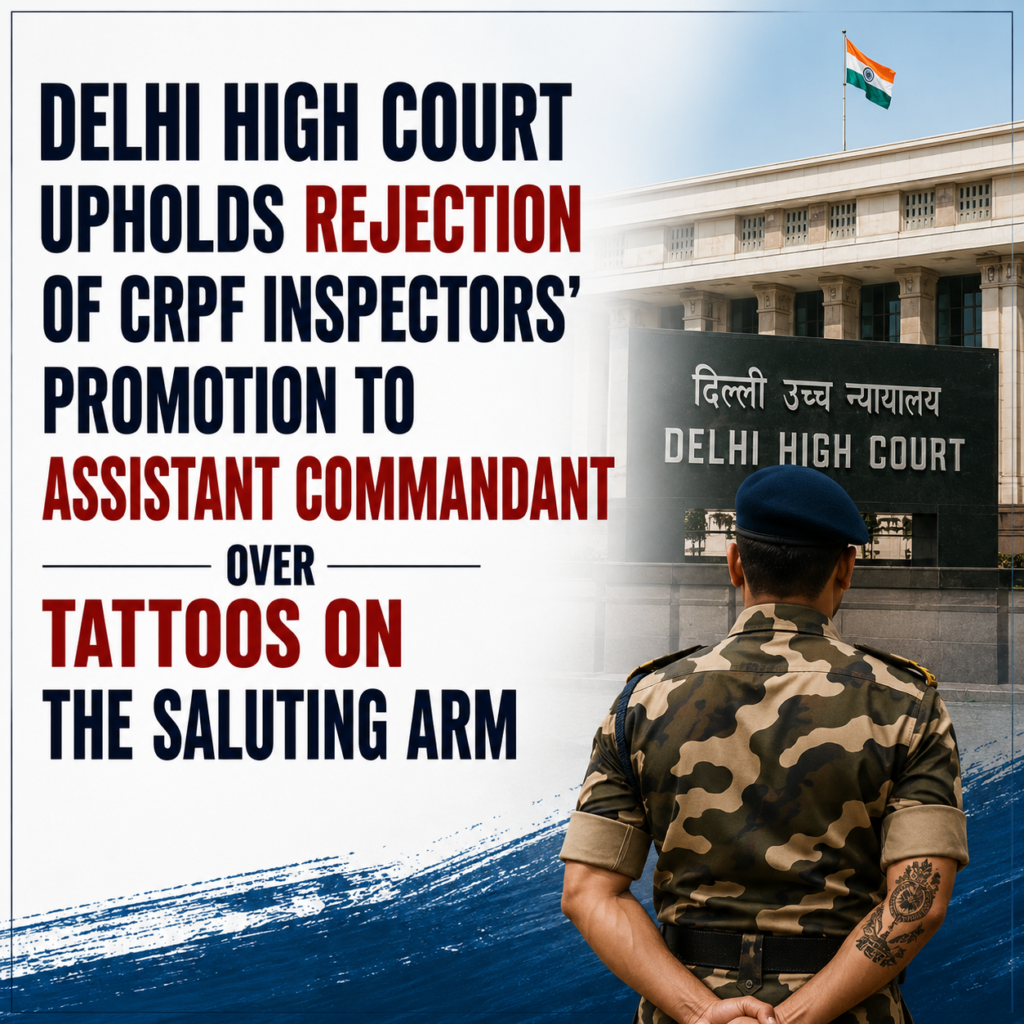
Delhi High Court Upholds Rejection of CRPF Inspectors from Assistant Commandant Promotion Over Tattoos on Saluting Arm
Facts
The Delhi High Court considered two connected writ petitions filed by Ankit Maan and Pradhan Choudhary, both serving members of the Central Reserve Police Force (“CRPF”).
Ankit Maan had joined the CRPF as a Sub-Inspector on 16 February 2012, while Pradhan Choudhary had joined as a Constable on 26 April 2010. They were subsequently promoted to the rank of Inspector in 2022 and 2023, respectively.
While serving as Inspectors, the petitioners applied for selection to the post of Assistant Commandant (General Duty) in the Central Armed Police Forces through the Limited Departmental Competitive Examination (“LDCE”)–2023, pursuant to an advertisement dated 8 April 2024.
Both petitioners cleared the written examination held on 30 June 2024 and were also found fit in the Physical Standard Test and Physical Efficiency Test.
However, during the Detailed Medical Examination conducted on 30 August 2024, they were declared medically unfit because they had tattoos on their right forearms, which constituted the saluting arm.
The petitioners sought a Review Medical Examination, which was conducted on 31 August 2024. The Review Medical Board also declared them unfit for the same reason. The decision was communicated through the report dated 3 September 2024.
After being declared unfit, the petitioners underwent surgical procedures and had the tattoos removed. They approached the Delhi High Court seeking a direction for constitution of another Review Medical Board so that they could be medically examined after removal of the tattoos.
Issues
- Whether the petitioners could be declared medically unfit for promotion to the post of Assistant Commandant because they had tattoos on their right forearms.
- Whether the applicable medical guidelines imposed an absolute prohibition on tattoos or merely regulated their content, size and location.
- Whether conducting the Review Medical Examination on the day immediately following the Detailed Medical Examination deprived the petitioners of a reasonable opportunity to remove the tattoos.
- Whether the subsequent surgical removal of the tattoos entitled the petitioners to another medical examination.
- Whether different standards should apply because the petitioners were already serving CRPF personnel seeking promotion through the LDCE rather than candidates applying through direct recruitment.
- Whether relief could be granted after all advertised vacancies had been filled and the selected candidates had not been impleaded as parties.
Petitioner’s Arguments
The petitioners argued that the advertisement for the LDCE–2023 did not expressly prohibit tattoos on any part of the body.
They submitted that the Guidelines for Recruitment Medical Examination in the CAPFs and Assam Rifles, revised in May 2015, did not provide that the mere existence of a tattoo would automatically render a candidate medically unfit.
According to the petitioners, the guidelines only prescribed criteria for determining whether a tattoo was permissible based on its content, location and size.
They further argued that the Review Medical Examination was conducted on the very next day after the Detailed Medical Examination. This gave them no effective opportunity to remove the tattoos or rectify the condition on account of which they had been declared unfit.
The petitioners emphasised that:
- They were already serving as Inspectors in the CRPF.
- The tattoos had existed during their service and had never interfered with the performance of their official duties.
- The tattoos became an objection only when they sought promotion to the post of Assistant Commandant.
- They had immediately undergone surgery and removed the tattoos after being declared unfit.
- Since the disqualifying condition no longer existed, they should be examined by a fresh Review Medical Board.
The petitioners relied upon decisions including:
- Nihal Singh v. Union of India;
- Pradeep v. Union of India;
- Shubham Sharma v. Union of India;
- Vineet Kumar Meena v. Union of India;
- Sachin Kumar v. Union of India; and
- Rahul Kumar v. Sashastra Seema Bal.
They argued that in those cases, candidates had been permitted to undergo another medical examination after removal or correction of the medical imperfection.
Respondent’s Arguments
The Union of India and the CRPF argued that the petitioners had been correctly declared unfit under the revised medical guidelines issued by the Ministry of Home Affairs.
The respondents submitted that tattoos were permissible only where they satisfied the prescribed requirements concerning content, location and size.
Under the guidelines, tattoos could be permitted on traditional sites such as:
- the inner aspect of the left forearm, being the non-saluting arm; or
- the dorsum of the hands.
The tattoo was also required to be less than one-fourth of the relevant part of the body.
The petitioners admittedly had tattoos on their right forearms, which constituted the saluting arm and was not a permissible location under the guidelines.
The respondents further argued that:
- The applicable rules did not prohibit conducting the Review Medical Examination on the next day.
- The cases relied upon by the petitioners involved direct recruitment and were distinguishable from promotion through an LDCE.
- As existing members of a disciplined force, the petitioners were expected to be aware of the applicable medical standards.
- All vacancies advertised under the LDCE had already been filled.
- The selected candidates had not been impleaded as respondents.
- Granting relief would adversely affect candidates who had already been selected and appointed.
The respondents relied upon Gedela Chandra Sekhara Rao v. Union of India, where the Delhi High Court had rejected a similar challenge involving a serving member of the armed forces who was declared unfit during an LDCE because of impermissible tattoos.
Analysis of the Law
The Court examined the Guidelines for Recruitment Medical Examination in the CAPFs and Assam Rifles, as revised in May 2015.
The guidelines did not impose an absolute prohibition on every tattoo. Instead, they prescribed three requirements for determining permissibility:
Content
Tattoos depicting religious symbols, religious figures or names, as traditionally followed in the Indian Army, could be permitted.
Location
Tattoos were permissible on traditional sites, particularly:
- the inner aspect of the left forearm, being the non-saluting limb; or
- the dorsum of the hands.
Size
The size of the tattoo had to be less than one-fourth of the particular part of the body, such as the elbow or hand.
The Court therefore accepted that tattoos were not completely prohibited. However, the petitioners’ tattoos were admittedly situated on their right forearms, which was not a permissible location under the applicable guidelines.
The Court further noted that there was no challenge to the legality or constitutional validity of the medical guidelines themselves. The petitioners also did not dispute the existence or location of their tattoos at the relevant time.
Accordingly, their eligibility had to be assessed by applying the guidelines as they existed on the relevant date.
Precedent Analysis
Gedela Chandra Sekhara Rao v. Union of India, 2024:DHC:9646-DB
The Court treated this decision as directly applicable.
In that case, a serving member of the armed forces had been declared unfit for selection through an LDCE because of tattoos on impermissible parts of his body. He argued that he should have been given time to remove the tattoos before the Review Medical Examination.
The Delhi High Court rejected the claim, observing that a serving member of a disciplined force was expected to know the applicable medical standards and could not plead ignorance of the prohibition.
Following the same reasoning, the Court held that the present petitioners, being serving CRPF Inspectors seeking appointment to a higher post through an LDCE, could not claim that they were unaware of the revised medical guidelines.
Decisions Relied Upon by the Petitioners
The petitioners relied upon Nihal Singh, Pradeep, Shubham Sharma, Vineet Kumar Meena, Sachin Kumar and Rahul Kumar, where candidates had allegedly been permitted another medical examination after rectifying the relevant medical condition.
The Court did not apply those decisions because they principally concerned direct recruitment. The present petitioners were serving members of the CRPF seeking selection to a higher post through a departmental examination.
The Court considered the distinction material because existing members of a disciplined force were expected to possess knowledge of the medical and disciplinary requirements applicable to the service.
Court’s Reasoning
The Court held that the petitioners were correctly declared medically unfit because their tattoos were situated on their right forearms, which were the saluting arms and therefore impermissible locations under the revised medical guidelines.
The Court rejected the contention that the Review Medical Examination had been conducted prematurely.
Under paragraph 3 of Annexure A to the Ministry of Home Affairs Office Memorandum dated 31 May 2021, the Review Medical Examination was required to be conducted in continuation of the Detailed Medical Examination, preferably on the following day.
Therefore, no fault could be attributed to the respondents merely because the Review Medical Examination had been conducted on 31 August 2024, one day after the Detailed Medical Examination.
The Court further held that eligibility had to be assessed with reference to the last date for submitting the application and the candidate’s condition during the prescribed selection process.
The subsequent removal of the tattoos could not retrospectively cure the petitioners’ ineligibility. Judicial review could not be used to grant them an additional opportunity that was not contemplated under the recruitment process.
The Court also noted that:
- The petitioners did not challenge the validity of the revised medical guidelines.
- The impermissible location of the tattoos was undisputed.
- Being serving members of the CRPF, the petitioners could not plead ignorance of the applicable medical standards.
- The petitioners could apply for the next examination after removal of their tattoos.
- All vacancies under the relevant LDCE had already been filled.
- The selected and appointed candidates had not been impleaded as parties.
Granting relief would adversely affect those selected candidates without giving them an opportunity to be heard. The petitions were therefore also defective for non-joinder of necessary parties.
Conclusion
The Delhi High Court upheld the medical disqualification of the two CRPF Inspectors from selection to the post of Assistant Commandant through the LDCE–2023.
The Court held that although tattoos were not absolutely prohibited under the applicable guidelines, tattoos on the right forearm or saluting arm were not permissible.
The subsequent surgical removal of the tattoos did not cure the petitioners’ ineligibility during the relevant selection process or entitle them to another Review Medical Examination.
The Court also held that the Review Medical Examination had validly been conducted on the day following the Detailed Medical Examination and that the serving petitioners were expected to be aware of the medical standards applicable to a disciplined force.
Both writ petitions were dismissed, and the pending applications were disposed of.
Case: Ankit Maan v. Union of India and Others, with Pradhan Choudhary v. Union of India and Others
Court: High Court of Delhi at New Delhi
Case Number: W.P.(C) 13759/2024 and W.P.(C) 13766/2024
Judge: Justice Anil Kshetarpal and Justice Amit Mahajan
Date: 1 July 2026
Result: Both writ petitions dismissed; pending applications disposed of.