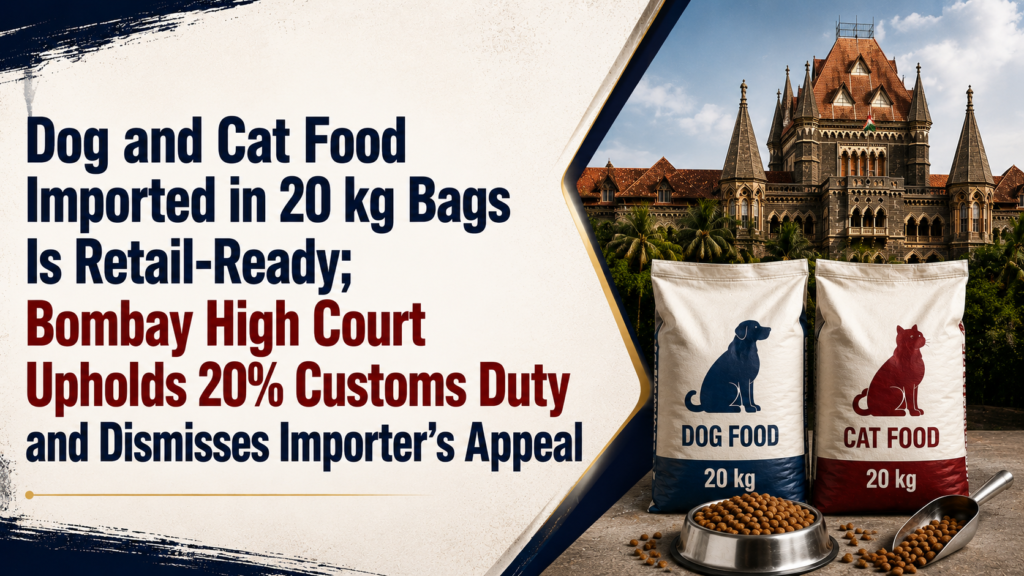
Pet Food Importer Called 20 kg Bags “Bulk Packaging”; Bombay High Court Finds Them Fit for Retail Sale and Rejects Lower Duty Claim
Facts
- Orange Pet Nutrition Private Limited proposed to import nutritionally complete dry dog and cat food in bags weighing 20 kg.
- The products contained dehydrated chicken protein, rice, maize, peas, beet pulp, oils and other nutrients. They were fully formulated and could be fed directly to pets without further processing or dilution.
- On 30 January 2025, the appellant applied to the Customs Authority for Advance Rulings (“CAAR”) for a ruling on whether the products should be classified as:
- CTH 2309 9010 – “Compounded animal feed,” attracting 15% Basic Customs Duty; or
- CTH 2309 1000 – “Dog or cat food, put up for retail sale,” attracting 20% Basic Customs Duty.
- The appellant claimed that the 20 kg bags were bulk or wholesale packages. After customs clearance, the contents were repacked into smaller packets ranging from approximately 70 grams to 12 kg and sold under the brand “Fidele+”.
- The imported 20 kg bags did not carry an MRP. However, their labels contained:
- The product’s composition and analytical constituents;
- Nutritional additives;
- Feeding directions and instructions for use;
- Batch and expiry information;
- An 18-month shelf life;
- Details of the manufacturer and importer; and
- Instructions to close the bag properly after each feeding.
- On 4 July 2025, CAAR ruled that the 20 kg bags were retail packs classifiable under CTH 2309 1000.
- Orange Pet Nutrition challenged that ruling before the Bombay High Court under Section 28KA of the Customs Act, 1962.
Issues
- Whether nutritionally complete dog and cat food imported in 20 kg bags was “put up for retail sale” and classifiable under CTH 2309 1000.
- Whether the goods should instead be treated as bulk “compounded animal feed” under the residual entry CTH 2309 9010.
- Whether the absence of an MRP and the appellant’s practice of repacking the goods after import prevented the original 20 kg bags from being treated as retail packages.
- Whether classification had to be based solely on the physical form of the goods at import, without examining their labeling, presentation and suitability for direct consumer use.
- Whether CAAR’s earlier ruling in Royal Canin India Pvt. Ltd. required the same classification in the appellant’s case.
Appellant’s Arguments
- The 20 kg bags were imported as bulk or wholesale packs and were not sold directly to consumers in their imported form.
- After import, the goods were always repacked into smaller packages carrying the MRP and other consumer declarations.
- Customs classification must be determined according to the form and condition of the goods at the time of import. The intended use or repacking undertaken after import should not affect classification.
- The words “put up for retail sale” require the product to be presented as a retail package at the time of import. The absence of an MRP and certain consumer declarations showed that the 20 kg bags were not retail packages.
- Merely because a package weighed less than 25 kg did not automatically make it a retail package under the Legal Metrology (Packaged Commodities) Rules, 2011.
- The HSN Explanatory Notes indicated that goods intended for resale after further repacking should not be treated as goods put up for retail sale.
- CAAR had classified pet food imported in bags weighing between 15 kg and 700 kg under CTH 2309 9010 in Royal Canin India Pvt. Ltd. The same treatment should have been given to the appellant.
- The Customs Department had taken inconsistent positions because it did not oppose the lower-duty classification in Royal Canin but opposed it in the appellant’s case.
- The appellant relied on Collector of Customs v. Sony India, Jayanti Food Processing (P) Ltd. v. Commissioner of Central Excise and Midas Fertchem Impex Pvt. Ltd. v. Principal Commissioner of Customs.
Respondents’ Arguments
- CAAR had correctly classified the goods according to their objective characteristics and presentation at the time of import.
- The products were complete, ready-to-feed dog and cat food and required no further processing.
- The detailed labels, nutritional information, feeding instructions, expiry date and importer details showed that the bags were suitable for direct sale and use by consumers.
- The absence of an MRP was not conclusive when the other features of the package demonstrated its retail character.
- The judgments and advance ruling cited by the appellant involved materially different facts and did not govern the present dispute.
- The appeal did not raise any substantial question of law and was liable to be dismissed.
Analysis of the Law
- Heading 2309 of the Customs Tariff covers preparations of a kind used in animal feeding.
- Under General Interpretative Rule 1, classification must first be determined according to the wording of the tariff headings and the relevant Section and Chapter Notes.
- Under General Interpretative Rule 6, subheadings at the same level must be compared. The competing entries were:
- CTH 2309 1000: Dog or cat food, put up for retail sale; and
- CTH 2309 9010: Compounded animal feed.
- CTH 2309 1000 is the more specific entry because it identifies both the product—dog or cat food—and its retail presentation.
- CTH 2309 9010 is a residual entry intended for compounded animal feed that does not fall within the more specific pet-food entry.
- The expression “put up for retail sale” cannot be decided solely by reference to package size or the presence of an MRP. The Court must examine:
- Packaging;
- Labeling;
- Consumer-facing information;
- Completeness of the product;
- Suitability for direct use; and
- Objective retail presentation at the time of import.
- Rule 3(a) of the Legal Metrology (Packaged Commodities) Rules exempts packages containing more than 25 kg or 25 litres from the relevant retail-package requirements. Since the bags weighed 20 kg, they were not covered by that exemption.
- The classification remained based on the goods in their imported condition. However, their labels, feeding instructions and suitability for direct use formed part of that imported condition.
- An importer’s voluntary decision to repackage the goods after customs clearance could not change the objective tariff classification of the goods at import.
Precedent Analysis
- Royal Canin India Pvt. Ltd., 2024 (390) ELT 530
- CAAR had dealt with pet food imported in bulk packages ranging from 15 kg to 700 kg.
- Those packages did not carry the requisite labeling and consumer information.
- The classification under CTH 2309 9010 was also based on a concession made by the jurisdictional Commissionerate.
- Orange Pet Nutrition’s 20 kg bags, in contrast, carried detailed nutritional information, feeding instructions, shelf-life information and manufacturer/importer details.
- The High Court therefore held that the Royal Canin ruling was factually distinguishable and did not assist the appellant.
- Midas Fertchem Impex Pvt. Ltd. v. Principal Commissioner of Customs, 2023 (1) TMI 998
- This CESTAT decision concerned fertilizer packages that lacked consumer declarations.
- It established that every package below 25 kg could not automatically be treated as a retail package.
- The High Court clarified that it was not classifying Orange Pet Nutrition’s goods as retail packs merely because they weighed less than 25 kg.
- Classification was based on the combined effect of weight, detailed labeling, ready-to-use nature and consumer presentation.
- The decision was therefore factually distinguishable.
- Jayanti Food Processing (P) Ltd. v. Commissioner of Central Excise, Rajasthan, [2007] 10 STT 375
- The case arose under excise law and involved packages supplied to an intermediary for use in the hotel industry.
- The assessee was not directly selling the packages to consumers.
- The factual and statutory context differed from consumer-ready pet food imported in fully labelled 20 kg bags.
- The Supreme Court judgment therefore did not support the appellant’s case.
- Collector of Customs v. Sony India, (2008) 231 ELT 385 (SC)
- The appellant relied on this decision for the principle that goods must be classified in the condition in which they are imported.
- The High Court did not reject that general principle.
- It explained that the goods’ imported condition included their packaging, labels, feeding directions, composition and suitability for direct consumer use.
- Consequently, applying the Sony India principle did not require the Court to ignore the retail-oriented presentation of the 20 kg bags.
Court’s Reasoning
- The imported products were complete and nutritionally balanced dog and cat food, rather than raw material or an intermediate product.
- No processing, mixing or dilution was required before feeding the product to pets.
- The 20 kg label carried extensive consumer-facing information, including composition, nutritional values, feeding guidelines, batch number, expiry details and manufacturer/importer information.
- The instruction to close the bag after each feeding demonstrated that the same bag could be retained and repeatedly used by the final consumer.
- The package had an 18-month shelf life and could function as a retail pack without being divided into smaller packets.
- An MRP was only one possible indicator of retail presentation. Its absence could not override the other objective evidence showing that the goods were suitable for direct consumer sale.
- The appellant did not produce any statutory exemption or factual evidence establishing that the 20 kg bags were legally incapable of being sold directly to consumers.
- The description “bulk packaging” printed on the bag was not decisive. Tariff classification depended on the package’s actual characteristics, not merely the description selected by the importer.
- The appellant’s later commercial decision to repackage the pet food into smaller quantities did not determine its classification at import.
- Since CTH 2309 1000 specifically covered dog and cat food put up for retail sale, it prevailed over CTH 2309 9010, which was a residual entry for compounded animal feed.
- The Court found no legal error in CAAR’s advance ruling and held that the appeal did not raise any substantial question of law.
Conclusion
The Bombay High Court held that the nutritionally balanced dog and cat food imported in 20 kg bags was “dog or cat food, put up for retail sale” under CTH 2309 1000.
The goods were fully formulated, ready to feed and presented with sufficient consumer-facing information to be sold and used directly in their imported form. Neither the absence of an MRP nor the appellant’s later repacking activity changed that classification.
The Court upheld CAAR’s advance ruling dated 4 July 2025, dismissed the appeal and made no order as to costs.
Case Details
Case: M/s Orange Pet Nutrition Private Limited v. Union of India and Others
Court: High Court of Judicature at Bombay, Ordinary Original Civil Jurisdiction
Case Number: Customs Appeal No. 53 of 2025
CNR: HCBM020274922025
Judges: Justice B.P. Colabawalla and Justice Firdosh P. Pooniwalla
Judgment authored by: Justice Firdosh P. Pooniwalla
Reserved on: 11 June 2026
Pronounced on: 22 July 2026
Result: Appeal dismissed; classification under CTH 2309 1000 upheld; no order as to costs