


HEADNOTE
National Insurance Company Ltd. v. Jawahar Prasad Keshri @ Jawahar Shah & Ors.
Court: High Court of Delhi
Bench: Justice Prateek Jalan
Date of Judgment: 12 December 2025
Citation: MAC.APP. 328/2013
Laws / Sections Involved: Sections 166, 140, 149(2), 149(4) Motor Vehicles Act, 1988; Sections 279 and 338 IPC
Keywords: Motor accident compensation, pay and recover principle, insurer liability, breach of policy, driving licence, vehicle permit
Summary:
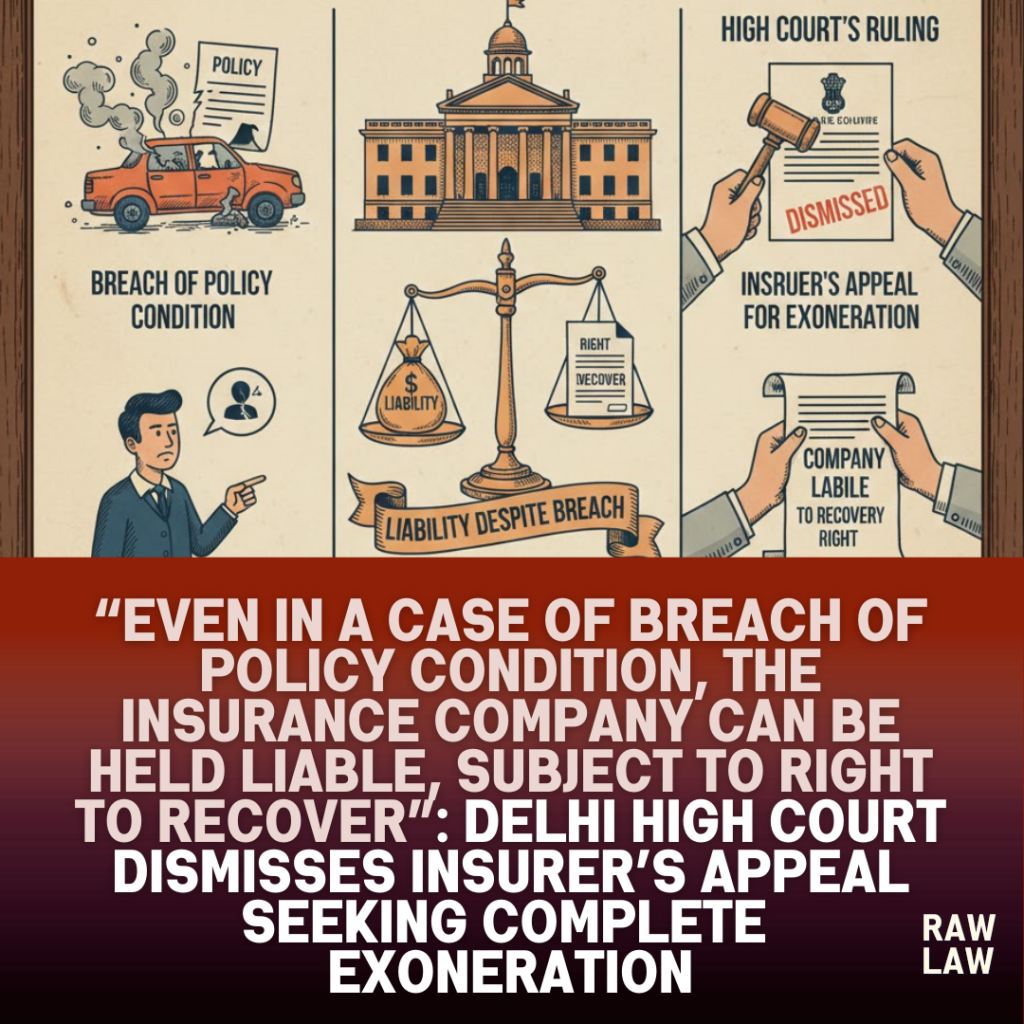
The Delhi High Court has dismissed an appeal filed by National Insurance Company Limited challenging a Motor Accident Claims Tribunal award of ₹4.11 lakh granted to an injured bus conductor. The insurer sought complete exoneration from liability on the ground that the offending vehicle was being driven without a valid permit and appropriate driving licence, constituting breach of policy conditions. Rejecting this contention, the Court reiterated that the “pay and recover” principle remains settled law. Even where an insurer successfully proves breach of policy conditions, it is still required to satisfy third-party claims and may subsequently recover the amount from the vehicle owner or driver. The Court relied on consistent Supreme Court jurisprudence, including recent 2025 decisions, holding that insurers cannot avoid liability altogether in third-party injury cases.
Court’s decision
The Delhi High Court dismissed the appeal filed by National Insurance Company Limited and upheld the award passed by the Motor Accident Claims Tribunal granting compensation to the injured claimant. The Court categorically held that the insurer’s attempt to seek complete exoneration from liability was untenable in law. It reiterated that even where the insurer successfully establishes breach of policy conditions under Section 149(2) of the Motor Vehicles Act, it remains under a statutory obligation to satisfy third-party claims. The Court affirmed that the appropriate course is to permit the insurer to recover the amount from the vehicle owner or driver after payment, rather than denying compensation to an innocent victim.
Facts
The accident took place on 13 June 2010 at around 9:00 PM. The claimant was employed as a conductor-cum-helper on a bus bearing registration number BR-45-P-0541. While passengers were alighting, the claimant stood behind the bus to assist them. At that moment, the driver suddenly reversed the vehicle without warning, causing the claimant to suffer grievous injuries. An FIR was registered against the driver for offences under the Indian Penal Code, and a chargesheet was filed after investigation. The injured claimant approached the Motor Accident Claims Tribunal seeking compensation under Sections 166 and 140 of the Motor Vehicles Act.
Issues
The principal issue before the High Court was whether the insurance company could be completely absolved of liability on the ground that the offending vehicle was being driven without a valid permit and that the driver lacked an appropriate licence to operate a heavy transport vehicle. The insurer contended that such violations constituted fundamental breaches of policy conditions and that, consequently, the Tribunal erred in directing it to satisfy the award. The applicability of the “pay and recover” principle in cases of proven breach was the core legal question.
Petitioner’s arguments
The insurance company argued that it had successfully established breach of policy conditions before the Tribunal. It submitted that the insured vehicle was operating without a valid permit and that the driver was not duly licensed to drive the category of vehicle involved. These violations, according to the insurer, went to the root of the insurance contract and extinguished its liability altogether. Relying on judicial observations questioning the correctness of the pay-and-recover doctrine, the insurer contended that compelling it to pay would amount to imposing a liability contrary to contract and statute.
Respondent’s arguments
Although the respondents did not actively contest the appeal during final hearing, the claimant’s position, as accepted by the Tribunal, was that he was a third-party victim who had no control over the permit status or licensing compliance of the vehicle. The claimant asserted that denial of compensation on technical grounds would defeat the social welfare object of the Motor Vehicles Act. It was urged that statutory insurance exists primarily to protect victims of road accidents and that disputes between insurer and insured should not prejudice innocent claimants.
Analysis of the law
The Court examined the statutory framework under Section 149 of the Motor Vehicles Act, which mandates insurers to satisfy judgments obtained by third parties against insured vehicles. While Section 149(2) permits insurers to raise specific defences, including breach of policy conditions, the Court emphasised that these defences do not automatically absolve insurers of liability towards third parties. The legislative intent is to ensure prompt and effective compensation to accident victims, leaving insurers free to pursue recovery from insured persons in appropriate cases.
Precedent analysis
The Court undertook an extensive review of Supreme Court jurisprudence on the pay-and-recover principle. It noted that although doubts were expressed in Parvathneni regarding compelling insurers to pay where no liability exists, the reference was never conclusively answered. Subsequent judgments, including Shamanna, Parminder Singh, and most recently Rama Bai v. Amit Minerals and Akula Narayana v. Oriental Insurance Co. Ltd. (2025), have consistently applied the pay-and-recover doctrine. The Court also referred to the Full Bench decision of the Karnataka High Court in Yallavva, which expressly overruled contrary views and reaffirmed insurer liability subject to recovery rights.
Court’s reasoning
Justice Prateek Jalan observed that the legal position has crystallised against the insurer’s contention. The Court held that both authorities relied upon earlier by insurers to argue against pay-and-recover have since been resolved. The Supreme Court has repeatedly directed insurers to satisfy awards even in cases of licence or permit violations. The Court underscored that denying compensation to third-party victims would undermine the beneficial purpose of the Motor Vehicles Act. Accordingly, the insurer’s plea for complete exoneration was rejected as being contrary to settled law.
Conclusion
The High Court concluded that the appeal was devoid of merit and dismissed it in its entirety. It clarified that if the insurance company had already satisfied the award during pendency of the appeal, it was at liberty to exercise recovery rights against the driver and owner in accordance with law. The Tribunal’s award and directions were affirmed in full, reinforcing the insurer’s statutory obligation towards third-party claimants.
Implications
This judgment further strengthens the pay-and-recover principle and sends a clear signal that insurers cannot evade liability towards accident victims by relying solely on policy breaches. It reinforces the social welfare character of motor accident compensation law and ensures that third-party victims are not left remediless due to disputes between insurer and insured. For insurers, the ruling reiterates that recovery proceedings, not denial of compensation, are the appropriate remedy in cases of breach.
CASE LAW REFERENCES
• National Insurance Co. Ltd. v. Swaran Singh – Insurer must satisfy third-party award despite licence breach, with right to recover
• Shamanna v. Divisional Manager – Pay-and-recover applied where driver lacked valid licence
• Parminder Singh v. New India Assurance Co. Ltd. – Insurer directed to pay and recover for policy violation
• Rama Bai v. Amit Minerals (2025) – Supreme Court reaffirmed pay-and-recover despite insurer’s statutory defence
• Akula Narayana v. Oriental Insurance Co. Ltd. (2025) – Followed Rama Bai and upheld insurer liability subject to recovery
FAQs
Q1. Can an insurance company avoid paying compensation if the driver had no valid licence?
No. Courts have consistently held that insurers must first pay compensation to third-party victims and may later recover the amount from the vehicle owner or driver.
Q2. What is the pay and recover principle?
It is a legal doctrine requiring insurers to satisfy motor accident awards even where policy conditions are breached, while preserving their right to recover from the insured.
Q3. Does absence of vehicle permit absolve the insurer completely?
No. Absence of permit constitutes a breach, but it does not absolve the insurer from its statutory duty towards third-party victims.