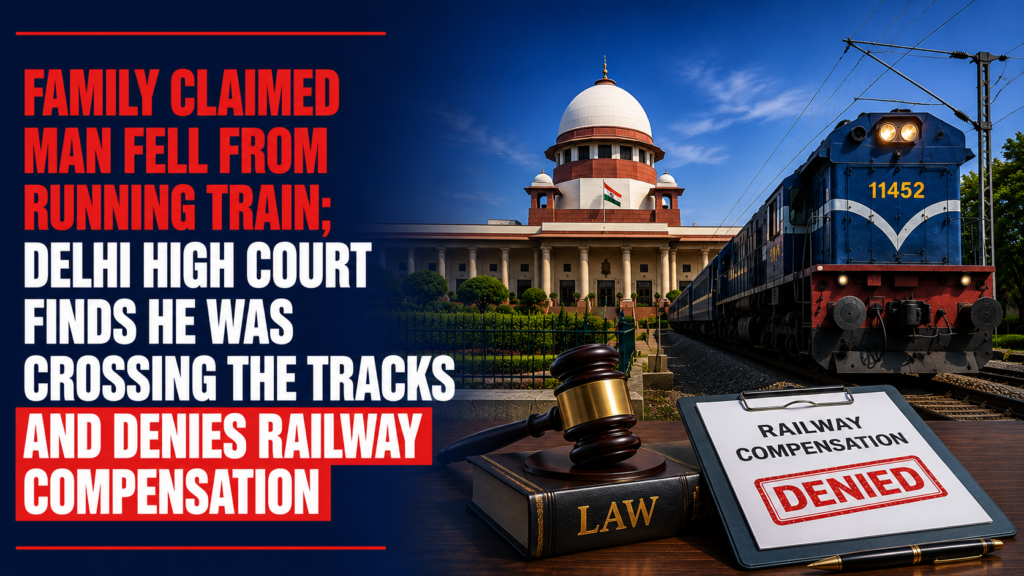
No Witness Saw Deceased Fall from Train; Delhi High Court Upholds Rejection of Railway Accident Compensation
Facts
The appellants, comprising the widow and legal heirs of the deceased, challenged the Railway Claims Tribunal’s judgment dated 6 March 2025 dismissing their compensation claim under the Railways Act, 1989. The Tribunal had held that the deceased was neither a bona fide passenger nor a victim of an “untoward incident” within the meaning of the Act.
According to the appellants, on 19 June 2022 the deceased, Kamlesh Kumar, purchased a railway ticket from Faridabad to Kanpur and boarded a train from Faridabad Railway Station. They alleged that when the train reached near Lakadpur Railway Station, he accidentally fell from the moving train due to overcrowding and pushing inside the compartment. He suffered grievous injuries and died on the following day. They further claimed that his travel ticket remained inside his bag, which was left in the train.
The Railways disputed this version. Relying upon the DRM Report, Railway Protection Force investigation, statutory inquiry and the evidence of the gateman, they asserted that the deceased was crossing the railway track near Gate No. 579-B when Tamil Nadu Express (Train No. 12622) passed through the section, resulting in a run-over accident.
Issues
- Whether the deceased was a bona fide passenger travelling on a valid railway ticket.
- Whether the death resulted from an “untoward incident” under Section 123(c) of the Railways Act, 1989.
- Whether the Railway Claims Tribunal was justified in rejecting the claim for statutory compensation.
Appellants’ Arguments
The appellants argued that the Tribunal had wrongly rejected the claim merely because the railway ticket could not be recovered from the deceased.
They submitted that the deceased had purchased a valid ticket, but it remained inside his bag, which was left in the train after the accident.
Reliance was placed upon the testimony of Ajay Kumar (AW-2), who accompanied the deceased to Faridabad Railway Station, to establish that the deceased had travelled by train.
They also relied upon the MLC, post-mortem report, and GRP records, contending that these documents established that the deceased suffered fatal injuries in a railway accident and therefore compensation ought to have been awarded.
Respondent’s Arguments
The Railways contended that the appellants failed to establish either that the deceased was travelling by train or that he accidentally fell from a running train.
The respondent relied upon the DRM Report, Railway Protection Force investigation, statutory inquiry and the testimony of Gateman Devender Kumar Saini (RW-1).
According to RW-1, the deceased attempted to cross the railway line despite repeated warnings after the railway gate had already been closed for the passage of Tamil Nadu Express (Train No. 12622). The deceased ignored the warnings, attempted to cross the track carrying a bag, and sustained fatal injuries.
The Railways therefore contended that the incident was a run-over case, not an “untoward incident” under the Railways Act.
Analysis of the Law
The Court reiterated that, in view of the Supreme Court’s decision in Union of India v. Rina Devi, mere non-recovery of a railway ticket cannot by itself justify rejection of a compensation claim. However, where the primary dispute concerns the manner in which the accident occurred, the claimant must still establish that the death resulted from an untoward incident within the meaning of the Railways Act.
The Court found that the appellants produced no eyewitness who actually saw the deceased board the train or fall from it. The widow admittedly had no personal knowledge of the occurrence, while AW-2 merely dropped the deceased at the railway station and left before the alleged accident.
Conversely, the respondent’s version was supported by direct eyewitness testimony of the gateman, together with the DRM Report, Railway Protection Force investigation and statutory inquiry, all of which consistently recorded that the deceased was injured while attempting to cross the railway line.
The Court also observed that although the MLC and post-mortem established that the deceased sustained injuries in a railway accident, they did not indicate that those injuries resulted from an accidental fall from a moving train. Consequently, the appellants failed to prove that the death arose from an “untoward incident” as contemplated by Section 123(c) of the Railways Act.
Precedent Analysis
Union of India v. Rina Devi (2019) 3 SCC 572
The Supreme Court held that mere non-recovery of a railway ticket does not automatically disprove that a deceased was a bona fide passenger. The Delhi High Court accepted this principle but clarified that the present appeal failed not because the ticket was missing, but because the appellants could not establish that the deceased actually fell from a running train. The decisive issue was the nature of the incident rather than the absence of the ticket.
Court’s Reasoning
The Court found that none of the witnesses produced by the appellants had witnessed the alleged fall from the train.
The widow’s testimony was entirely hearsay, and AW-2 admitted during cross-examination that he had merely accompanied the deceased to the railway station and did not witness the occurrence.
On the other hand, the testimony of Gateman Devender Kumar Saini (RW-1) was found reliable. He categorically deposed that he repeatedly warned the deceased not to cross the railway line after the gate had been closed for the passage of Tamil Nadu Express, but the deceased ignored those warnings.
The Court further observed that the gateman’s testimony was corroborated by the DRM Report, Railway Protection Force investigation and statutory inquiry, all of which consistently concluded that the deceased sustained injuries while crossing the railway track rather than by falling from a moving train.
Since the appellants failed to establish the essential ingredients of an “untoward incident”, the Tribunal had rightly rejected the compensation claim.
Conclusion
The Delhi High Court upheld the Railway Claims Tribunal’s decision and dismissed the appeal. Although non-recovery of the railway ticket was not treated as fatal, the Court held that the appellants failed to prove that the deceased was injured due to an accidental fall from a running train. The evidence overwhelmingly established that he sustained fatal injuries while attempting to cross the railway track, which did not constitute an “untoward incident” under Section 123(c) of the Railways Act. Consequently, no statutory compensation was payable.
Case Details
Case: Rubi Devi & Ors. v. Union of India
Court: High Court of Delhi
Case No.: FAO 191/2025
Judge: Justice Manoj Kumar Ohri
Reserved On: 20 July 2026
Pronounced On: 24 July 2026
Relevant Provisions: Section 23, Railway Claims Tribunal Act, 1987; Section 123(c), Railways Act, 1989
Result: Appeal dismissed; Tribunal’s rejection of compensation upheld on the ground that the deceased did not suffer an “untoward incident” under the Railways Act.