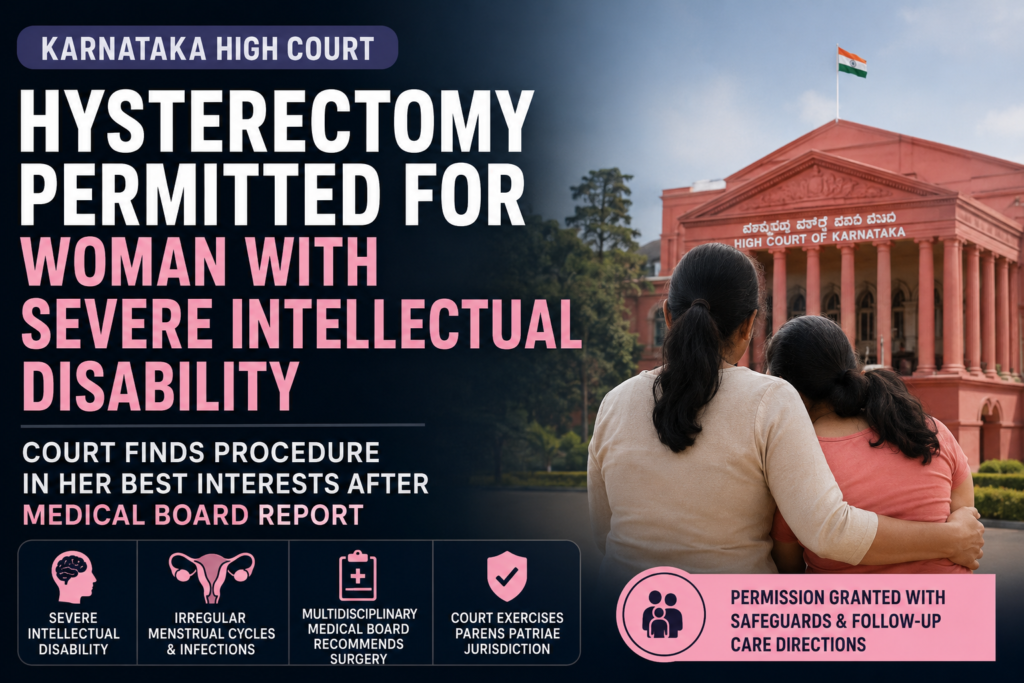
Parents’ Consent Alone Is Not Enough, but Best-Interests Test Supports Hysterectomy: Karnataka High Court
Facts
The petitioners were the parents and primary caregivers of a 23-year-old woman suffering from cerebral palsy, seizure disorder, global developmental delay and moderate permanent intellectual disability.
They approached the Karnataka High Court seeking permission to perform a Total Abdominal Hysterectomy on their daughter.
According to the parents, their daughter was unable to understand or independently manage basic bodily functions, including menstrual hygiene. Her irregular menstrual cycles allegedly resulted in recurring infections, fever and prolonged health complications.
The parents submitted that she remained completely dependent upon them for personal care and could not effectively communicate menstrual discomfort or related medical concerns.
They also expressed concern that, as they grew older, they might become physically incapable of providing the same level of assistance in the future.
Considering the invasive and irreversible nature of the proposed procedure, the High Court constituted a multidisciplinary Medical Board at Vanivilas Hospital.
The woman was examined by specialists in psychology, psychiatry, neurology, obstetrics and gynaecology, radiology and anaesthesiology.
The Medical Board found that:
- her social age was approximately five years and four months;
- her IQ was 36;
- her permanent intellectual disability was assessed at 75%;
- she was incapable of independently managing menstrual hygiene;
- she suffered from cerebral palsy and seizure disorder;
- she was medically fit to undergo surgery; and
- a Total Abdominal Hysterectomy could be considered in her best interests.
Issues
- Whether the Court could permit an irreversible hysterectomy where the patient was incapable of giving informed consent.
- Whether parental consent alone was sufficient to authorise removal of a reproductive organ.
- Whether the proposed procedure violated the woman’s rights to bodily integrity, reproductive autonomy, dignity and privacy.
- Whether the Court could exercise its parens patriae jurisdiction to determine what was in the patient’s best interests.
- Whether the medical and caregiving circumstances justified the proposed hysterectomy.
Petitioner’s Arguments
The parents argued that their daughter’s severe intellectual and developmental disabilities prevented her from understanding menstruation or maintaining menstrual hygiene.
They submitted that she was unable to communicate pain, discomfort or medical complications arising during her menstrual cycles.
According to them, her inability to manage menstrual hygiene had resulted in recurring infections, intermittent fever and prolonged illness.
The parents clarified that the request was not made for convenience, population control or any collateral purpose.
They contended that the proposed procedure was intended solely to protect their daughter’s health, dignity, comfort, safety and long-term welfare.
They also highlighted their advancing age and the practical difficulty of continuing lifelong physical caregiving at the same level.
The parents relied on medical and psychological assessments showing substantial developmental and social-adaptive deficits.
Respondent’s Arguments
The State did not appear to raise a substantive objection after the Court obtained the independent Medical Board’s report.
The matter was primarily examined by the Court from the perspective of constitutional rights, medical ethics and the patient’s welfare rather than as an adversarial dispute.
The respondent authorities were required to ensure that any procedure was performed only after compliance with applicable medical, legal and ethical safeguards.
Analysis of the Law
The High Court held that an invasive and irreversible medical procedure affecting a reproductive organ ordinarily requires the free, informed and voluntary consent of the person concerned.
Valid informed consent requires the ability to understand:
- the nature of the proposed procedure;
- its benefits and risks;
- its consequences;
- available alternatives; and
- its long-term implications.
The Court emphasised that persons with disabilities possess the same rights to dignity, bodily integrity, privacy and reproductive autonomy as every other individual.
Disability alone can never justify removal of a reproductive organ.
The Court therefore rejected any approach under which substituted parental consent by itself would be treated as sufficient.
However, where a person is demonstrably incapable of meaningful informed decision-making, the Court may exercise its parens patriae jurisdiction.
Under that jurisdiction, the Court must independently determine whether the proposed intervention is genuinely in the person’s best interests.
The “best interests” test requires a holistic examination of:
- medical necessity;
- physical health;
- psychological wellbeing;
- emotional consequences;
- dignity and quality of life;
- available alternatives;
- long-term welfare; and
- the person’s safety and support needs.
The Court also noted that parental inconvenience alone cannot justify hysterectomy. Caregiving difficulties are relevant only where they directly affect the patient’s health, dignity and quality of care.
Precedent Analysis
The High Court relied principally on the Supreme Court’s decision in Suchita Srivastava v. Chandigarh Administration.
In that case, the Supreme Court recognised reproductive choice as an integral part of personal liberty under Article 21 of the Constitution.
The judgment affirmed that every woman has rights to bodily integrity, privacy and reproductive autonomy, including women with intellectual disabilities.
The Karnataka High Court applied these principles and clarified that a person cannot be subjected to reproductive surgery merely because she has a disability.
At the same time, the Court distinguished the present case from situations involving forced sterilisation or removal of reproductive capacity for eugenic or population-control purposes.
The permission in the present case was based upon:
- proven inability to provide informed consent;
- recurring health and hygiene complications;
- permanent developmental impairment;
- independent multidisciplinary medical evaluation;
- absence of medical contraindication; and
- the Medical Board’s unanimous recommendation.
The Court held that the constitutional principles in Suchita Srivastava continued to govern the decision and required heightened judicial scrutiny rather than an automatic refusal or approval.
Court’s Reasoning
The High Court found that the patient lacked the cognitive and intellectual capacity required to make an informed decision regarding hysterectomy.
Her IQ was assessed at 36, her social age at approximately five years and four months, and her permanent disability at 75%.
The Court noted that the patient was unable to understand menstruation, communicate menstrual discomfort or independently maintain hygiene.
The parents’ concerns regarding recurring infections and illness were supported by the findings of the Medical Board and were not merely unsupported apprehensions.
The Court attached considerable importance to the fact that the recommendation was made by a multidisciplinary board rather than a single doctor.
Specialists from several medical disciplines independently examined the patient and collectively supported the procedure.
The Court also found that:
- the patient’s condition was permanent and unlikely to improve sufficiently;
- no medical contraindication to surgery had been identified;
- the anaesthesiologist certified her fitness for surgery;
- no less intrusive and equally effective long-term alternative had been suggested; and
- the parents appeared motivated solely by concern for their daughter’s welfare.
The Court expressly held that the decision was not based on parental consent alone.
It was a court-supervised best-interests determination made after independent medical examination and scrutiny of the patient’s constitutional rights.
The Court concluded that the proposed procedure would advance the patient’s health, hygiene, dignity, safety and quality of life.
Conclusion
The Karnataka High Court allowed the writ petition and permitted the parents to have a Total Abdominal Hysterectomy performed on their daughter at Vanivilas Hospital, Bengaluru.
The Medical Superintendent was directed to make all necessary arrangements in accordance with the Medical Board’s recommendations and applicable medical, legal and ethical requirements.
The Court further directed that:
- the patient’s dignity, safety and welfare be protected throughout treatment;
- pre-operative counselling and psychological support be provided;
- appropriate post-operative care and rehabilitation be arranged;
- specialists monitor her recovery; and
- a report regarding the procedure and post-operative condition be submitted to the Registrar General within eight weeks.
The judgment makes clear that disability alone cannot justify an irreversible reproductive procedure. Permission may be granted only where the patient lacks capacity, independent medical evidence supports the procedure and the Court is satisfied that it genuinely serves the patient’s best interests.
Case Details
Case: H. Kusuma & Another v. Chief Secretary to Government & Another
Court: High Court of Karnataka at Bengaluru
Case Number: Writ Petition No. 14350 of 2026
Judge: Justice Suraj Govindaraj
Date: 17 June 2026
Result: Hysterectomy permitted subject to medical supervision, counselling, post-operative care and reporting safeguards