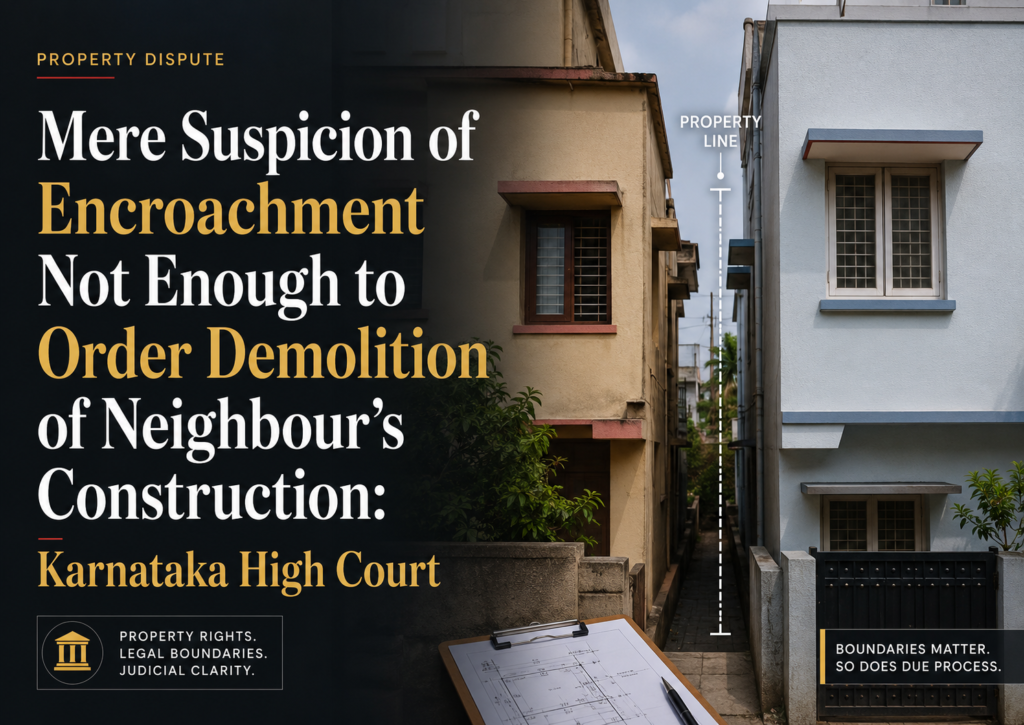
Mere Suspicion of Encroachment Not Enough to Order Demolition of Neighbour’s Construction: Karnataka High Court

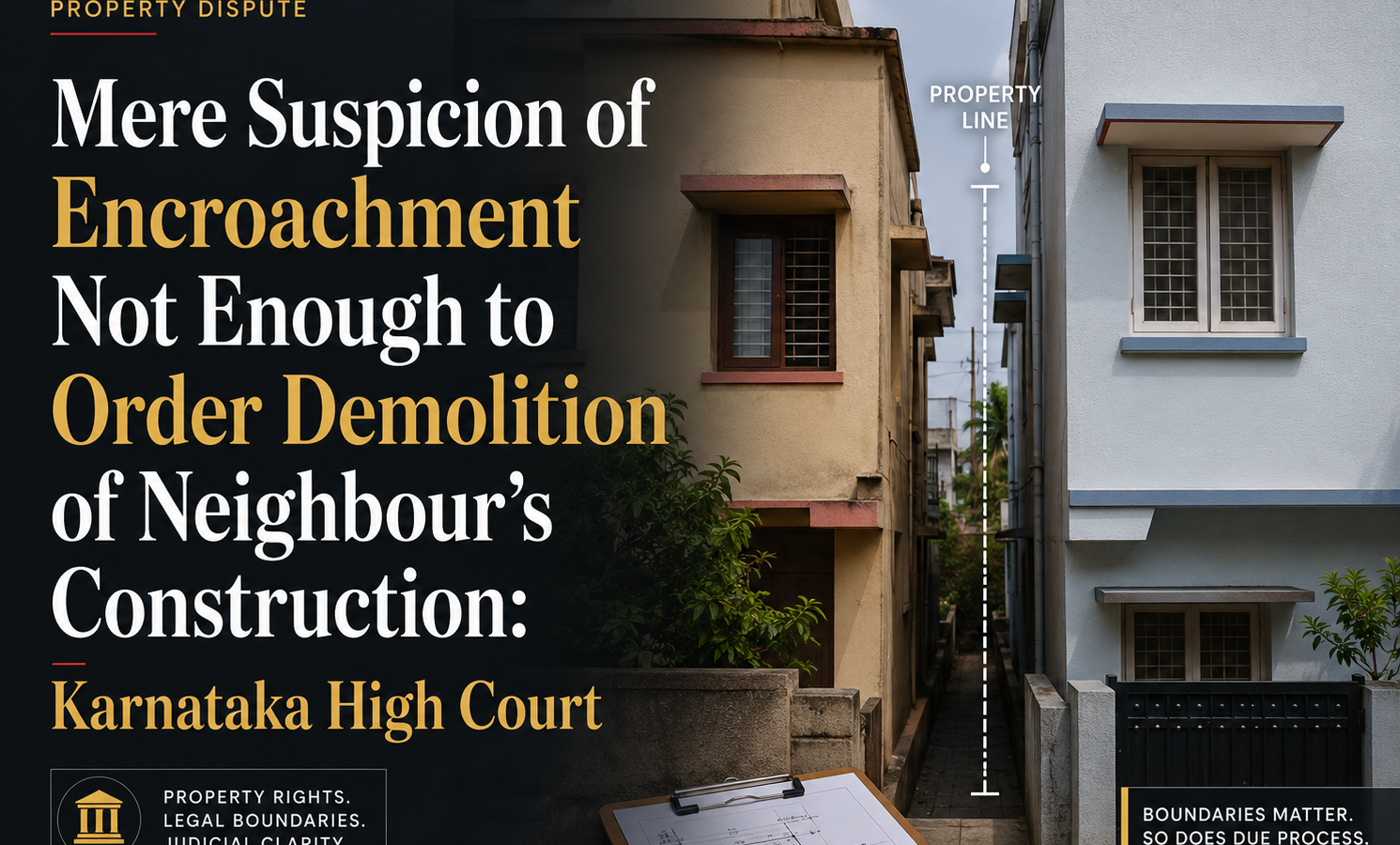
Karnataka High Court Rejects Demolition Claim Where Property Boundaries and Encroachment Were Not Clearly Proved
Facts
The dispute arose between two neighbouring property owners in Holenarasipura, Karnataka.
M.A. Rajaiah and his wife claimed ownership over property adjoining the house of S. Vishnupadachar. They alleged that Vishnupadachar had demolished an old mud-walled house and constructed a new building by encroaching upon a narrow strip of their property.
Two separate civil suits were filed.
In the first suit, the plaintiffs claimed ownership over a strip measuring approximately two feet by forty feet. They sought:
- declaration of ownership;
- possession of the allegedly encroached portion;
- demolition of the wall constructed over it;
- damages; and
- permanent injunction.
In the second suit, the plaintiffs claimed ownership over another strip measuring approximately two feet by twenty-one feet. They alleged that the defendant had opened windows on the first floor, constructed a projecting sunshade or “chajja”, and directed rainwater towards their property.
They sought removal of the chajja, permanent closure of the windows, possession and injunction.
The Trial Court dismissed both suits.
On appeal, the First Appellate Court reversed the Trial Court’s decisions. In one suit, it declared the plaintiffs’ ownership and awarded damages but refused to order demolition of the wall. In the other suit, it granted declaration and directed the defendant to remove the chajja and permanently close the windows.
Both sides approached the Karnataka High Court through three connected second appeals.
The plaintiffs challenged the refusal to order demolition, while the defendant challenged the declaration of ownership and the mandatory direction to remove the chajja and close the windows.
Issues
- Whether the plaintiffs had proved that the defendant encroached upon their property while reconstructing his house.
- Whether the First Appellate Court could reconcile the different measurements and descriptions given for the disputed property in the two suits.
- Whether the plaintiffs were entitled to a mandatory injunction directing demolition of the wall.
- Whether the defendant could be ordered to remove the first-floor chajja and permanently close the windows.
- Whether the disputed passage or “oni” belonged to the plaintiffs or to the Municipality.
- Whether mandatory relief could be granted despite the Court Commissioner’s finding that no encroachment had occurred.
Petitioner’s Arguments
Arguments of the Plaintiffs
The plaintiffs argued that the defendant’s sale deed showed a property width of approximately eighteen-and-a-half feet, whereas he had admittedly constructed a building measuring about twenty feet in width.
According to them, this admission established that the defendant had encroached upon their land.
They argued that the differences in the measurements mentioned in the two suits were not material. The descriptions related to different portions of the same property and could be reconciled by reading their sale deed, municipal records and boundaries together.
The plaintiffs also challenged the Court Commissioner’s report. They alleged that the Commissioner had accepted documents from the defendant’s lawyer during the local inspection and had failed to properly follow their instructions.
They contended that once the First Appellate Court declared them to be owners of the disputed portion, it should also have granted the consequential relief of demolition.
In relation to the windows and chajja, they argued that the construction was contrary to the sanctioned plan and interfered with their peaceful enjoyment of the property.
They further submitted that earlier writ proceedings had not finally declared the passage to be municipal property. The question of ownership, according to them, remained open for determination by the Civil Court.
Respondent’s Arguments
Arguments of the Defendant
The defendant argued that there was no encroachment whatsoever.
He relied heavily upon the Court Commissioner’s report and sketch, which found that the passage between the two properties continued to exist and that the construction had not entered the plaintiffs’ land.
The defendant explained that the old house had thick mud walls. When those walls were demolished and replaced with thinner brick walls, additional usable space became available within the same property. Therefore, the increased width of the new structure did not prove encroachment.
He also argued that the plaintiffs’ own sale deed included a petty shop, gutter and passage within the total measurements claimed by them. They could not exclude those portions while asserting that the remaining shortfall had been occupied by him.
The defendant pointed out several inconsistencies in the plaintiffs’ evidence regarding:
- the exact width and length of the disputed land;
- whether a passage existed between the properties;
- whether the passage belonged to the plaintiffs or the Municipality; and
- whether the windows and chajja actually projected into the plaintiffs’ property.
He further argued that windows had existed in the old building as well. Merely opening windows within his own property could not justify a mandatory injunction when no encroachment or legal injury was proved.
Analysis of the Law
The appeals were decided under Section 100 of the Code of Civil Procedure, which limits a second appeal to substantial questions of law.
The High Court emphasised that a plaintiff seeking declaration of ownership and mandatory injunction must clearly establish:
- the identity and measurements of the property;
- lawful title over the disputed portion;
- the exact nature and extent of encroachment; and
- the legal necessity for demolition or removal.
A mandatory injunction is a serious and exceptional remedy. It compels a person to demolish, remove or alter an existing structure.
Such relief cannot be granted merely because a neighbouring construction is inconvenient or because there is a difference between the dimensions mentioned in the defendant’s sale deed and the completed building.
The plaintiff must prove that the construction actually extends into the plaintiff’s land or unlawfully interferes with an enforceable property right.
The Court also explained that where ownership of a disputed passage may vest in a Municipality, the Municipality is a necessary or at least a proper party. A binding declaration concerning that passage should not ordinarily be made without giving the municipal authority an opportunity to participate.
Precedent Analysis
The judgment principally turned on the evidence, the Commissioner’s report and the limits of jurisdiction under Section 100 of the Code of Civil Procedure.
The Court also considered the effect of earlier writ and writ-appeal proceedings concerning the disputed passage.
Those proceedings had not conclusively declared ownership in favour of either private party. The Municipality had been directed to examine the issue after the civil litigation was decided.
The High Court therefore held that the earlier writ proceedings did not conclusively establish the plaintiffs’ title over the passage.
At the same time, the plaintiffs could not obtain final relief regarding the passage without impleading the Municipality or examining a responsible municipal officer.
The Court applied the settled principle that a First Appellate Court may reassess evidence, but it cannot grant a mandatory injunction contrary to accepted evidence showing that no encroachment occurred.
Court’s Reasoning
The High Court found significant inconsistencies in the plaintiffs’ case.
The two suits described the disputed portions differently. The measurements, boundaries and nature of the alleged encroachment were not presented with sufficient clarity.
The plaintiffs had also failed to produce the complete chain of title showing the exact measurements obtained by their predecessors.
The Court Commissioner had inspected the properties, measured the land and prepared a report and sketch. The report found no encroachment by the defendant.
Although the plaintiffs questioned the Commissioner’s conduct, the High Court noted that they themselves had failed to provide the necessary documents to the Commissioner during the inspection.
The plaintiffs could not reject the Commissioner’s report merely because its findings went against them.
The Court accepted the defendant’s explanation that replacing thick mud walls with thinner brick walls could increase the internal or plinth area without extending the building beyond the original property.
The defendant’s construction measuring approximately twenty feet in width, despite a smaller measurement in the sale deed, was therefore not conclusive proof that he had occupied the plaintiffs’ land.
The Court further noted that the plaintiffs and their witnesses had admitted the existence of a passage between the two properties.
Since the ownership of that passage remained connected with municipal records and earlier proceedings, the plaintiffs should have impleaded the Municipality or summoned a municipal official.
Regarding the windows, the Court observed that similar windows existed in the earlier structure. When no encroachment was proved, the plaintiffs could not prevent the defendant from opening windows within his own property.
The First Appellate Court had accepted the Commissioner’s finding that there was no encroachment. Having accepted that finding, it could not logically direct removal of the chajja and permanent closure of the windows.
The High Court therefore held that the mandatory injunction granted in the second suit was legally unsustainable.
At the same time, the Court found no reason to interfere with the refusal to grant demolition in the first suit because the alleged encroachment had not been proved.
Conclusion
The Karnataka High Court dismissed the plaintiffs’ appeal seeking demolition of the defendant’s wall.
It also dismissed the defendant’s appeal challenging the decision in the first property suit.
However, the Court allowed the defendant’s appeal against the mandatory injunction directing him to remove the chajja and permanently close the first-floor windows.
The direction for removal of the chajja and closure of the windows was therefore set aside.
The Court held that:
- the plaintiffs had not clearly proved the measurements and identity of the disputed property;
- the Court Commissioner had found no encroachment;
- a wider building measurement alone did not establish occupation of the neighbour’s land;
- the disputed municipal passage could not be conclusively claimed without involving the Municipality; and
- windows and a sunshade constructed within the defendant’s property could not be ordered to be removed in the absence of proved encroachment.
Case Details
Case: M.A. Rajaiah and Others v. S. Vishnupadachar through Legal Representatives
Court: High Court of Karnataka at Bengaluru
Case Numbers: RSA Nos. 198, 337 and 339 of 2010
Judge: Justice V. Srishananda
Date of Decision: 19 June 2026
Result: Plaintiffs’ appeal dismissed; defendant’s challenge to mandatory removal of chajja and closure of windows allowed; no order as to costs
READ ALSO: Court Can Interfere With Arbitral Award Where Vital GST Evidence Is Ignored: Karnataka High Court