Supreme Court Holds Pre-2007 Indivisible Turnkey ATM Contracts Cannot Be Vivisected for Service Tax; Upholds CESTAT Order Quashing Installation Tax Demand

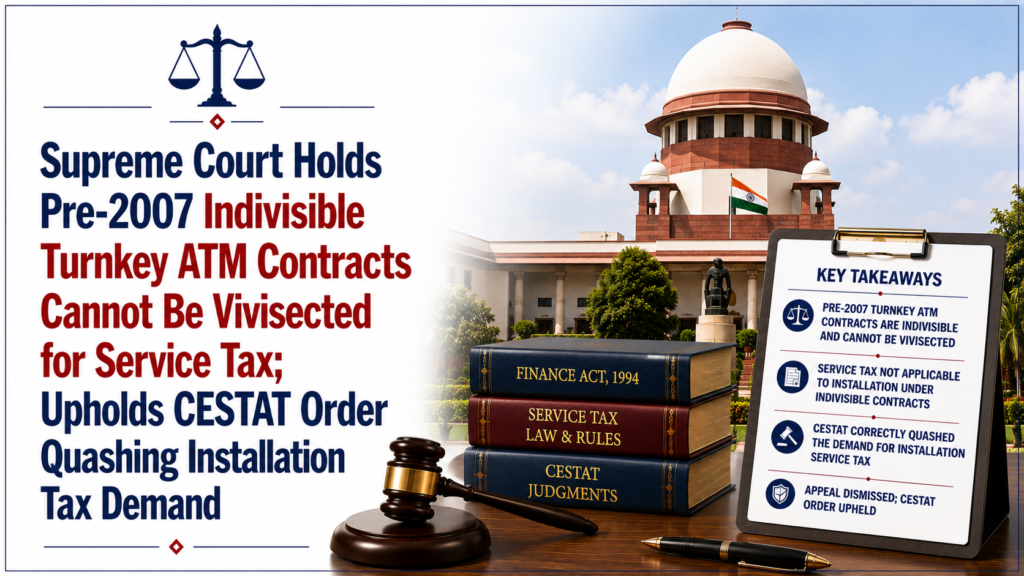
Supreme Court Rejects Service Tax on 33% of Composite Turnkey Contract Value for ATM Installation
Facts
The respondent, M/s Diebold Systems Pvt. Ltd., entered into turnkey contracts with various banks for the supply, installation and commissioning of Automated Teller Machines (ATMs). The Revenue sought to levy service tax on 33% of the composite contractual consideration, treating that portion as representing consideration for installation and commissioning services under the category of “commissioning or installation” under the Finance Act, 1994. Three show cause notices covering the period July 2003 to April 2006 resulted in substantial service tax demands, interest and penalties. The CESTAT held that the contracts were indivisible turnkey contracts and set aside the demands, leading the Revenue to file appeals before the Supreme Court.
Issues
- Whether turnkey contracts for supply, installation and commissioning of ATMs constituted indivisible composite contracts incapable of being vivisected for levy of service tax during the relevant period.
- Whether the Revenue could levy service tax on 33% of the composite contractual consideration by treating it as consideration for installation and commissioning services.
- Whether the CESTAT correctly held that no part of the composite consideration was taxable under the category of “commissioning or installation” under the Finance Act, 1994.
Appellant’s Arguments
The Revenue argued that the contracts unmistakably involved installation and commissioning services in addition to the supply of ATMs. According to it, execution through a turnkey contract or receipt of composite consideration did not alter the independent taxable nature of installation and commissioning services. It contended that the Finance Act, 1994 taxed specified services irrespective of contractual structure and that taxing only 33% of the gross consideration represented a reasonable valuation of the service component. The Revenue also argued that the CESTAT wrongly relied upon Daelim Industrial Co. Ltd. and that the decision did not grant blanket immunity to all turnkey contracts.
Respondent’s Arguments
The respondent submitted that the contracts were indivisible turnkey contracts executed for a single consolidated consideration, under which installation and commissioning were merely incidental to supplying fully functional ATMs. It argued that during the relevant period, the Finance Act, 1994 contained no charging provision authorising the artificial splitting or vivisection of composite contracts to isolate and tax the service element. It further pointed out that sales tax/VAT had already been paid on the entire contract value and that no separate consideration was ever received for installation or commissioning.
Analysis of the Law
The Supreme Court emphasised that liability to tax must arise strictly from the charging provisions of the taxing statute. During the relevant period, Sections 65, 66 and 67 of the Finance Act, 1994 did not authorise the Revenue to dissect an indivisible composite turnkey contract and tax one constituent element separately. The Court distinguished between charging provisions and valuation provisions, observing that valuation machinery cannot create a taxable event where the charging section itself does not authorise one.
The Court held that composite contracts involving supply of goods together with incidental services could not be artificially fragmented in the absence of statutory authority. Parliament recognised this legislative gap only by introducing “works contract service” under Section 65(105)(zzzza) with effect from 1 June 2007, together with an appropriate valuation mechanism. This demonstrated that prior to that date the Finance Act did not authorise taxation of indivisible composite works contracts.
Precedent Analysis
The Court relied upon several leading authorities, including:
- State of Madras v. Gannon Dunkerley & Co. (Madras) Ltd., recognising the indivisible nature of composite works contracts.
- Commissioner, Central Excise & Customs v. Larsen & Toubro Ltd., (2016) 1 SCC 170, holding that prior to 1 June 2007, the Finance Act, 1994 neither contained the charging provision nor the valuation machinery to levy service tax on indivisible composite works contracts.
- Daelim Industrial Co. Ltd., whose principle against vivisection of indivisible turnkey contracts was approved.
- Shiv Steels v. State of Assam, reiterating that fiscal liability must have clear statutory authority and cannot rest on assumptions or notional valuation.
Court’s Reasoning
The Court found that the respondent’s contractual obligation was to deliver fully functional ATMs. Supply, transportation, installation, testing and commissioning formed integral parts of a single commercial transaction supported by one consolidated consideration. There was no separate bargain or separate remuneration for installation services.
The Court rejected the Revenue’s attempt to treat 33% of the contract value as representing installation charges, holding that the Finance Act, 1994 provided neither the charging authority nor any statutory mechanism for such artificial segregation. Accepting the Revenue’s approach would effectively create a taxable event by administrative attribution rather than legislative enactment.
The Court further observed that the subsequent introduction of “works contract service” with effect from 1 June 2007 itself confirmed that Parliament recognised the earlier law as inadequate to tax composite contracts. Accordingly, the Revenue’s demands were contrary to the statutory framework applicable during July 2003 to April 2006.
Conclusion
The Supreme Court held that the respondent’s contracts were indivisible turnkey contracts executed for a composite consideration and could not be vivisected for levy of service tax under the category of “commissioning or installation” during the period prior to 1 June 2007. It upheld the CESTAT’s decision setting aside the service tax demands and dismissed all appeals filed by the Revenue.
Case Details
Case: Commissioner of Service Tax, Chennai v. M/s Diebold Systems (P) Ltd.
Court: Supreme Court of India
Case Number: Civil Appeal Nos. 4708–4711 of 2008
Judges: Hon’ble Mr. Justice Prashant Kumar Mishra and Hon’ble Mr. Justice Shree Chandrashekhar
Date: 06 August 2026
Result: Revenue’s appeals dismissed; CESTAT order setting aside the service tax demands affirmed.