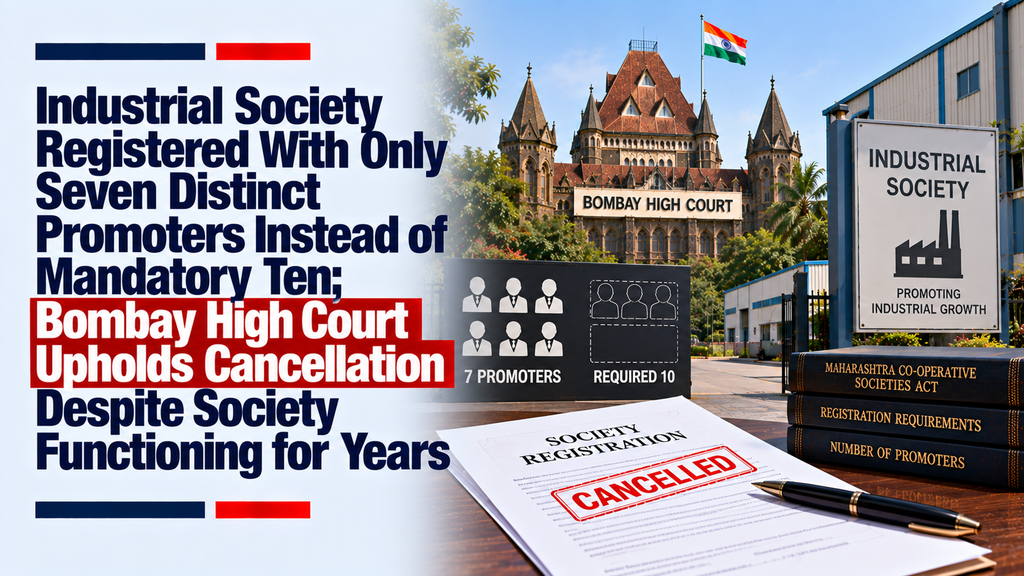
Industrial Society Registered With Only Seven Distinct Promoters Instead of Mandatory Ten; Bombay High Court Upholds Cancellation Despite Society Functioning for Years

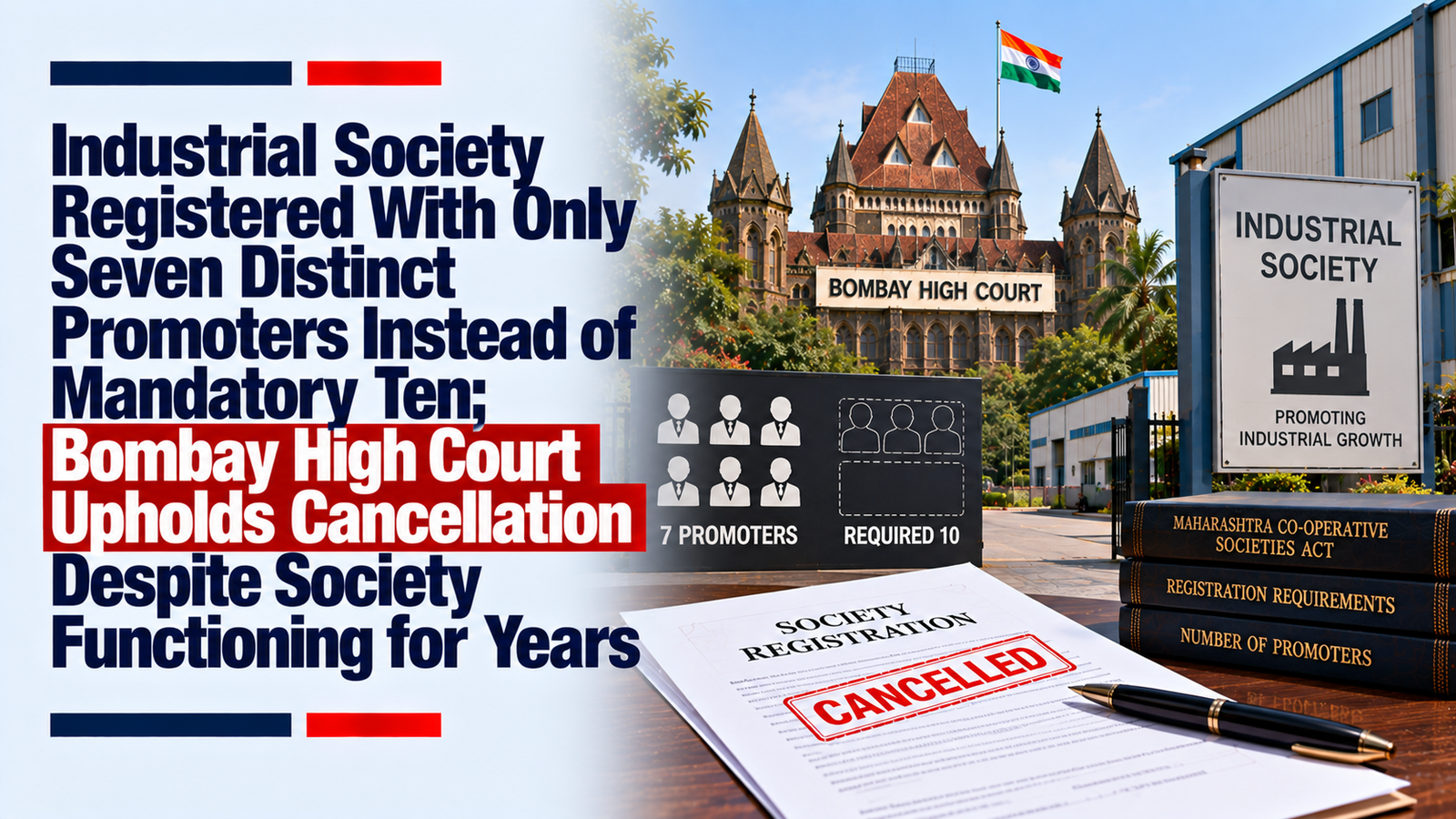
Same Persons Sign Multiple Times for Different Industrial Units; Bombay High Court Says Ten Distinct Persons Required to Register Co-operative Society
Facts
The dispute concerned Shantiniketan Industrial Estate at Marol, Andheri (East), Mumbai, consisting of 42 industrial units/galas. On the same plot, another building, Sahajeevan Industrial Estate, comprising 24 units, had also been constructed. Individual agreements for sale were executed with purchasers of the industrial units.
When the developer allegedly failed to form a society, certain unit purchasers came together and sought registration of Shantiniketan Industrial Premises Co-operative Society Ltd. The Society was registered on 9 November 2009.
M/s Dipti Builders Universal Pvt. Ltd., which had acquired rights in certain unsold premises, challenged the registration. The Divisional Joint Registrar, by order dated 2 September 2011, cancelled the Society’s registration.
The Society did not challenge that order immediately. Instead, it waited until 2024—approximately 13 years later—to file a revision. The Minister for Cooperation dismissed the revision on 6 April 2026. The Society then approached the Bombay High Court.
Issues
The principal question was whether the mandatory condition under Section 6 of the Maharashtra Co-operative Societies Act, 1960, requiring at least ten persons belonging to different families, had been satisfied when the registration proposal was submitted.
The Court also considered whether:
- a partnership firm/company could be independently counted as a person;
- the Society could challenge the cancellation after nearly 13 years;
- the developer/assignee had locus to challenge registration;
- fraud or misrepresentation was necessary before registration could be set aside in appeal; and
- the Society’s long functioning could cure the original defect in its registration.
Petitioner’s Arguments
The Society argued that its original registration satisfied Section 6.
It contended that partnership firms, companies and Hindu Undivided Families could not simply be treated as members of the same family. Relying upon Section 22, it argued that such entities could independently qualify for membership.
The Society further argued that it had been functioning for approximately 17 years and that cancellation would create serious practical difficulties in managing the industrial premises.
It also contended that Dipti Builders had subsequently sold all its units and therefore no longer possessed sufficient interest to oppose the Society.
Reliance was placed on Mukesh Mehta v. State of Maharashtra, Aurum Avenue CHSL v. State of Maharashtra and Om Sai Pratibha CHSL v. State of Maharashtra.
Respondent’s Arguments
Dipti Builders argued that the registration proposal fundamentally failed the statutory requirement under Section 6.
Although the application ostensibly contained 20 promoters, several names/entities were repeated because the same persons or entities owned multiple premises.
It further highlighted that the Society waited 4,649 days before filing its revision against the cancellation order.
According to the respondent, the Society had ceased to legally exist once its registration was cancelled in 2011, and proceedings subsequently instituted in the Society’s own name were therefore defective.
Analysis of the Law
Ten Distinct Persons Are Mandatory
The Court closely examined Section 6(1) of the MCS Act.
Justice Sandeep V. Marne explained that the provision contains two distinct requirements.
First, at least ten persons must come together, with each belonging to a different family.
Second, those persons must separately possess the statutory qualifications necessary to become members under the Act.
The Court emphasised the distinction between the words “persons” and “members” used in Section 6. Qualification to become a member under Section 22 does not eliminate the independent requirement that ten distinct persons must participate in forming the society.
Twenty Promoter Entries Became Only Seven
This was the decisive factual finding.
Although Form A contained 20 promoter entries/signatures, the Court found substantial repetition:
- Ajit Thakker appeared twice;
- Velankani Info Systems appeared seven times;
- Bharat Thakker appeared six times; and
- Maya Developers appeared twice.
The same person or entity could not be counted repeatedly merely because it owned multiple premises.
After eliminating the duplicate entries, the Court found that there were only seven promoters.
Therefore, the mandatory statutory requirement of ten persons was not fulfilled.
Partnership Firms as Separate Entities
The Court did, however, partly accept the Society’s legal argument concerning firms.
It observed that the Divisional Joint Registrar may not have been entirely correct in treating Bharat Thakker as the “owner” of a partnership firm or treating Maya Developers merely through its partners’ family relationships.
If Maya Developers was a partnership firm, the Court observed that it could be treated as an independent entity and could not simply be regarded as a family member for Section 6.
But that did not change the result.
Even after treating the relevant firms as separate entities, the Society still did not have the mandatory ten persons.
13-Year Delay and “Non-Existent Entity”
The Court strongly criticised the Society’s delay.
Its registration had been cancelled on 2 September 2011, yet no challenge was brought for approximately 13 years.
Justice Marne observed that after cancellation, the Society became a “non-existent entity.”
Nevertheless, a revision was instituted in 2024 in the name of that entity. The Court identified two problems:
- the revision suffered from gross delay of 13 years; and
- it was instituted in the name of an entity whose registration already stood cancelled.
The High Court further observed that even the writ petition had been instituted in the name of the Society despite its registration never having been restored and there being no stay of the 2011 cancellation order.
The Court ultimately did not rest its decision solely on these procedural defects because it agreed with the authorities on the merits.
Developer/Assignee Had Locus to Challenge Registration
The Society argued that Dipti Builders had sold its units in 2013 and therefore lacked locus.
The Court rejected this argument.
Dipti Builders had filed its appeal against registration in 2010, when it still claimed rights in the premises. Its subsequent sale of units in 2013 could not retrospectively destroy its locus to maintain an appeal already filed in 2010.
The Court also clarified that Om Sai Pratibha CHSL did not establish any absolute proposition that a developer can never challenge registration of a society.
Fraud Not Necessary to Set Aside Registration in Appeal
An important distinction was drawn between de-registration under Section 21A and an appeal challenging the original registration under Section 152.
The Society relied upon Aurum Avenue CHSL to argue that registration could not be cancelled in the absence of fraud or misrepresentation.
The Court rejected the argument.
It held that where de-registration is sought under Section 21A, one of the statutorily enumerated circumstances must exist.
But an appeal against the original registration itself stands on a different footing.
The Court expressly held that in an appeal under Section 152:
fraud or misrepresentation need not necessarily be established.
A procedural irregularity or failure to satisfy Section 6 itself can justify setting aside the registration.
This is one of the more significant legal propositions in the judgment.
Precedent Analysis
Mukesh Mehta v. State of Maharashtra
The Society relied on this judgment to establish that Chapter XIII-B applies even to industrial premises societies.
The High Court accepted that proposition but found that the precedent actually worked against the Society because Mukesh Mehta also recognised that registration requires a minimum of ten eligible persons, each belonging to a different family.
Aurum Avenue CHSL v. State of Maharashtra
The Court distinguished this judgment because it concerned de-registration under Section 21A, whereas the present matter involved an appeal against the original registration.
Om Sai Pratibha CHSL v. State of Maharashtra
The Court held that this authority did not create an absolute prohibition against a developer challenging the registration of a society. In the present case, Dipti Builders was also an assignee of certain units and had challenged the registration while it possessed an interest in those premises.
Court’s Reasoning
The Bombay High Court found the statutory defect straightforward.
The law required ten distinct eligible persons belonging to different families to come together for registration.
Merely showing 20 entries in Form A could not satisfy that requirement when several entries represented the same person or entity repeatedly because they owned multiple units.
Once duplicates were removed, only seven promoters remained.
The Society’s long functioning could not alter the original statutory deficiency. The Court also found its 13-year delay in challenging cancellation problematic.
The Court observed that if the unit purchasers genuinely wished to collectively manage the building through a valid society, they could either have promptly challenged the 2011 cancellation or submitted a fresh registration proposal satisfying the statutory requirements.
Conclusion
The Bombay High Court dismissed the writ petition and refused to interfere with the orders cancelling the Society’s registration.
Importantly, the Court clarified that the unit purchasers are not permanently prevented from forming a society. They may still submit a fresh proposal for registration in accordance with law.
The core holding is that multiple premises owned by the same person or entity cannot be used to multiply the promoter count and circumvent Section 6’s requirement of at least ten distinct persons for registration of a co-operative society.
The Court further clarified that fraud or misrepresentation is not indispensable when the original registration is challenged in appeal; failure to comply with the mandatory statutory conditions of registration can itself justify setting it aside.
Case Details
Case: Shantiniketan Industrial Premises Co-operative Society Ltd. v. Divisional Joint Registrar, Co-operative Societies & Ors.
Court: Bombay High Court
Case No.: Writ Petition No. 8735 of 2026
Citation: 2026:BHC-AS:38136
Judge: Justice Sandeep V. Marne
Reserved on: 8 September 2026
Pronounced on: 18 September 2026
Result: Writ Petition dismissed; cancellation of the Society’s registration upheld; fresh registration proposal remains open to the unit purchasers