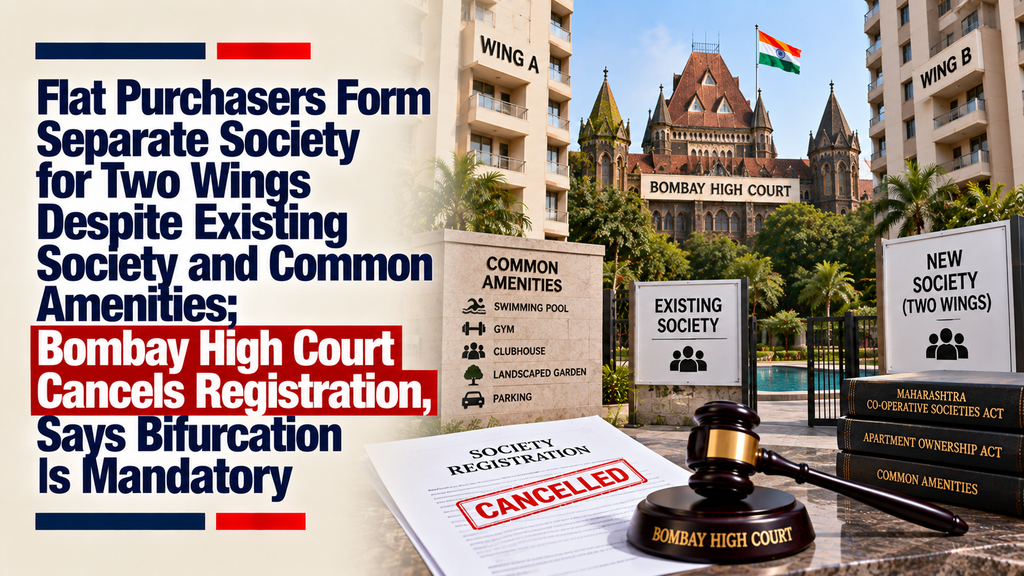
Flat Purchasers Form Separate Society for Two Wings Despite Existing Society and Common Amenities; Bombay High Court Cancels Registration, Says Bifurcation Is Mandatory

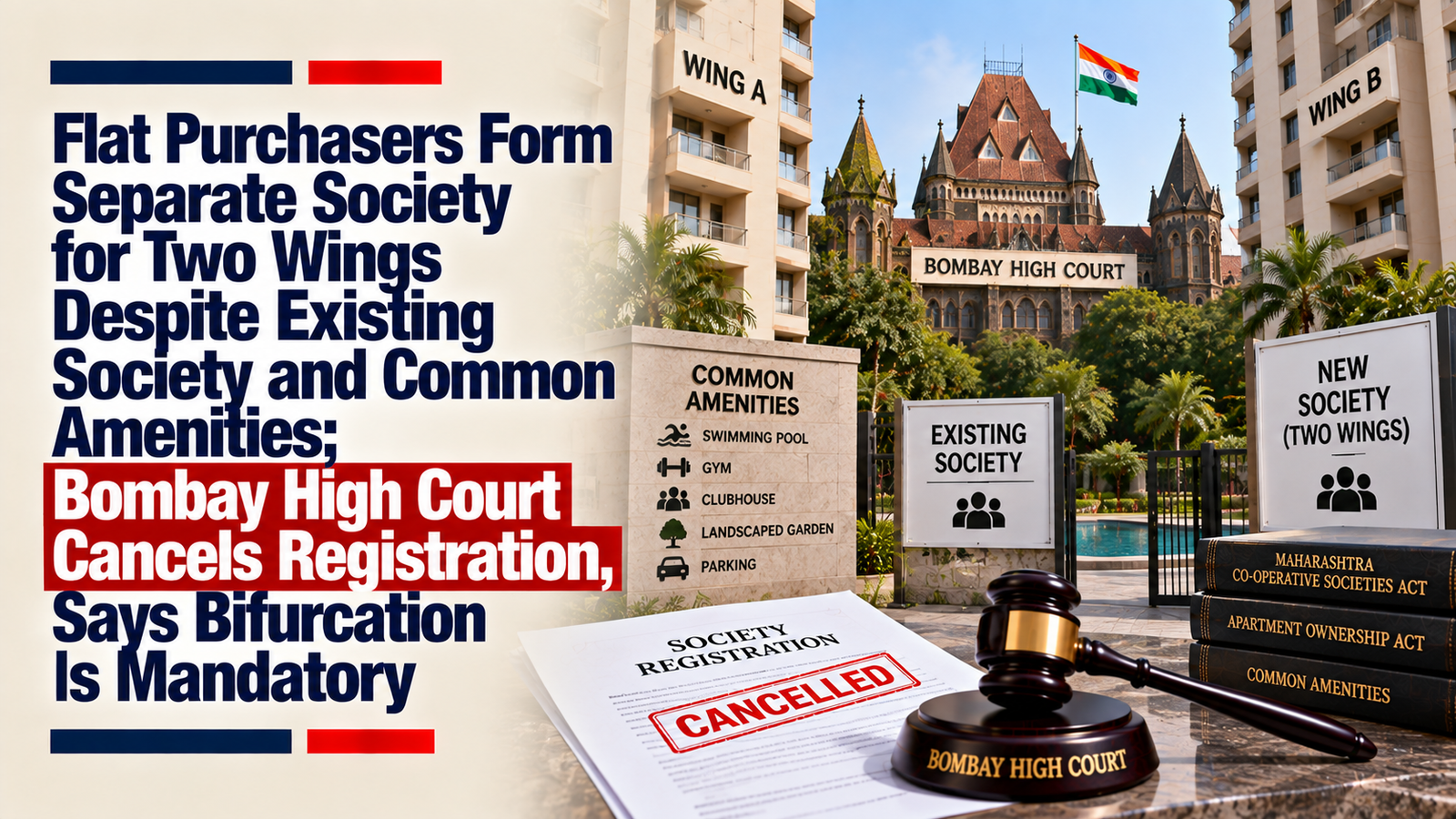
Common Parking, Water Tank, Entrance and Amenities Make Two Societies Impractical; Bombay High Court Cancels Separate Society’s Registration
Facts
The Swa-Griha Co-operative Housing Society Ltd. was originally registered in 1968 in respect of a MHADA property at Parel, Mumbai. The Society initially consisted of 32 members occupying 32 flats. MHADA had leased the land to the Society for 99 years in 1980 and subsequently transferred its right, title and interest in the land to the Society in 1982.
The Society later undertook redevelopment along with adjoining MHADA lands. A Development Agreement dated 5 August 2020 was entered into with Sugee Developers Pvt. Ltd. for redevelopment of approximately 3,430.30 sq. metres. The redevelopment resulted in a building consisting of Wings A, B, C and D. Under a Tripartite Agreement with MHADA, 75 flats were also required to be provided to MHADA allottees, who were to become members of the existing Society.
After construction, purchasers of flats in Wings A and B sought to form a separate society named Atharva Co-operative Housing Society Ltd. A proposal signed by 71 purchasers was submitted to the Deputy Registrar.
Despite objections by Swa-Griha CHS, the Deputy Registrar registered Atharva CHS on 20 February 2025. The Joint Registrar subsequently dismissed Swa-Griha’s appeal, and the Minister for Cooperation dismissed its revision.
Swa-Griha therefore approached the Bombay High Court.
Issues
The principal question was whether purchasers of flats situated in some wings of a building can obtain fresh registration of another co-operative housing society under Section 9 of the Maharashtra Co-operative Societies Act, 1960, when a society already exists for that building.
The Court also considered:
- whether Sections 17 and 18 of the MCS Act, dealing with division/bifurcation, provide the proper statutory route;
- whether the physical integration and common amenities of the four wings permitted independent management;
- whether purchasers who contractually agreed to become members of the existing Society could subsequently form a separate society.
Petitioner’s Arguments
Swa-Griha argued that once a co-operative housing society already existed for the building, the Registrar had no jurisdiction to register another society independently under Section 9.
According to it, anyone seeking separation had to pursue bifurcation under Section 17 or Section 18 of the MCS Act.
The Society pointed out that there were approximately 240 flats in the four wings and that several purchasers, including 72 purchasers in Wings A and B, had already become members of Swa-Griha.
It further emphasised the integrated nature of the development: common parking, common water arrangements, common electricity and utilities, common recreational areas, common vehicular access and other shared facilities.
The Society also relied on the Agreements for Sale, Development Agreement and other contractual documents under which purchasers were allegedly required to become members of the existing Society.
Respondents’ Arguments
Atharva CHS contended that Wings A and B constituted a distinct and independently manageable portion of the project.
It argued that Sections 9 and 154B-2 of the MCS Act did not expressly prohibit registration of multiple housing societies.
According to Atharva CHS, several amenities could either be separately managed or segregated. It asserted that there were separate electricity arrangements for certain utilities, separate water tanks for individual wings, separable fire systems, different society offices and parking floors allocated to its members.
It also offered to independently maintain various common facilities and bear the corresponding expenditure.
Analysis of the Law
The High Court rejected the proposition that Section 9 could be used to directly create a second society once a society already existed in respect of the building.
Justice Sandeep V. Marne held that Sections 9, 17, 18 and 154B-2 must be harmoniously construed.
Section 9 continues to govern registration of housing societies, but where a society is already registered for the concerned building, residents seeking separation cannot simply apply for registration of another society.
The statutory mechanism is:
Section 17: the existing society may resolve by the prescribed majority to divide itself into two or more societies.
Section 18: the Registrar may direct division/reorganisation where statutory requirements are satisfied, including public interest, members’ interest, co-operative movement or proper management.
The Court therefore held that where residents seek to separate from an existing society, bifurcation is the statutory route. A direct Section 9 application is impermissible.
Why Bifurcation Matters
The Court explained that bifurcation is not merely an administrative formality.
Dividing a housing society can affect:
- ownership and allocation of land;
- building structures;
- common amenities and utilities;
- property rights;
- assets and liabilities;
- funds;
- maintenance responsibilities; and
- rights and obligations of existing members.
For this reason, Sections 17 and 18 contain procedural safeguards, including consultation with the federal society, preparation of a draft scheme, consideration of objections and allocation of property, rights, liabilities and responsibilities.
The Court warned that permitting independent registration under Section 9 without first bifurcating the existing society could result in multiple societies asserting overlapping rights over the same property, producing “utter chaos.”
Serious Error by the Deputy Registrar
The Court found an additional jurisdictional problem in the manner in which Atharva CHS was registered.
The Deputy Registrar was apparently not even made aware that Swa-Griha CHS already existed for the building.
The existing Society had also submitted objections on 6 February 2025, but those objections were not taken into consideration.
More significantly, the Court noted that 72 purchasers of Wings A and B were already members of Swa-Griha CHS, and held that this position had been suppressed while seeking registration of Atharva CHS.
The Court held that the Joint Registrar and the Minister also failed to correct this fundamental error.
Common Amenities Made Separation Impractical
The Court independently examined whether two societies could realistically function in the redevelopment.
It found the project to be essentially an integrated structure despite having four wings.
The Court noted, among other things:
- a common terrace connecting the wings;
- common underground water tank;
- common water supply lines and pumps;
- common vehicular entrance;
- common recreational ground;
- common gymnasium facilities; and
- interconnected structural arrangements.
Most importantly, there was a separate 10-storey parking structure used by residents of all four wings. The Court considered subdivision of this parking facility between the two proposed societies impracticable.
The Court therefore found that two separate societies would likely create difficulties concerning property ownership, common facilities, maintenance and convenience of members.
Contractual Estoppel Against Flat Purchasers
The judgment contains another significant finding.
The Agreements for Sale executed with purchasers of Wings A and B expressly contemplated the continued existence of Swa-Griha CHS and provided that the developer was not required to create a new independent society.
Instead, purchasers were contractually required to become members of Swa-Griha CHS.
The Court therefore held that purchasers who had bought their flats on those contractual terms could not subsequently disregard the stipulation and create a separate society.
Relying upon Kritika Jewels Co-operative Housing Society v. State of Maharashtra, the Court held that there was “estoppel by contract” against the purchasers forming Atharva CHS.
Precedent Analysis
The Court relied substantially on four Bombay High Court decisions.
Sarita Cooperative Housing Society Ltd. supported the proposition that Section 9 cannot be used to indirectly fragment an existing society. Physical separability alone is insufficient; lawful bifurcation under Sections 17 or 18 is necessary.
Cosmopolitan III Co-operative Housing Society Ltd. emphasised that bifurcation under Section 18 must be a comprehensive exercise dealing with constitution, property rights, liabilities, obligations and separation of common amenities.
Sadguru Universal CHS Ltd. laid down factors for determining whether separate societies can practically function, including structural design, separate access, utilities, amenities, maintenance obligations and parking arrangements.
Kritika Jewels Co-operative Housing Society established the relevance of contractual promises contained in registered agreements concerning formation of a common society.
Court’s Reasoning
The High Court found multiple independent illegalities in the registration of Atharva CHS:
First, the Deputy Registrar lacked jurisdiction to register a fresh society under Section 9 without following the statutory bifurcation mechanism.
Second, the Deputy Registrar proceeded without properly appreciating the existence of Swa-Griha CHS and ignored its objections.
Third, numerous purchasers seeking the new society were already members of Swa-Griha.
Fourth, the physical configuration and common amenities made independent functioning of two societies problematic.
Fifth, the Agreements for Sale specifically required purchasers to join the existing Society and prohibited formation of a separate independent society.
The Court accordingly held that the orders of the Deputy Registrar, Joint Registrar and Minister for Cooperation were indefensible.
Conclusion
The Bombay High Court allowed Swa-Griha CHS’s writ petition.
It:
- set aside the Deputy Registrar’s order dated 20 February 2025 registering Atharva CHS;
- set aside the Joint Registrar’s appellate order dated 8 July 2025;
- set aside the Minister for Cooperation’s revisional order; and
- consequently cancelled the registration of Atharva Co-operative Housing Society Ltd.
The Court clarified the governing principle: once a co-operative housing society already exists for a building, residents who wish to form a separate society must follow the bifurcation mechanism under Sections 17 or 18 of the Maharashtra Co-operative Societies Act; they cannot bypass that procedure by seeking fresh registration under Section 9.
After pronouncement, however, the Court stayed operation of its judgment for six weeks on Atharva CHS’s request.
Case Details
Case: The Swa-Griha CHS Ltd. v. State of Maharashtra & Ors.
Court: Bombay High Court
Case No.: Writ Petition No. 7754 of 2026
Citation: 2026:BHC-AS:38134
Judge: Justice Sandeep V. Marne
Reserved: 1 September 2026
Pronounced: 18 September 2026
Result: Petition allowed; registration of Atharva CHS cancelled; operation of judgment stayed for six weeks.