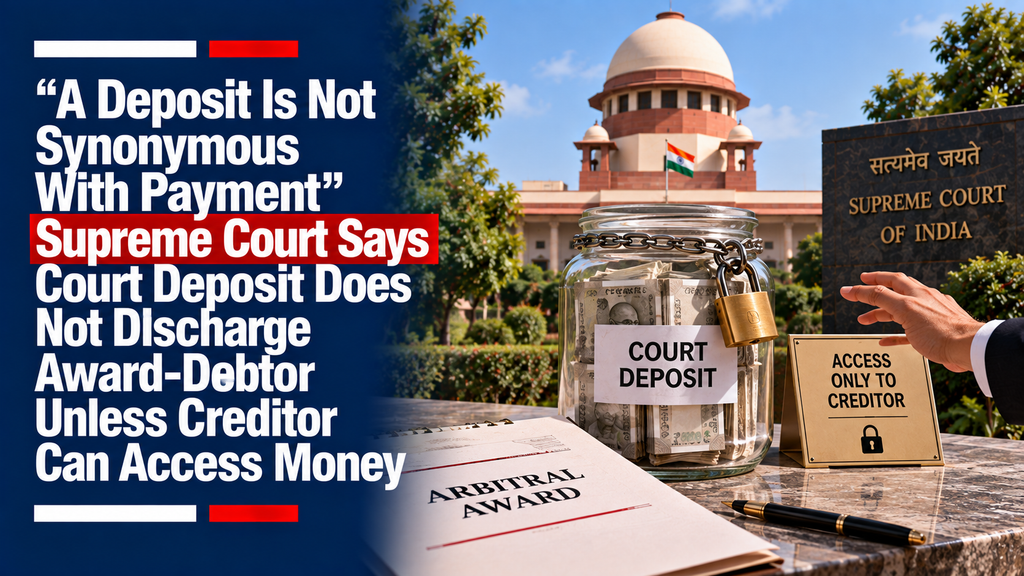
“A Deposit Is Not Synonymous With Payment”: Supreme Court Says Court Deposit Does Not Discharge Award-Debtor Unless Creditor Can Access Money

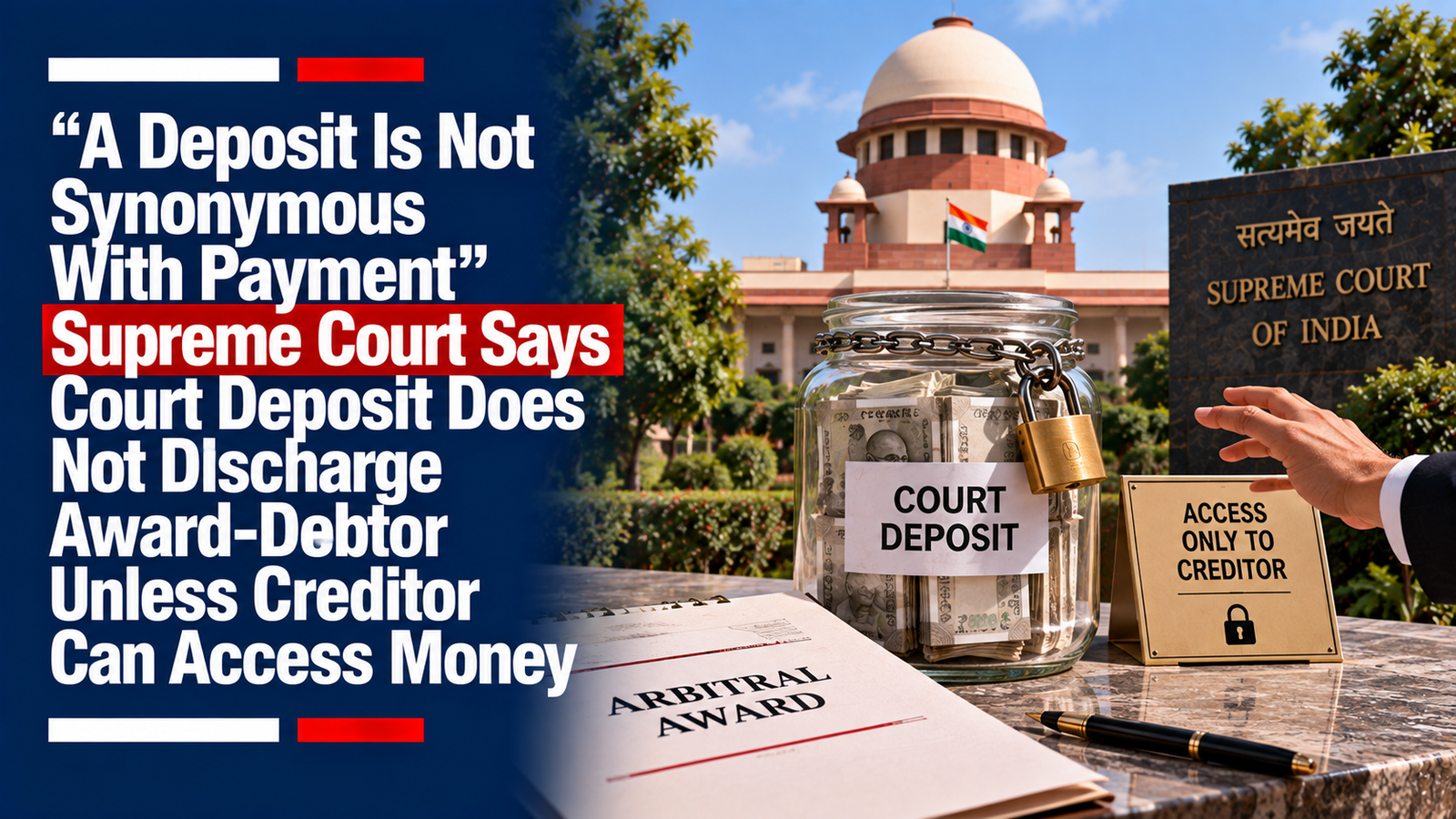
Award-Debtor Deposits Money in Court but Opposes Its Withdrawal; Supreme Court Says Interest Continues Until Amount Is Unconditionally Available to Award-Holder
Facts
An arbitral award dated 13 June 2019 was passed against National Seeds Corporation Ltd. directing payment of ₹1,46,40,005.02, together with interest at 12% per annum from 26 August 2017 until the date of the award. The aggregate amount calculated at the award stage was ₹1,77,97,434.
National Seeds Corporation challenged the award under Section 34 of the Arbitration and Conciliation Act, 1996 before the Delhi High Court. On 16 October 2019, the High Court stayed enforcement subject to deposit of 50% of the principal award amount.
Accordingly, the appellant deposited ₹73,20,003 on 25 November 2019. However, this deposit had been made to secure the stay of enforcement and was not made available to the award-holder for unconditional withdrawal.
The Section 34 petition was dismissed on 5 January 2022. National Agro Seed Corporation then initiated execution and sought withdrawal of the deposited money, but National Seeds Corporation opposed the withdrawal because its Section 37 appeal was pending.
The appellant subsequently deposited another ₹1,53,17,792 in April 2022.
On 7 July 2022, the High Court permitted withdrawal of ₹1 crore, but only if the award-holder furnished security through title deeds of immovable property. The award-holder, facing financial difficulty, ultimately did not avail this conditional withdrawal.
The Section 37 appeal was dismissed, followed by dismissal of the Special Leave Petition on 26 August 2022.
Eventually, on 8 September 2022, the High Court directed unconditional release of the deposited amount. At that stage, the appellant did not object. The surviving dispute therefore concerned interest between 13 June 2019 and 8 September 2022.
The Delhi High Court held that the appellant remained liable to pay 12% interest because depositing money while simultaneously preventing the award-holder from using it could not be treated as payment in satisfaction of the award.
National Seeds Corporation approached the Supreme Court.
Issues
The Supreme Court formulated two principal questions:
- Whether an award-debtor continues to be liable for interest on an amount deposited before the Court under Order XXI Rule 1 CPC?
- Whether the deposits made by National Seeds Corporation complied with Order XXI Rule 1 so that its interest liability had ceased?
Appellant’s Arguments
National Seeds Corporation argued that depositing the awarded amount signifies satisfaction of the award and consequently stops further accrual of interest.
It contended that even where only part of the award is deposited, interest should cease at least to the extent of the deposited amount.
It further argued that the Arbitration and Conciliation Act is a self-contained code and that reliance upon Order XXI Rules 1 and 4 CPC was misplaced.
A particularly important factual argument was that although ₹73.20 lakh had been deposited on 25 November 2019, the respondent did not apply for its withdrawal until 14 February 2022. The appellant therefore argued that it should, at minimum, not be liable for interest on that deposited amount during this period.
Respondent’s Arguments
The award-holder argued that the ₹73.20 lakh deposit was made merely to obtain a stay of enforcement and not towards satisfaction of the award.
More importantly, the money was never freely available to it because the appellant consistently resisted withdrawal.
The respondent therefore argued that interest continued until 8 September 2022, when unconditional withdrawal was finally permitted.
Analysis of the Law
“A Deposit Is Not Synonymous With Payment”
The Supreme Court opened the judgment with the central proposition:
“A deposit is not synonymous with payment.”
Putting money beyond the debtor’s own reach does not necessarily discharge the liability because the decisive consideration is whether the money has actually been placed at the creditor’s disposal.
This distinction became the foundation of the judgment.
Section 36 Makes CPC Principles Relevant
Although the Arbitration and Conciliation Act is a self-contained code, Section 36(1) expressly provides that an arbitral award is enforceable in accordance with the CPC as if it were a decree.
Section 36(3) also requires courts dealing with stay of a money award to have due regard to the CPC provisions governing stay of money decrees.
The Supreme Court therefore rejected the proposition that CPC principles were irrelevant merely because the dispute arose under the Arbitration Act.
When Does Interest Stop?
Under Order XXI Rule 1, where money is deposited into Court in accordance with the prescribed procedure, interest may cease after the requisite notice is given to the decree-holder.
However, the Court emphasised an important distinction:
The deposit must genuinely constitute payment and must be available to the decree-holder.
A deposit made merely as security for obtaining a stay, where the decree-holder cannot freely access the money, does not automatically extinguish interest liability.
Nine Principles Laid Down by the Supreme Court
The Court distilled the governing law into nine principles:
- The Arbitration and Conciliation Act is a self-contained code, but Section 36 creates a legal fiction enabling enforcement of an award as though it were a decree.
- While considering stay of a money award, the Court must have due regard to CPC principles concerning stay of money decrees.
- The practical effect of depositing money in Court is ordinarily to put it beyond the reach of the parties.
- To qualify under Order XXI Rule 1, the deposit must be unconditional and available to the decree-holder for withdrawal.
- If withdrawal is permitted only upon furnishing security, the deposit is not payment in satisfaction of the decree for purposes of Order XXI Rule 1.
- Where the deposit does not comply with Order XXI Rule 1, interest continues to run even after the money has been deposited.
- Conversely, if money is actually made available for withdrawal and the decree-holder takes no steps to withdraw it, such inaction may constitute deemed refusal of tender, affecting the claim for further interest.
- Where the deposited amount is converted into a fixed deposit at the decree-holder’s own request, the decree-holder is entitled only to the interest accrued on that fixed deposit in the circumstances contemplated by the precedent discussed.
- Where only part of the outstanding amount is deposited but that part is unconditionally available for withdrawal, interest stops only on that deposited amount; the balance continues to attract the applicable interest.
This nine-point formulation is the most practically significant part of the judgment for execution of arbitral awards.
Application to the Present Case
The Supreme Court found that the initial ₹73.20 lakh deposit was made solely to obtain a stay during the Section 34 proceedings.
It was not accompanied by notice under Order XXI Rule 1(2).
More importantly, when the award-holder subsequently sought withdrawal, the appellant resisted the request, even after dismissal of the Section 34 petition and during the Section 37 appeal.
Even the subsequent order permitting withdrawal of ₹1 crore required the award-holder to furnish title deeds as security.
Therefore, the money was not freely and unconditionally available to the award-holder.
The Supreme Court consequently held that the deposits did not satisfy Order XXI Rule 1 and the appellant’s liability to pay interest did not cease.
Precedent Analysis
Gurpreet Singh v. Union of India
The Constitution Bench had held that in execution of money decrees, interest ceases on the deposited amount once the statutory requirements—including notice of deposit—are fulfilled.
The present judgment adopts that principle while stressing that the deposit must actually operate as payment.
P.S.L. Ramanathan Chettiar v. O.R.M.P.R.M. Ramanathan Chettiar
This was crucial. The earlier three-Judge Bench had held that where withdrawal is subject to furnishing security, the money is merely placed beyond the parties’ reach during litigation and does not constitute payment in satisfaction of the decree.
DLF Ltd. v. Koncar Generators and Motors Ltd.
The Court considered the more recent approach that focuses on whether the award-holder could access and benefit from the deposit. Once withdrawal is permitted, the award-holder may have to comply with reasonable security conditions or seek modification if unable to do so.
The present judgment synthesises these authorities through its nine governing principles rather than treating every court deposit identically.
Major Institutional Direction: Court Deposits Across India
The judgment goes substantially beyond the parties’ individual dispute.
The Supreme Court found significant inconsistency across Indian courts and tribunals regarding:
- how much an appellant must deposit to obtain stay;
- where court deposits are invested;
- the type of financial instrument used;
- applicable interest rates;
- renewal and reinvestment;
- withdrawal conditions; and
- adjustment of interest when litigation ends.
The Court noted that different High Courts follow different systems. In the Bombay High Court, for instance, the Original Side Rules contemplate payment to the Prothonotary and Senior Master or Sheriff, while subsequent judicial decisions have adopted the practice of placing such amounts in fixed deposits with nationalised banks.
The Supreme Court emphasised the time value of money: money available today has greater economic value than the same nominal sum receivable in the future, particularly because of opportunity cost, inflation and economic uncertainty.
It therefore suggested the need for a common platform/unified scheme under which court deposits could be pooled and invested in appropriate financial instruments.
The Court examined comparable systems in the United States and Canada as possible reference points.
Most significantly, the Supreme Court requested the Law Commission of India to examine the issue and consider suitable legislation after consultation with the Reserve Bank of India, Ministry of Finance and Ministry of Law and Justice.
Court’s Reasoning
The essential reasoning can be reduced to one distinction:
Deposit ≠ Payment unless the money is effectively placed at the award-holder’s disposal in the manner recognised by law.
An award-debtor cannot obtain the benefit of cessation of interest merely by losing control over its own money while simultaneously preventing the award-holder from gaining control over it.
In this case, National Seeds Corporation deposited money to secure protection against enforcement and subsequently opposed its release. The award-holder therefore did not receive the economic benefit of the award merely because the money was physically lying with the Court.
Accordingly, the interest liability continued.
Conclusion
The Supreme Court refused to interfere with the Delhi High Court’s order and affirmed the award-debtor’s liability.
The appeal was disposed of with the broader institutional direction that the Law Commission examine a uniform legislative framework governing court and tribunal deposits, including investment, interest and adjustment mechanisms.
Case Details
Case: National Seeds Corporation Ltd. v. National Agro Seed Corporation (India)
Court: Supreme Court of India
Citation: 2026 INSC 1017
Proceeding: Civil Appeal arising out of SLP (C) No. 5710 of 2025
Bench: Justice Pamidighantam Sri Narasimha and Justice Alok Aradhe
Date: 18 September 2026
Result: Appeal disposed of; Delhi High Court order affirmed. The award-debtor’s interest liability did not cease because the deposits were not made in accordance with Order XXI Rule 1 and were not unconditionally available to the award-holder.