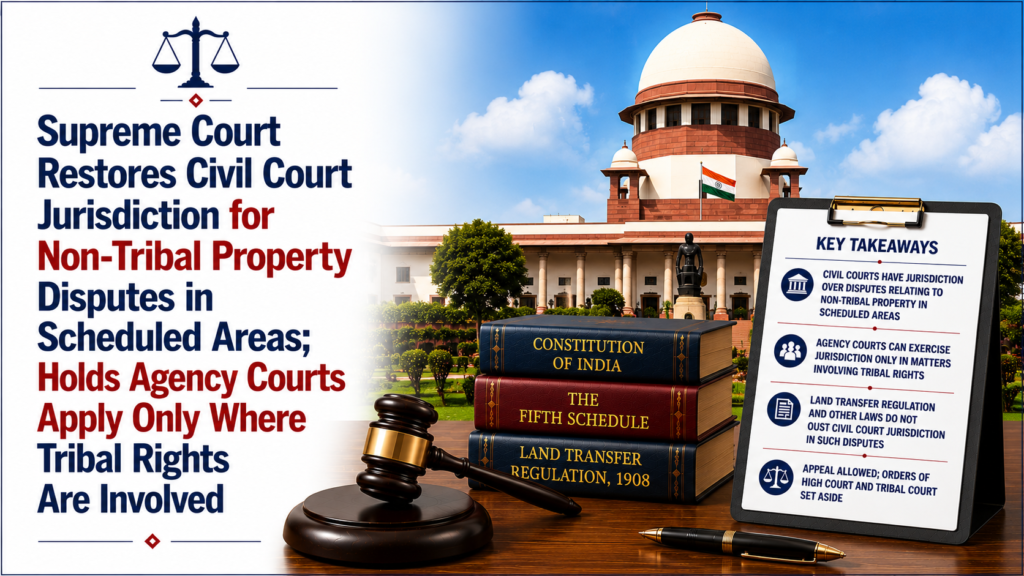
Supreme Court Restores Civil Court Jurisdiction for Non-Tribal Property Disputes in Scheduled Areas; Holds Agency Courts Apply Only Where Tribal Rights Are Involved

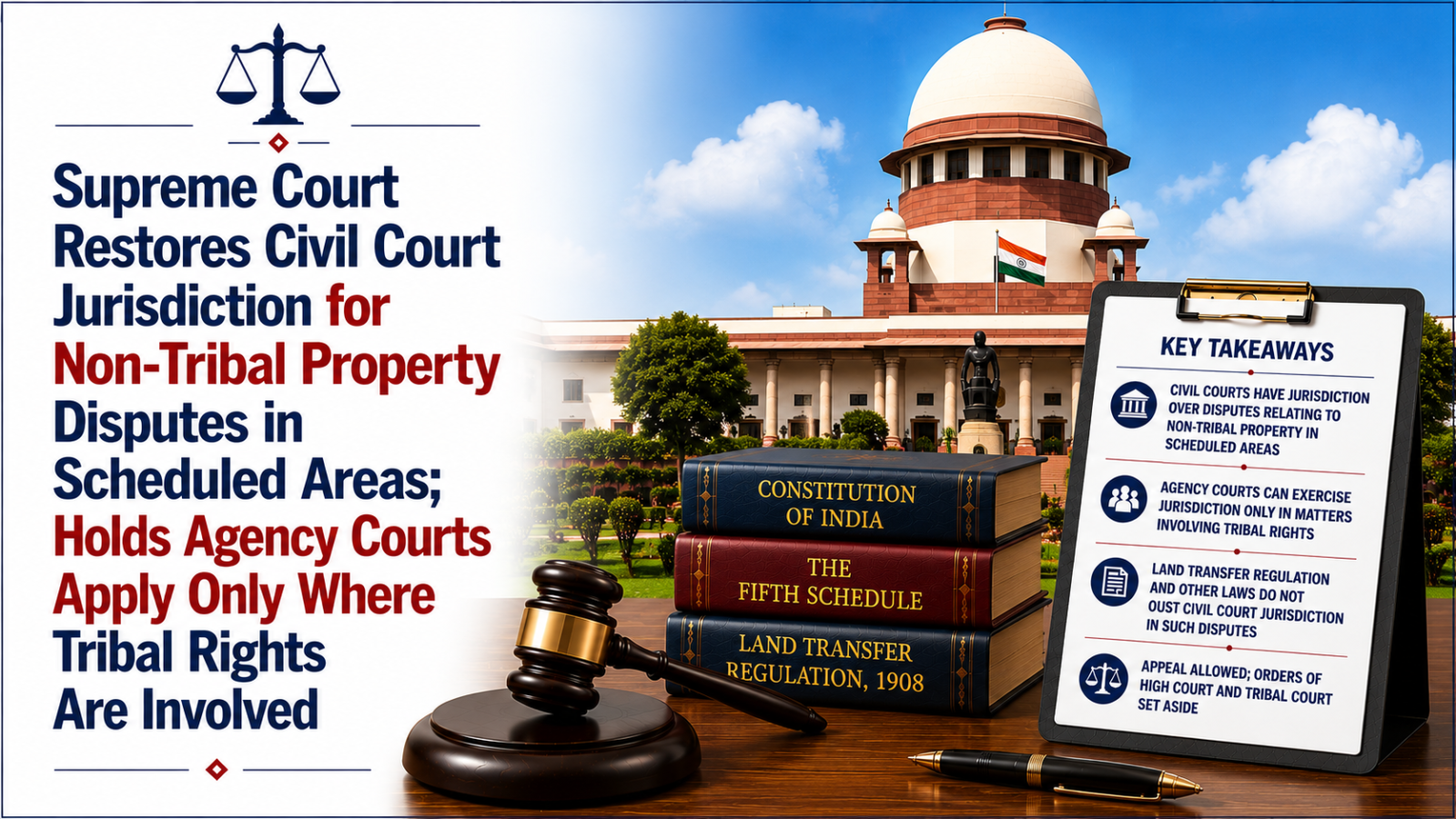
Supreme Court Restores Civil Court Jurisdiction in Scheduled Areas for Disputes Between Non-Tribal Parties
Facts
The dispute concerned a partition suit filed by members of the Mukkera family regarding ancestral property situated in a Scheduled Area of Telangana. The Trial Court dismissed the suit after finding that partition had already taken place during the lifetime of the common ancestor and that each branch was in separate possession. The First Appellate Court reversed the decree, holding that the properties remained joint family properties. In second appeal, the High Court set aside the appellate decree, holding that Civil Courts lacked jurisdiction because the property was situated in a Scheduled Area, relying upon Nagarjuna Gramin Bank v. Medi Narayana. The plaintiffs challenged that decision before the Supreme Court.
Issues
- Whether Civil Courts have jurisdiction over civil disputes concerning property situated in Scheduled Areas where all parties are non-tribals.
- Whether Nagarjuna Gramin Bank v. Medi Narayana constitutes a binding precedent excluding Civil Court jurisdiction in such cases.
- Whether the High Court was justified in setting aside the appellate decree solely on the ground of lack of jurisdiction.
Appellants’ Arguments
The appellants contended that the High Court wrongly relied upon Nagarjuna. They argued that the earlier decision did not decide any question of law regarding the Andhra Pradesh Civil Courts Act, 1972, but merely recorded the State Government’s administrative decision. Consequently, it did not constitute a binding precedent. They further submitted that since all parties were non-tribals, excluding Civil Court jurisdiction served no purpose underlying the constitutional protection afforded to Scheduled Tribes.
Respondents’ Arguments
The State and the amicus curiae argued that because the Andhra Pradesh Civil Courts Act, 1972 was expressly excluded from Scheduled Areas, Civil Courts lacked jurisdiction irrespective of the identity of the parties. According to them, disputes concerning land situated in Scheduled Areas ought to be adjudicated only through the special forum contemplated for such areas.
Analysis of the Law
The Supreme Court undertook an extensive examination of:
- the Scheduled Districts Act, 1874;
- the Andhra Pradesh Agency Rules, 1924;
- the constitutional history relating to Scheduled Areas;
- the Fifth Schedule and Article 244(1) of the Constitution;
- Constituent Assembly Debates; and
- the Andhra Pradesh Civil Courts Act, 1972.
The Court observed that the constitutional scheme consistently aims to protect tribal communities, their land, customs and autonomy. The exclusion of Civil Court jurisdiction in Scheduled Areas exists to safeguard tribal interests and prevent their exploitation. It was never intended to subject disputes exclusively between non-tribals to special procedures designed solely for tribal protection. The Court also applied the principle of reasonable classification under Article 14, holding that forcing non-tribals to litigate before special forums lacking any rational nexus with the object of tribal protection would violate the constitutional guarantee of equality.
Precedent Analysis
The Supreme Court analysed numerous authorities concerning precedent and constitutional interpretation, including:
- Read v. Bishop of Lincoln;
- Abdul Kayoom v. CIT;
- State of Gujarat v. Utility Users’ Welfare Association (Wambaugh Test for identifying ratio decidendi);
- Career Institute Educational Society v. Om Shree Thakurji Educational Society;
- State of Madras v. Gannon Dunkerley (discussed historically);
- Samatha v. State of A.P.;
- State of Punjab v. Davinder Singh;
- State of West Bengal v. Anwar Ali Sarkar; and
- Nagarjuna Gramin Bank v. Medi Narayana.
The Court held that Nagarjuna did not lay down any binding proposition of law because it merely recorded the State’s administrative position without analysing the statutory provisions or deciding the legal issue. Consequently, it was not a binding precedent excluding Civil Court jurisdiction.
Court’s Reasoning
The Court observed that the object behind creating special procedures for Scheduled Areas is the protection of tribal people and their lands. Where both litigating parties are admittedly non-tribals, requiring them to invoke special procedures meant exclusively for tribal welfare bears no rational nexus with that constitutional objective.
The Court held that the expression “Scheduled Areas” refers to geographical areas notified for protecting tribal communities and cannot automatically deprive non-tribals of access to ordinary Civil Courts merely because the property is situated there. It concluded that Civil Courts retain jurisdiction over disputes exclusively between non-tribals, whereas Agency Courts continue to have exclusive jurisdiction whenever even one party is a tribal residing in the Scheduled Area.
Accordingly, the High Court erred in treating Nagarjuna as binding precedent and in dismissing the appeal solely on jurisdictional grounds.
Conclusion
The Supreme Court allowed the appeal, set aside the High Court’s judgment, restored the second appeal for decision on merits, and clarified that Civil Courts have jurisdiction over civil disputes involving exclusively non-tribal parties even if the property is situated in Scheduled Areas. The Court further held that this declaration would operate prospectively for pending and future cases, while Agency Courts would continue to exercise jurisdiction whenever a tribal party is involved. (Based on the concluding portion of the judgment.)
Case Details
Case: Mukkera Venkata Ratnam & Ors. v. Vantasala China Venkateswarlu & Ors.
Court: Supreme Court of India
Case Number: Civil Appeal of 2026 (Arising out of SLP (C) Diary No. 21610 of 2022)
Judges: Hon’ble Mr. Justice Sanjay Karol and Hon’ble Mr. Justice Nongmeikapam Kotiswar Singh
Date: 06 August 2026
Result: Appeal allowed; High Court judgment set aside; second appeal restored to the High Court for decision on merits; Civil Court jurisdiction upheld for disputes exclusively between non-tribal parties in Scheduled Areas