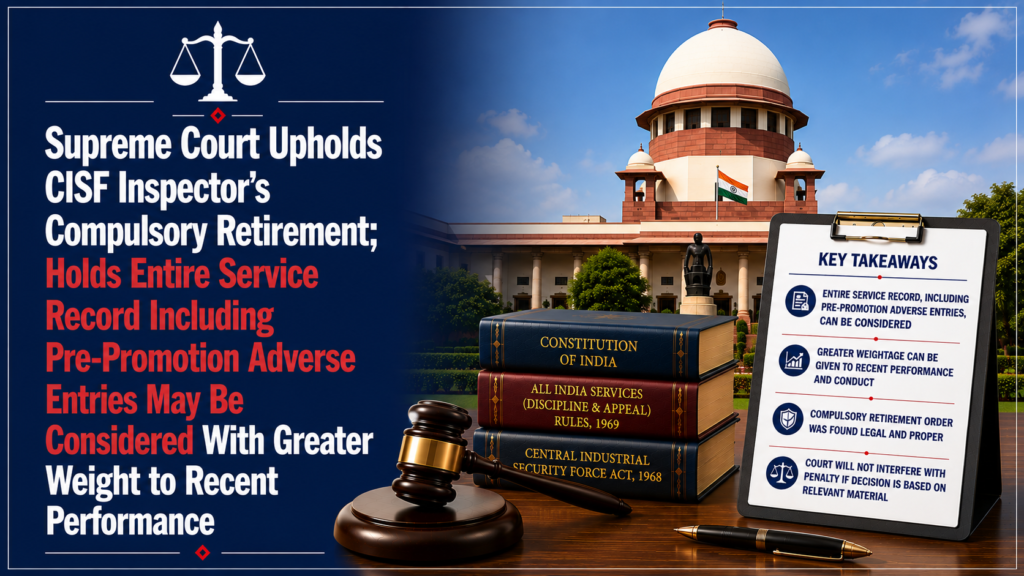
Supreme Court Upholds CISF Inspector’s Compulsory Retirement; Holds Entire Service Record Including Pre-Promotion Adverse Entries May Be Considered With Greater Weight to Recent Performance

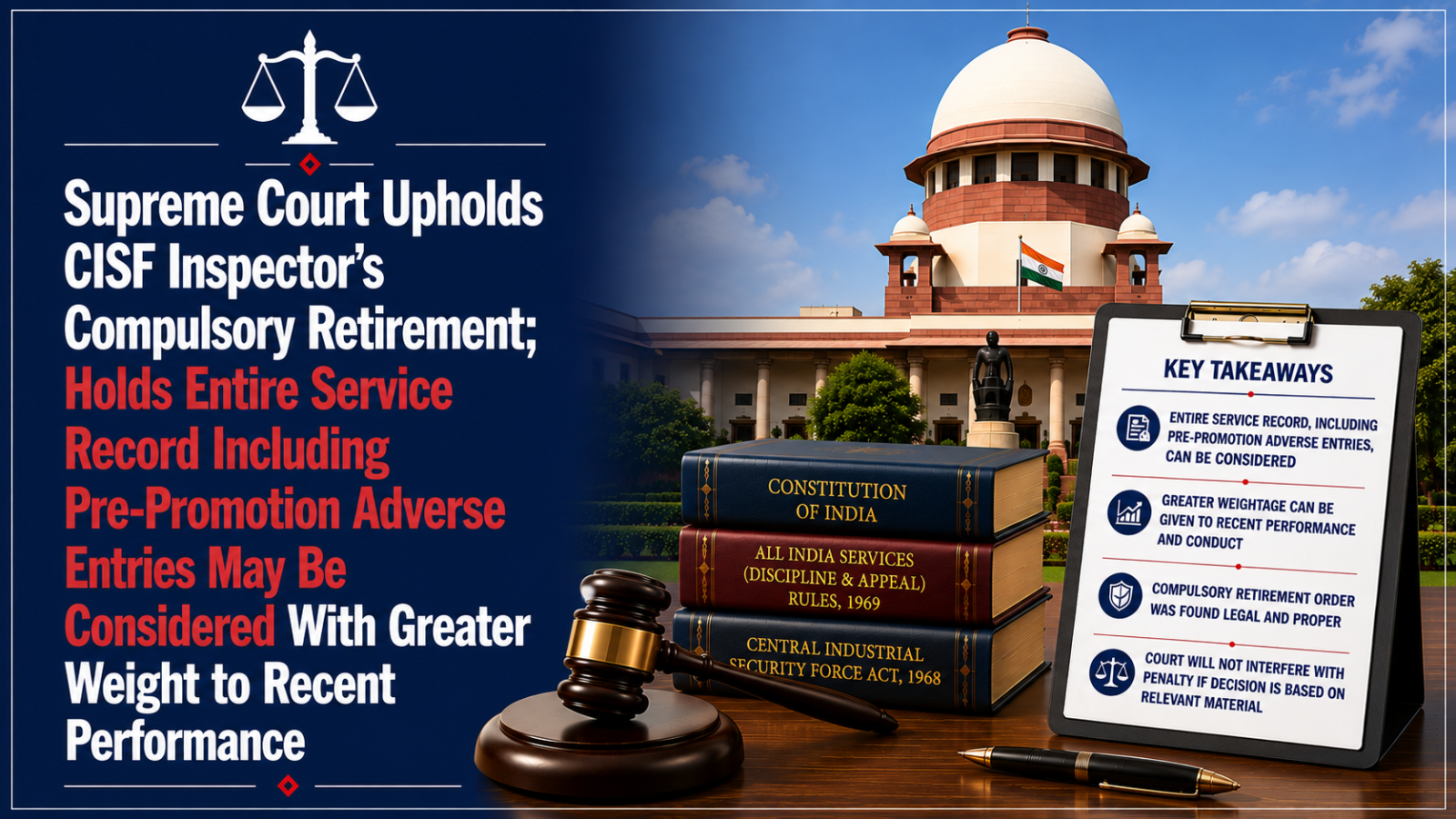
Supreme Court Upholds CISF Officer’s Compulsory Retirement; Holds Entire Service Record Must Be Considered
Facts
The appellant joined the Central Industrial Security Force (CISF) as an Assistant Sub-Inspector in 1982 and was promoted to Sub-Inspector in 1990 and Inspector in 2003. Upon attaining the age of 50 years, his service record was reviewed under Fundamental Rule 56(j) by the Internal Screening Committee, which found him unfit for retention in service. The recommendation was affirmed by the Review Committee, resulting in an order of compulsory retirement dated 6 June 2010. His representation was rejected, and the Delhi High Court upheld the order. Aggrieved thereby, the appellant approached the Supreme Court.
Issues
- Whether the order of compulsory retirement under Fundamental Rule 56(j) was arbitrary, perverse or liable to judicial interference.
- Whether adverse entries and penalties preceding the appellant’s promotion could be considered while assessing his suitability for continued service.
- Whether the Screening Committee correctly evaluated the appellant’s entire service record while according greater weight to his recent performance.
Appellant’s Arguments
The appellant contended that the authorities wrongly relied upon adverse entries and penalties that pre-dated his promotion as Inspector. According to him, once he was promoted, those adverse entries stood “washed off” and could not be considered while deciding whether he should be compulsorily retired. He further argued that the decision was arbitrary and unsupported by the overall service record, which reflected promotions and satisfactory performance.
Respondents’ Arguments
The Union of India submitted that compulsory retirement under FR 56(j) is intended to maintain efficiency in public service by removing employees whose utility has declined. It argued that the competent authority had considered the appellant’s entire service record, while giving greater importance to the immediately preceding years, during which his performance had noticeably deteriorated. The respondents also relied upon settled law that the “washed-off theory” does not apply in compulsory retirement cases.
Analysis of the Law
The Supreme Court reiterated that compulsory retirement under Fundamental Rule 56(j) is not punitive and carries no stigma. It is an administrative measure taken in public interest to maintain efficiency by removing “dead wood” from service. Since it is based upon the subjective satisfaction of the employer, the principles of natural justice do not apply.
However, the Court clarified that such orders remain subject to limited judicial review and may be interfered with only if they are mala fide, arbitrary, perverse or based on no evidence. The authority must consider the entire service record, although greater importance should be attached to the employee’s performance during the years immediately preceding compulsory retirement. The Court further held that uncommunicated adverse entries do not by themselves invalidate such an order.
Precedent Analysis
The Court relied upon the following authorities:
- Baikuntha Nath Das v. Chief District Medical Officer, (1992) 2 SCC 299, holding that compulsory retirement is not punitive and judicial review is limited.
- Ram Murti Yadav v. State of Uttar Pradesh, (2020) 1 SCC 801, reiterating the narrow scope of judicial review over compulsory retirement.
- Rajasthan State Road Transport Corporation v. Babu Lal Jangir, (2013) 10 SCC 551, holding that the “washed-off theory” applies only to promotion and not to compulsory retirement, where the entire service record must be considered.
- Posts and Telegraphs Board v. C.S.N. Murthy, (1992) 2 SCC 317, holding that deterioration in performance during the last two years can justify compulsory retirement.
- Central Industrial Security Force v. HC (GD) Om Prakash, (2022) 5 SCC 100, reaffirming that the entire service record must be assessed while giving greater weight to recent performance.
Court’s Reasoning
The Supreme Court noted that although the appellant had received good and very good gradings for several years and earned promotions, his performance significantly declined between 2008 and 2009, when his ACRs fell from “Good” to “Average.” In addition, after his promotion as Inspector, he received a censure for furnishing a false reason to obtain leave, was warned on four occasions for negligence and cautioned twice for lethargic conduct.
Rejecting the appellant’s reliance on the washed-off theory, the Court held that while earlier adverse entries may lose relevance for future promotions, they continue to remain relevant when assessing whether an employee should be retained in service. The Committee had correctly considered the appellant’s entire service record while giving due weight to the decline in his recent performance. The Court further observed that, being a member of the CISF, a disciplined uniformed force entrusted with critical security functions, the appellant was expected to maintain consistently high standards of efficiency, vigilance and discipline.
Conclusion
The Supreme Court dismissed the appeal and upheld the order of compulsory retirement. It held that the competent authority had validly considered the appellant’s entire service record while attaching greater importance to his declining performance in the years immediately preceding retirement. The Court further held that the washed-off theory has no application in compulsory retirement cases and found no arbitrariness, mala fides or perversity warranting judicial interference.
Case Details
Case: Sushil Sharma v. Union of India & Others
Court: Supreme Court of India
Case Number: Civil Appeal No. 8634 of 2012
Judges: Hon’ble Mr. Justice Prashant Kumar Mishra and Hon’ble Mr. Justice Shree Chandrashekhar
Date: 06 August 2026
Result: Civil Appeal dismissed; order of compulsory retirement under Fundamental Rule 56(j) upheld.