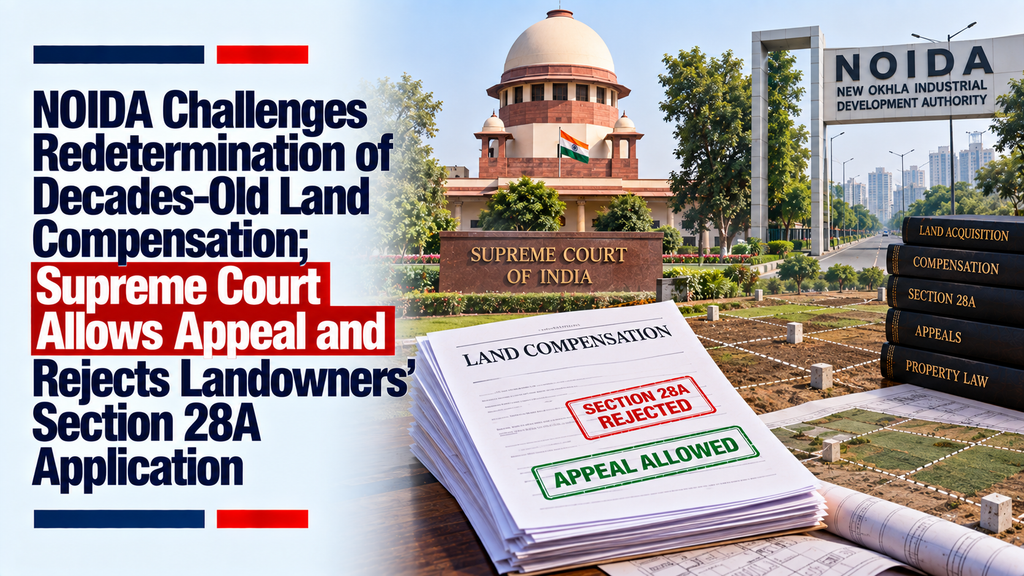
NOIDA Challenges Redetermination of Decades-Old Land Compensation; Supreme Court Allows Appeal and Rejects Landowners’ Section 28A Application

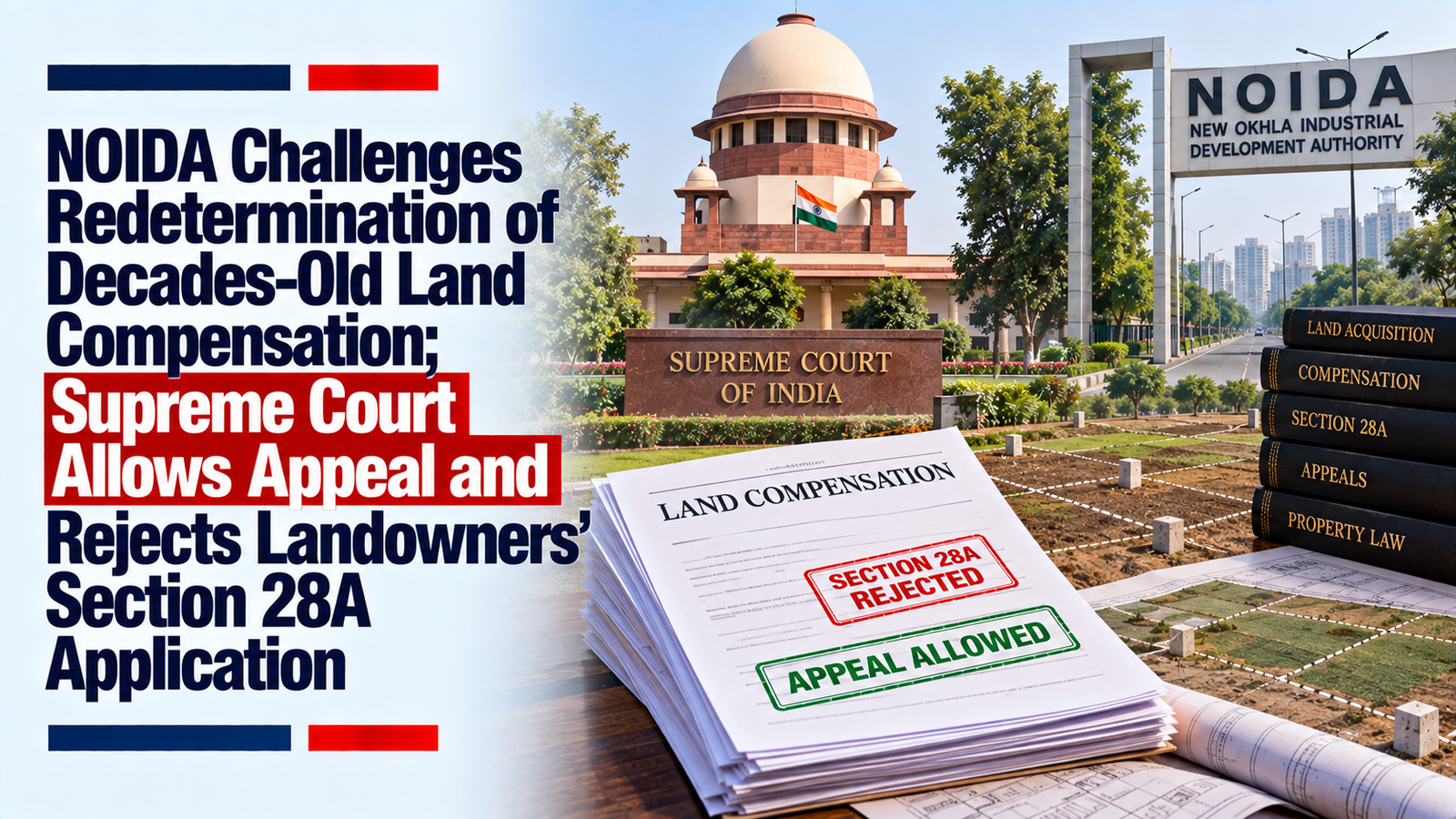
High Court Directs Consideration of Enhanced Land Compensation; Supreme Court Reverses, Finds Section 28A Application Filed Years Too Late
Facts
The dispute arose from acquisition proceedings under the Land Acquisition Act, 1894. The predecessors-in-interest of the respondents had their land acquired under Section 4(1) read with Section 17. An award was passed on 15 February 1977, and they accepted the entire compensation without seeking a reference under Section 18. Other landowners covered by the same acquisition notification did seek references, although those references were initially rejected.
One connected First Appeal was ultimately decided on 8 July 2019, resulting in the relevant enhancement of compensation. Another First Appeal concerning lands in the same village and under the same notification was disposed of on 18 April 2022 by following that earlier decision.
The respondents thereafter filed an application under Section 28A on 23 May 2022, seeking redetermination of their compensation. The Collector rejected it as not maintainable because it was founded upon a High Court appellate decision rather than an award of the Reference Court.
The High Court interfered with that rejection. NOIDA and another consequently approached the Supreme Court. The case before the Supreme Court was New Okhla Industrial Development Authority & Anr. v. Rajveer Singh & Ors., arising from SLP (C) No. 18801 of 2025.
Issues
The principal questions were:
- Whether an application under Section 28A for redetermination of land acquisition compensation can be founded upon an order passed by the High Court in a First Appeal under Section 54.
- When the three-month limitation under Section 28A begins where the Reference Court originally grants no enhancement but compensation is subsequently enhanced in appeal.
- Whether a later High Court order concerning the same acquisition can create a fresh cause of action and fresh limitation period.
- Whether successive appellate orders can repeatedly revive the right to seek redetermination.
Appellants’ Arguments
NOIDA contended, in substance, that Section 28A ordinarily operates with reference to an award made by the Reference Court following a Section 18 reference. A subsequent appellate judgment cannot ordinarily become an independent starting point for limitation.
It relied upon the statutory scheme and earlier Supreme Court decisions distinguishing an award of the Reference Court from an appellate judgment.
Since the relevant enhancement had already occurred on 8 July 2019, the respondents could not wait until a later 2022 order and then claim a fresh three-month limitation period.
Respondents’ Arguments
The landowners relied substantially upon Union of India v. Pradeep Kumari and the beneficial nature of Section 28A.
They argued that successive awards can furnish fresh causes of action for redetermination. On that reasoning, successive appellate orders should similarly enable a landowner to invoke Section 28A within three months of the later order.
They also relied upon Banwari v. Haryana State Industrial and Infrastructure Development Corporation Ltd., where the Supreme Court had permitted recourse to Section 28A after compensation was enhanced for the first time by the High Court because the original reference itself had been rejected without enhancement.
Analysis of the Law
Section 28A was introduced to enable landowners who had not sought a reference under Section 18 to obtain redetermination when another landowner covered by the same acquisition notification secures enhanced compensation.
The Court reiterated the conditions identified in Pradeep Kumari, including that the applicant’s land must be covered by the same Section 4(1) notification, the applicant must not have sought a Section 18 reference, the application must be made within three months of the relevant award, and ordinarily only one Section 28A application can be made.
The Court stressed, however, that Pradeep Kumari dealt with successive awards of the Reference Court, not successive appellate judgments of the High Court.
Ordinarily, therefore, the limitation runs from the relevant Reference Court award and not from the appellate judgment.
Precedent Analysis
Union of India v. Pradeep Kumari
The three-Judge Bench had held that Section 28A was not necessarily confined to the first award of the Reference Court. A subsequent Reference Court award granting greater compensation could furnish the basis for redetermination.
The present Court clarified that this principle did not automatically extend to successive High Court appellate orders.
Jose Antonio Cruz Dos R. Rodriguese v. Land Acquisition Collector
This decision held that the three-month limitation ordinarily begins from the Reference Court’s award, rather than from the appellate order passed under Section 54.
Popat Bahiru Govardhane v. Special Land Acquisition Officer
The Court reiterated that statutory limitation must be applied with its prescribed rigour even if the result appears harsh. The limitation under Section 28A does not begin from the landowner’s date of knowledge.
Banwari v. HSIIDC
The Court recognised an important exception.
Where a Section 18 reference is rejected altogether without enhancement, no Section 28A cause of action exists at that stage. If the High Court subsequently enhances compensation for the first time in appeal, Section 28A may become available because the right to redetermination has arisen for the first time.
The Supreme Court held that this principle did not rescue the respondents in the present case.
Court’s Reasoning
The decisive fact was that the relevant compensation enhancement had already occurred through the High Court order dated 8 July 2019.
The subsequent order dated 18 April 2022 did not independently enhance compensation. It merely followed the earlier appellate decision concerning the same village and acquisition notification.
Accordingly, the respondents’ Section 28A limitation began on 8 July 2019 and expired three months later, on 7 October 2019. The 2022 order could not restart the limitation clock.
The Court specifically rejected the broader proposition that successive appellate orders can generate successive fresh causes of action under Section 28A. It observed that a later coordinate Bench of the High Court would itself be bound by the earlier decision.
The judgment also explained the proper procedure where a timely Section 28A application has already been filed and an appeal against the Reference Court award remains pending: the Collector may keep the Section 28A proceedings in abeyance, so that any later enhancement by the High Court can ultimately enure to the applicant’s benefit.
Conclusion
The Supreme Court allowed NOIDA’s appeal, set aside the High Court’s order and rejected the respondents’ Section 28A application.
The central takeaway is:
A later High Court order that merely follows an earlier compensation-enhancement decision does not give landowners a fresh three-month limitation period under Section 28A.
Where enhancement arises for the first time in appeal after the Reference Court has rejected the reference entirely, Banwari may permit Section 28A to operate. But that exceptional situation does not mean that every successive appellate order restarts limitation.
Case Details
Case: New Okhla Industrial Development Authority & Anr. v. Rajveer Singh & Ors.
Court: Supreme Court of India
Case No.: Civil Appeal arising out of SLP (C) No. 18801 of 2025
Bench: Justice J.B. Pardiwala and Justice K. Vinod Chandran
Judgment by: Justice K. Vinod Chandran
Date: 21 September 2026
Result: Appeal allowed; High Court order set aside; Section 28A application rejected.