SAP Stops Software Support to Nayara Energy After EU Sanctions; Delhi High Court Orders Immediate Restoration, Says Foreign Law Cannot Override Indian Contract Without Proof

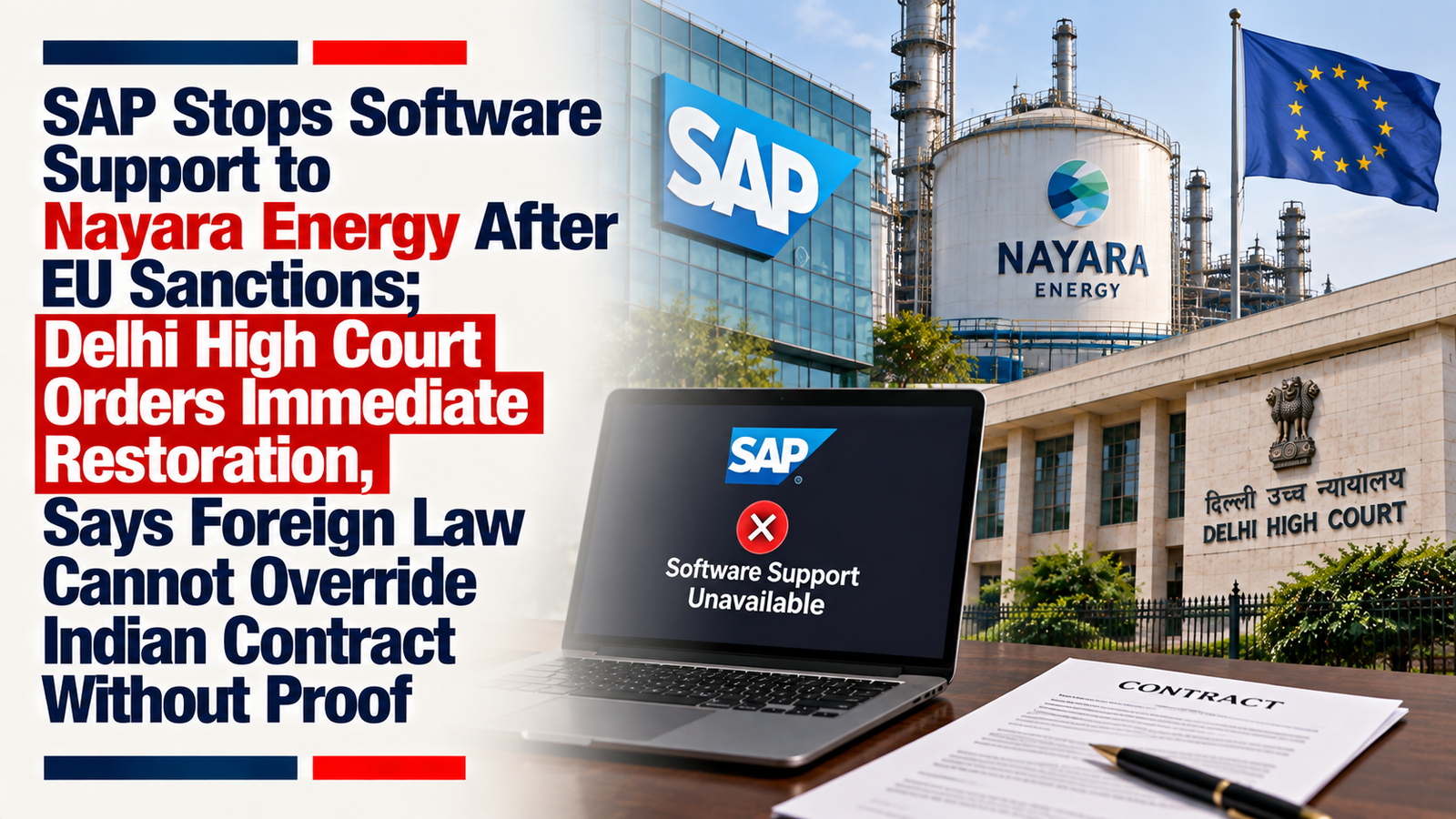
Nayara Energy Loses SAP Support After EU Sanctions Over Russian Oil Links; Delhi High Court Directs Immediate Restoration of Services
Facts
Nayara Energy Limited, formerly Essar Oil Limited, operates a large-scale oil refinery and a nationwide network of retail fuel outlets. It uses SAP software as part of its core operational infrastructure.
The contractual relationship originated from a 2004 SAP Software End-User Value License Agreement. The software licences were perpetual in nature and were subsequently assigned to Essar Oil, later renamed Nayara Energy, through an Assignment Agreement dated 22 June 2017.
The parties thereafter executed three Software License and Support Agreements/Order Forms in 2017 and 2020. A separate SAP Delivered Support Agreement dated 29 March 2019 provided supplementary support, including portal access, software patches, licence-key generation and expert assistance.
According to the judgment, annual work orders had facilitated the support arrangement since 2017, and SAP accepted payment for support for the period 1 January to 31 December 2025.
What Triggered the Dispute?
On 24 July 2025, SAP completely blocked Nayara’s access to its Support Portal/SAP Marketplace, initially referring to an “export issue.”
SAP subsequently relied upon EU Council Regulation No. 269/2014, after Nayara was placed on the EU sanctions list. SAP stated that, being part of an EU-headquartered group, it was required to comply with the sanctions.
Nayara therefore filed the commercial suit and sought an interim mandatory injunction requiring SAP India to restore:
- SAP Marketplace and Online Service System access;
- hardware and software-change keys;
- technical and functional support;
- incident-resolution services; and
- uninterrupted use of SAP software and services.
Issues
The Delhi High Court examined six principal questions:
- What was the governing/proper law of the contracts?
- Could SAP India rely upon EU sanctions/foreign law to suspend its Indian contractual obligations?
- Did Sections 32 or 56 of the Indian Contract Act excuse performance?
- Were the contracts incapable of specific enforcement under the Specific Relief Act?
- Did Nayara suppress material facts concerning its proceedings before the European Court of Justice?
- Did Nayara satisfy the heightened requirements for an interim mandatory injunction?
Plaintiff’s Arguments
Nayara argued that these were contracts between Indian entities, governed by Indian law and performed in India.
Clause 12.5 of the General Terms and Conditions expressly provided that claims arising from the agreement would be governed by Indian law and, in case of conflict between foreign and Indian laws or regulations, Indian law would prevail.
Nayara emphasised that India had imposed no corresponding sanctions prohibiting SAP from providing services to it.
It also argued that the EU Regulation did not have extraterritorial application to SAP India merely because SAP India’s parent company was based in Germany. Both contracting parties were Indian companies and the contractual performance was centred in India.
Nayara further claimed that losing SAP support created a serious operational and cybersecurity risk. Its SAP systems required proprietary patches, keys and technical assistance which third parties could not adequately provide.
Defendant’s Arguments
SAP India argued that Nayara had been specifically included in the EU sanctions regime because of its connection with the Russian energy sector.
It pointed out that Nayara’s Vadinar refinery was stated in the sanctions material to be 49% owned by Russian State oil company Rosneft and to be a major refiner of Russian crude oil.
SAP contended that the support services were not wholly localised in India. They were delivered through its German parent, SAP SE, and therefore at least part of the business was conducted within the European Union.
It argued that providing support could expose SAP SE and associated persons to penalties, including potential criminal liability under German law.
SAP also relied upon:
- export-control provisions in the contracts;
- force majeure;
- Sections 32 and 56 of the Indian Contract Act;
- the contention that the agreements were determinable and therefore not specifically enforceable; and
- expiry of the 2025 annual work order.
Analysis of the Law
1. Indian Law Governs the Contract
The Court prima facie found that the contractual relationship was strictly governed by Indian law.
The agreements consciously gave Indian law primacy where foreign laws, rules or regulations conflicted with the governing contractual framework.
This became crucial because SAP’s principal justification for stopping support arose from EU sanctions rather than any prohibition under Indian law.
2. Foreign Law Must Be Pleaded and Proved
One of the most important aspects of the judgment concerns the treatment of foreign sanctions.
The Court held at the interim stage that EU sanctions were in the realm of foreign law.
Their applicability, jurisdictional reach and binding effect upon the particular contractual relationship were matters requiring pleading and proof as facts during trial.
Accordingly, SAP could not prematurely rely upon unproven foreign regulations to escape its contractual obligations.
Importantly, this is an interim prima facie finding, not a final declaration that EU sanctions are invalid or can never affect an Indian contract.
3. Sections 32 and 56 — Contingency and Frustration
SAP argued that the sanctions either triggered a contractual contingency under Section 32 or made performance impossible under Section 56.
The Court prima facie rejected both defences.
It noted that SAP’s support operated through a worldwide network. The possibility that support would have to be provided from a jurisdiction unaffected by the sanctions might make performance commercially more onerous, but that was different from establishing that performance had become legally or practically impossible.
The Court also noted that the force-majeure provisions contemplated an extension of time rather than outright termination.
4. Contracts Were Not Prima Facie “Determinable”
SAP relied on the Specific Relief Act to contend that the contracts could not be specifically enforced because they were determinable.
The Court disagreed at the interim stage.
A termination mechanism did not automatically make a contract inherently determinable. The relevant provisions did not permit SAP to terminate the arrangement at its “sweet will.”
The termination rights were linked to defined contractual circumstances or specified periods rather than an unrestricted power of immediate termination.
The Court therefore found no prima facie statutory bar under Section 14 of the Specific Relief Act to enforcement of the agreements.
5. Continuous Technical Services Were Not Incapable of Enforcement
SAP also argued that the technical nature of its continuing support obligations would require constant judicial supervision.
The Court rejected this objection.
The contractual framework itself defined the parties’ respective obligations, and the support arrangement had operated for almost a decade. Directing continuation of those defined services would not require the Court to assume day-to-day managerial control.
Precedent Analysis
Dorab Cawasji Warden v. Coomi Sorab Warden
The Supreme Court’s test requires a party seeking an interlocutory mandatory injunction to establish:
- a strong case for trial, higher than the ordinary prima facie standard;
- serious or irreparable injury incapable of adequate monetary compensation; and
- balance of convenience in its favour.
Deoraj v. State of Maharashtra
The Court relied on Deoraj for exceptional cases where withholding interim relief would effectively destroy the substantive relief before the case could finally be decided.
Such relief may be granted where the case is exceptionally strong and withholding protection would perpetuate serious injustice.
Hammad Ahmed v. Abdul Majeed
The Court relied upon this decision to reiterate that an interim direction in mandatory form is legally permissible in appropriate and compelling circumstances.
K.S. Manjunath v. Moorasaviappa
This precedent was central to the question of whether the agreements were “determinable.”
The Court applied the distinction between a genuinely determinable contract and one terminable only upon specified causes or conditions.
Satyabrata Ghose and Energy Watchdog
These authorities informed the Court’s consideration of frustration/impossibility. The central question was whether performance had actually become impossible—not merely inconvenient or more expensive.
Court’s Reasoning
The Court found that Nayara satisfied the heightened threshold applicable to an interim mandatory injunction.
Strong Prima Facie Case
The contracts were governed by Indian law.
The Court prima facie found SAP’s Specific Relief Act objections untenable and held that neither Section 32 nor Section 56 presently justified suspension.
Most importantly, SAP could not rely at the interlocutory stage upon the asserted effect of EU sanctions without their legal reach and effect being properly proved at trial.
The Court therefore characterised SAP’s unilateral suspension of services as prima facie illegal and contrary to the contractual stipulations.
Irreparable Harm
The Court accepted that SAP support was not an ordinary convenience.
Without ongoing technical support, Nayara’s software ecosystem could become vulnerable to:
- system failures;
- cybersecurity breaches;
- unresolved software bugs; and
- operational disruption.
The Court also took account of the regulatory requirement for refineries to maintain robust cyber infrastructure. The judgment records Nayara’s uncontroverted pleading that it caters to approximately 8% of India’s energy needs.
Balance of Convenience
The balance also favoured restoration.
The Court found that resuming services would cause comparatively little inconvenience to SAP India, whereas continued denial could expose Nayara’s critical operational infrastructure to substantial risk.
Accordingly, withholding relief could effectively render the main suit meaningless before final adjudication.
Conclusion
The Delhi High Court allowed Nayara Energy’s interim application.
It directed SAP India to immediately restore the status quo ante as it existed before 24 July 2025 and resume all enterprise and software support services under the respective agreements.
Crucially, the Court expressly clarified that all its findings are prima facie and confined to the interim application under Order XXXIX Rules 1 and 2 CPC. They will not bind the final adjudication of the suit.
The main suit remains pending.
Case Details
Case: Nayara Energy Limited v. SAP India Private Limited & Anr.
Court: High Court of Delhi at New Delhi
Case No.: CS(COMM) 1006/2025
Application: I.A. 23754/2025 under Order XXXIX Rules 1 & 2 CPC
Judge: Justice Vikas Mahajan
Date: 21 September 2026
Result: Interim application allowed; SAP India directed to immediately restore all enterprise and software support services to Nayara Energy to the position existing before 24 July 2025; observations expressly confined to the interim stage.