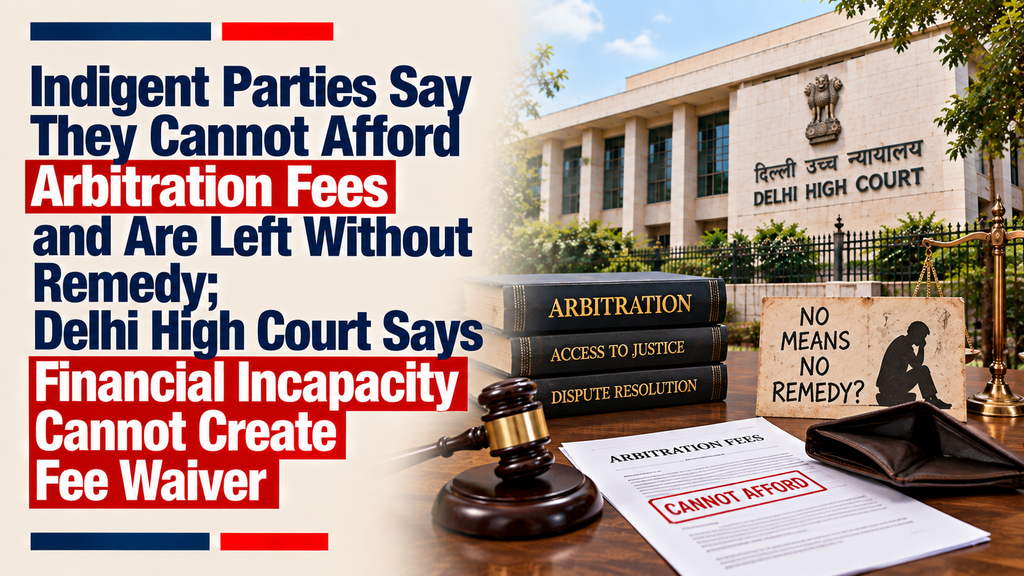
Indigent Parties Say They Cannot Afford Arbitration Fees and Are Left Without Remedy; Delhi High Court Says Financial Incapacity Cannot Create Fee Waiver

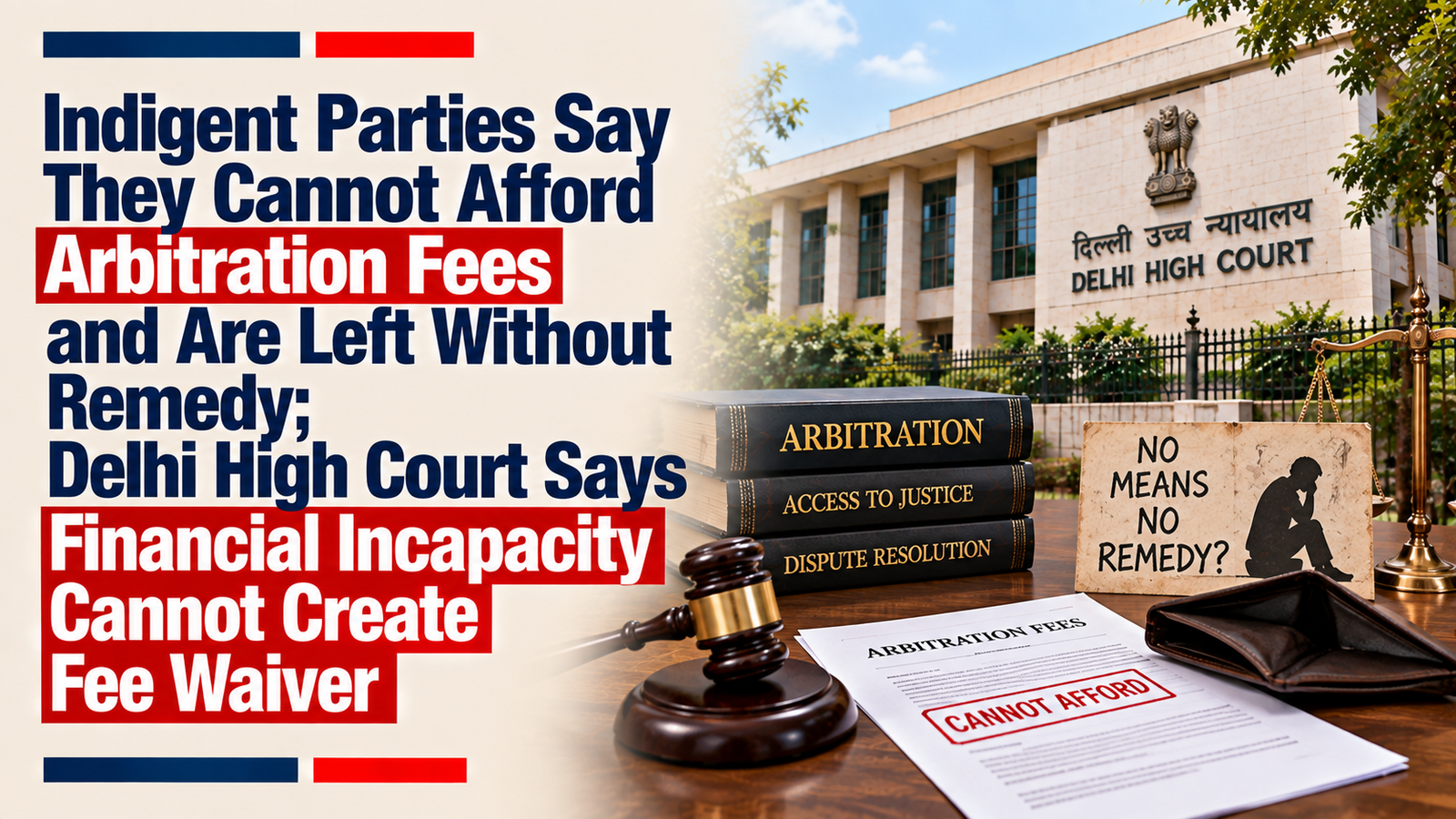
Petitioners Say Arbitration Fees Create Financial Barrier to Access to Justice; Delhi High Court Says Section 38 Permits Termination for Non-Payment
Connected with M/s Sri Export Co. v. Union of India & Ors.
Facts
The Delhi High Court considered two connected petitions raising a common problem: what happens when a party is contractually compelled to arbitrate but claims that it cannot afford the arbitrator’s fees and institutional charges?
In the first case, Rajesh Kumar had initially instituted a suit for possession and recovery before the Commercial Court at Saket. The suit was rejected after the opposite party invoked the arbitration agreement under Section 8 of the Arbitration and Conciliation Act, 1996.
Rajesh Kumar thereafter approached the Delhi High Court under Section 11. On 18 March 2025, an arbitrator was appointed under the aegis of the Delhi International Arbitration Centre (DIAC).
However, the arbitration itself was subsequently terminated on 14 April 2026 because he was unable to pay the DIAC fees.
The second petitioner, M/s Sri Export Co., was a respondent in separate DIAC arbitration proceedings. It had raised a counterclaim, but the Arbitrator dropped the counterclaim on 29 May 2026 because it could not pay its share of the arbitration fees and expenses.
Both approached the High Court under Article 226.
Reliefs Sought
The petitioners sought waiver of their respective shares of:
- arbitrator’s fees; and
- DIAC administrative charges.
Alternatively, they asked that payment be deferred until conclusion of the arbitration, leaving the Tribunal to determine the ultimate allocation of costs in the final award.
They also sought directions requiring the Union Government, Delhi Government and DIAC to frame appropriate rules or guidelines providing financial or structural assistance to indigent claimants and counterclaimants in arbitration proceedings.
Petitioners’ Arguments
The petitioners raised an important access-to-justice argument.
They contended that they had effectively become remediless.
On one side, they could not pursue their claims before a Civil or Commercial Court because the underlying agreements contained arbitration clauses.
On the other, they could not effectively pursue arbitration because they lacked the financial means to pay DIAC’s fees.
They argued that Section 38(2) of the Arbitration and Conciliation Act and Rule 33.5 of the DIAC Arbitration Proceedings Rules, 2023 require payment of arbitral fees and permit suspension or termination where those fees are not paid.
According to the petitioners, although they qualified as indigent persons under Order XXXIII CPC, there was no corresponding mechanism in arbitration allowing them to seek exemption from institutional fees.
They therefore contended that this financial barrier to accessing adjudication violated Articles 14 and 21 of the Constitution.
Analysis of the Law
What Section 38 Provides
Section 38 permits an Arbitral Tribunal to require advance deposits towards the expected costs of arbitration.
Ordinarily, the deposit is payable equally by both parties.
If one party does not pay its share, the other party may pay it. But if the unpaid share remains unpaid, the Tribunal may suspend or terminate the proceedings concerning the relevant claim or counterclaim.
The High Court held that the statutory scheme itself therefore expressly contemplates termination of arbitral proceedings where the required deposit towards arbitration costs is not made.
An Arbitral Tribunal cannot ordinarily be required to continue adjudicating a claim or counterclaim without receiving the requisite deposit towards its costs.
Can Financial Incapacity Create an Exception?
The Court answered this question in the negative.
The petitioners wanted the High Court to carve out an exception where the claimant or counterclaimant genuinely lacked the financial ability to pay.
Justice Amit Mahajan held that Section 38 contains no exception based on financial incapacity.
Accordingly, the Court could not grant the requested exemption or waiver merely because a party claimed indigency.
This is the central ratio of the judgment.
Order XXXIII CPC Does Not Automatically Extend to Arbitration
The petitioners’ case highlighted the contrast between civil litigation and arbitration.
Order XXXIII CPC permits qualifying indigent persons to institute civil proceedings without upfront payment of prescribed court fees.
But the judgment records that no corresponding indigency exemption exists under Section 38 of the Arbitration Act for deposits towards arbitral costs.
The Court declined to judicially create such an exemption when Parliament had not provided one.
Precedent Analysis
Harshbir Singh Pannu v. Jaswinder Singh
The Delhi High Court relied upon the Supreme Court’s decision in Harshbir Singh Pannu v. Jaswinder Singh, 2025 SCC OnLine SC 2742.
The Supreme Court had considered the consequences of non-payment of arbitral fees under Section 38 and recognised that Section 38(2) empowers an Arbitral Tribunal to terminate proceedings where the requisite deposit has not been made.
The High Court treated this as reinforcing the statutory position that payment of the required deposit is integral to continuation of the relevant arbitral claim or counterclaim.
Can the High Court Create an Indigent Arbitration Scheme?
The petitioners alternatively sought a broader systemic remedy.
They requested directions requiring the Government and DIAC to frame rules or guidelines providing financial or structural support to persons who cannot afford arbitration.
The High Court declined.
It held that establishing such a mechanism is fundamentally a matter of policy falling within the legislative domain.
While exercising Article 226 jurisdiction, the High Court could not direct formulation of a policy or itself frame the rules sought by the petitioners.
Important Constitutional Point
The petitioners relied upon Articles 14 and 21 and argued that the fee requirement operated as a barrier to access to justice.
However, the Court specifically noted that they had not challenged the constitutional validity of Section 38 itself.
That proved significant.
Since Section 38 remained constitutionally unchallenged and the impugned orders had been passed in accordance with that statutory provision, the Court held that it could not grant relief contrary to the existing statutory framework.
Court’s Reasoning
The Court’s reasoning can therefore be reduced to three propositions:
- Section 38 expressly authorises suspension or termination of a claim/counterclaim when the required arbitration-cost deposit remains unpaid.
- The statute contains no exception based upon indigency or financial incapacity, and the High Court cannot judicially introduce one.
- Creation of a financial-support or fee-waiver mechanism for indigent arbitration parties is a policy/legislative question, not something the Court could formulate through the writ petitions before it.
The judgment is therefore significant because it exposes a practical gap between ordinary civil litigation and arbitration: while the CPC recognises proceedings by indigent persons, the Court found no equivalent statutory exception under Section 38 of the Arbitration Act on which these petitioners could rely.
Conclusion
The Delhi High Court dismissed both writ petitions.
It refused to:
- waive the petitioners’ shares of arbitrator and DIAC fees;
- defer payment until completion of arbitration;
- interfere with termination/dropping of the respective claim and counterclaim on the basis urged; or
- direct the Government or DIAC to create a financial-assistance framework for indigent arbitration parties.
The Court emphasised that Section 38 presently contains no financial-incapacity exception, and the petitioners had not challenged its constitutional validity.
Case Details
Cases: Rajesh Kumar v. Union of India & Ors.; M/s Sri Export Co. v. Union of India & Ors.
Court: High Court of Delhi at New Delhi
Case Nos.: W.P.(C) 13882/2026 and W.P.(C) 13884/2026
Judge: Justice Amit Mahajan
Date: 21 September 2026
Result: Both petitions dismissed; no waiver or deferment of arbitral fees granted on the ground of financial incapacity; request for an indigent-arbitration funding framework left to the legislative/policy domain.