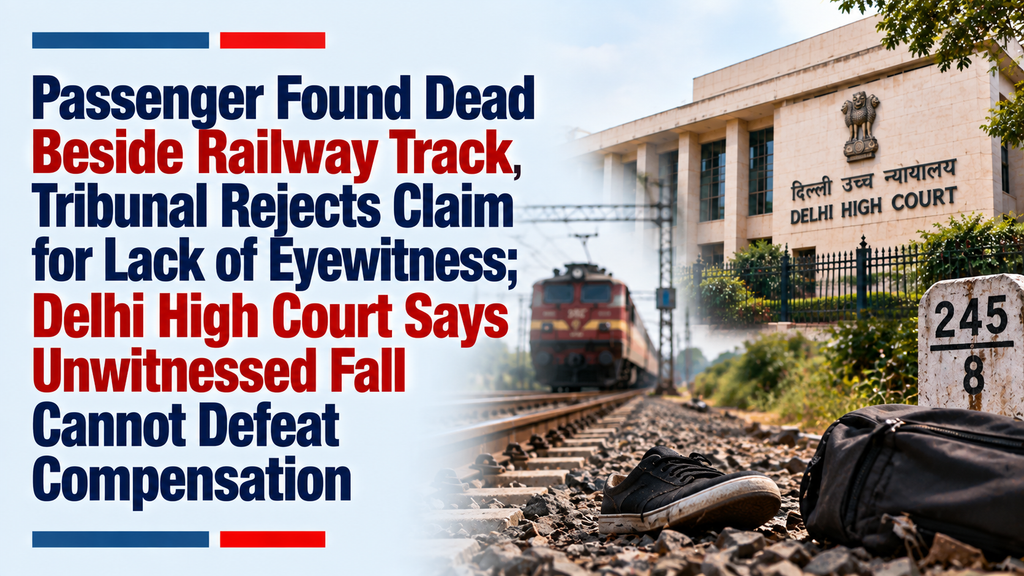
Passenger Found Dead Beside Railway Track, Tribunal Rejects Claim for Lack of Eyewitness; Delhi High Court Says Unwitnessed Fall Cannot Defeat Compensation

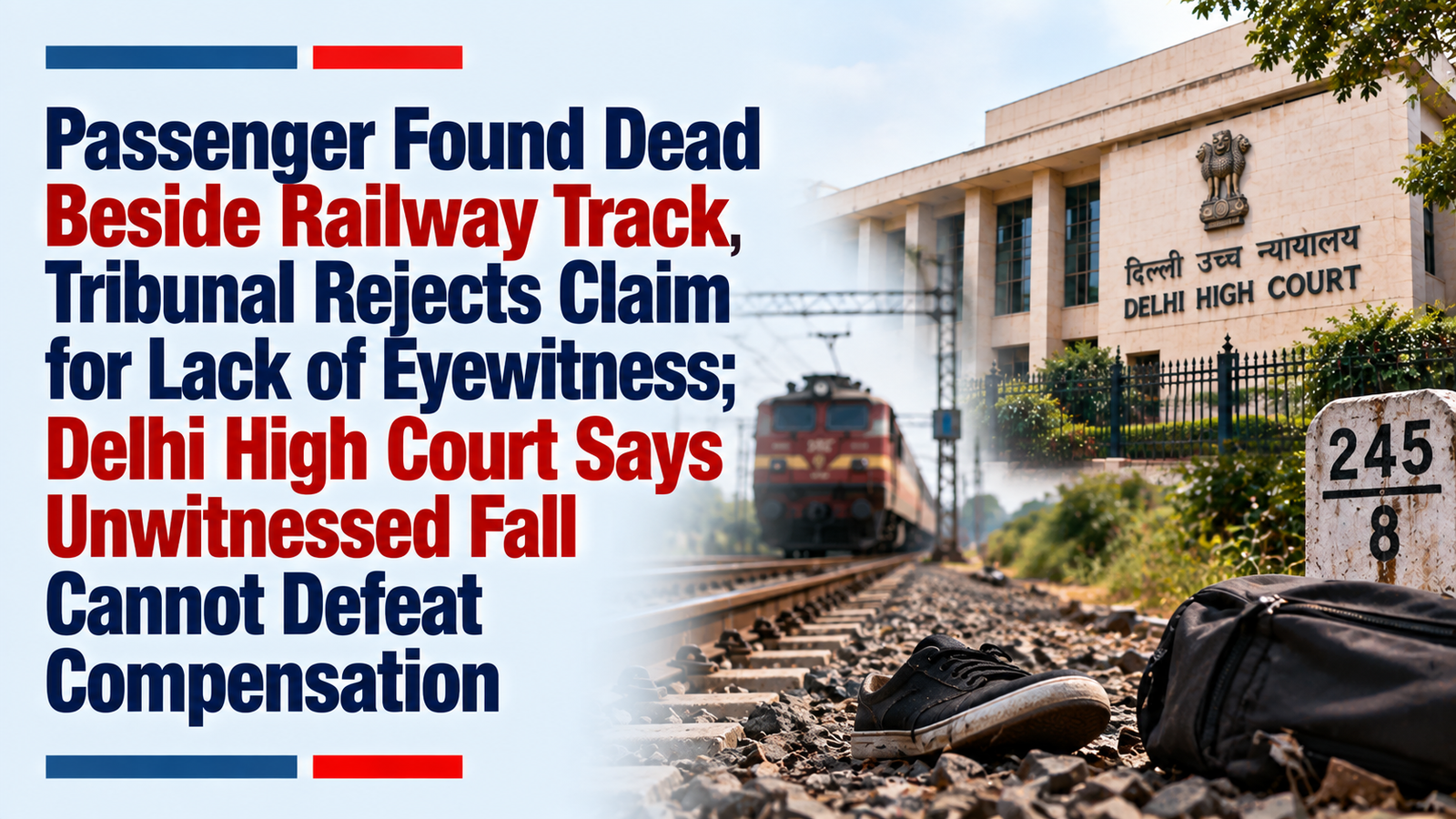
No Alarm Chain Pulled and Railway Staff Receive No Report of Passenger Falling; Delhi High Court Says These Facts Cannot Defeat Compensation
Facts
The case arose from the death of Ramesh Meena on 13 November 2019. He was travelling with his brother-in-law, Babulal, from Jatusana to Kund via Rewari. They had purchased a single ticket covering two adult passengers and, after reaching Rewari, boarded Passenger Train No. 59720 for Kund.
According to the claimant, Babulal got down at Kund while Ramesh remained inside the train. Later that day, Ramesh was found dead near the railway line between Rewari and Khori.
His mother, Phooli Devi, sought compensation before the Railway Claims Tribunal on the basis that her son was a bona fide passenger who died due to an accidental fall from the train, constituting an “untoward incident” under the Railways Act, 1989.
The Tribunal dismissed her claim on 21 October 2021. She therefore appealed to the Delhi High Court under Section 23 of the Railway Claims Tribunal Act, 1987.
Issues
The High Court considered two principal questions:
- Whether Ramesh Meena was a bona fide passenger despite the journey ticket not being recovered from his body.
- Whether his death could be treated as an “untoward incident” under Sections 123(c) and 124-A of the Railways Act, despite there being no eyewitness to the actual fall and no contemporaneous report to railway officials.
Appellant’s Arguments
The mother argued that the Tribunal had adopted an unduly strict approach.
The ticket for two passengers had been verified by Jatusana Railway Station. Babulal’s testimony established that he and the deceased had travelled together, and his evidence could not be discarded merely because he was related to the deceased.
She further relied on the circumstances in which the body was found, the post-mortem report and investigative material to contend that Ramesh had accidentally fallen from the train.
Relying on Union of India v. Rina Devi, she argued that the claimant’s initial burden in a railway compensation proceeding is not onerous and the case must be examined on the preponderance of probabilities, rather than by applying the criminal standard of proof.
Respondent’s Arguments
The Railways argued that there was no reliable evidence establishing that Ramesh had fallen from Passenger Train No. 59720.
Neither the Loco Pilot nor the Guard had received any information about a passenger falling from the train. No alarm chain had been pulled and no incident was reported at Khori Railway Station.
The Railways further emphasised that no ticket was recovered from the deceased’s person and questioned Babulal’s testimony.
Analysis of the Law
Deceased Was a Bona Fide Passenger
The High Court first examined the ticket.
Ticket No. UDA23916912 had been issued at Jatusana for two adult passengers travelling to Kund via Rewari. Its genuineness had been verified by the issuing station and was not disputed.
The Court held that merely because the ticket was not physically recovered from the deceased’s body could not destroy his status as a bona fide passenger, particularly when Babulal—who had accompanied him—subsequently produced the ticket.
The claimant had therefore discharged the initial burden, and the Court expressly held that Ramesh Meena was a bona fide passenger.
Relative’s Testimony Cannot Be Rejected Merely Because of Relationship
The Tribunal had principally disbelieved Babulal because of his relationship with the deceased and circumstances surrounding his deboarding at Kund.
The High Court disagreed.
Even if aspects of his conduct created some doubt, that alone could not render his testimony false, particularly when his account was supported by the genuine journey ticket and surrounding evidence.
The Tribunal’s finding that Babulal had been “introduced as a false witness” was therefore set aside.
No Eyewitness to the Fall — Does It Defeat the Claim?
No.
This is the most significant proposition emerging from the judgment.
The Tribunal had attached considerable importance to two circumstances:
- nobody actually witnessed Ramesh falling from the train; and
- railway personnel received no contemporaneous information about such a fall.
The High Court held that neither circumstance could, by itself, establish that the accident did not occur.
An accidental fall from a moving train may naturally happen without being witnessed by other passengers or noticed by railway personnel.
The Court therefore held:
“The absence of direct evidence of the precise moment of the fall… cannot be converted into positive evidence against the claimant.”
Strict Liability Under Section 124-A
The High Court emphasised that Section 124-A embodies a scheme of strict or no-fault liability.
A claimant is not required to establish negligence on the part of the Railway Administration once the occurrence qualifies as an “untoward incident.”
Thus, the focus is not on identifying who was at fault but on whether the statutory requirements for compensation are satisfied.
Precedent Analysis
Union of India v. Prabhakaran Vijaya Kumar
The Supreme Court held that “accidental falling of a passenger from a train carrying passengers” must receive a liberal and purposive interpretation because the compensation provisions of the Railways Act constitute beneficial legislation.
The expression includes not only a person falling after entering the train but also a bona fide passenger falling while attempting to board it.
Most importantly, Section 124-A creates strict/no-fault liability, making the question of fault irrelevant once the case falls within the provision.
Union of India v. Amit Parashar
The Delhi High Court had previously recognised that absence of direct evidence explaining exactly how a passenger fell from a train cannot itself become evidence that no fall occurred.
The same principle applied here because the Tribunal had relied substantially on the absence of a contemporaneous report by railway officials.
Union of India v. Rina Devi
The appellant relied upon Rina Devi for the evidentiary principle that the initial burden on a claimant in such proceedings is not onerous and that the case is to be assessed on the preponderance of probabilities.
Court’s Reasoning
The High Court held that the beneficial nature of the Railways Act could not be ignored.
The evidence had to be considered as a whole and on the preponderance of probabilities.
The absence of an eyewitness or an immediate report to railway authorities might explain why direct evidence was unavailable, but it could not be elevated into affirmative evidence that the accident never happened.
Crucially, the Railways had produced no cogent material establishing any alternative manner of death capable of displacing the case that Ramesh accidentally fell from the train.
Accordingly, the Tribunal’s restrictive approach could not be sustained.
Conclusion
The Delhi High Court allowed the appeal and set aside the Railway Claims Tribunal’s judgment.
The matter was remanded to the Tribunal only for assessment of the compensation payable to Phooli Devi in accordance with law.
The Tribunal was requested to ensure that the compensation is disbursed within two months from receipt of the High Court’s order, and the matter was directed to be listed before the Tribunal on 15 October 2026.
Case Details
Case: Phooli Devi v. Union of India
Court: High Court of Delhi at New Delhi
Case No.: FAO 77/2022
Judge: Justice Manoj Kumar Ohri
Reserved: 3 September 2026
Pronounced: 21 September 2026
Result: Appeal allowed; Tribunal’s rejection of compensation claim set aside; deceased held to be a bona fide passenger and matter remanded for assessment and disbursement of compensation within two months.