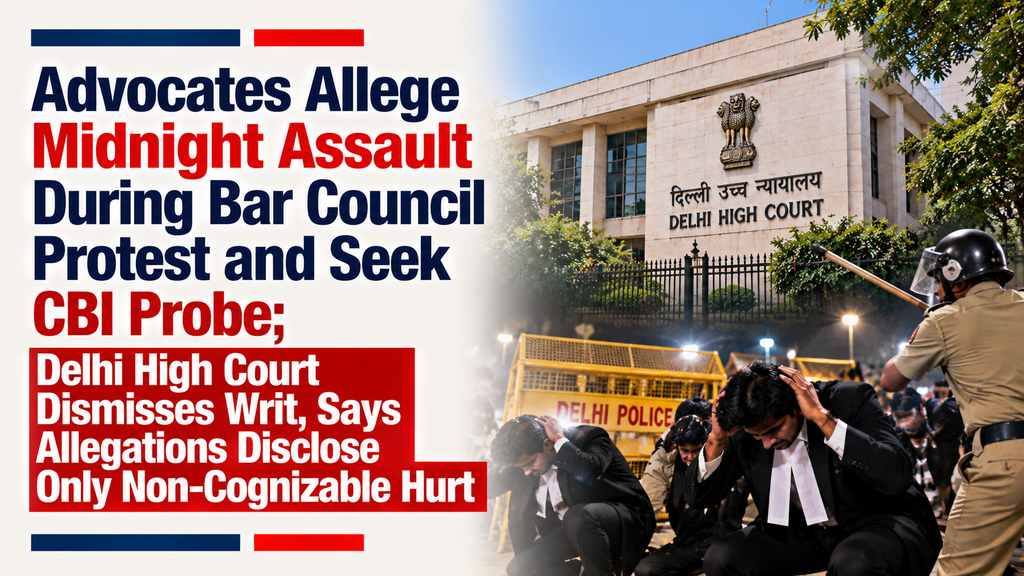
Advocates Allege Midnight Assault During Bar Council Protest and Seek CBI Probe; Delhi High Court Dismisses Writ, Says Allegations Disclose Only Non-Cognizable Hurt

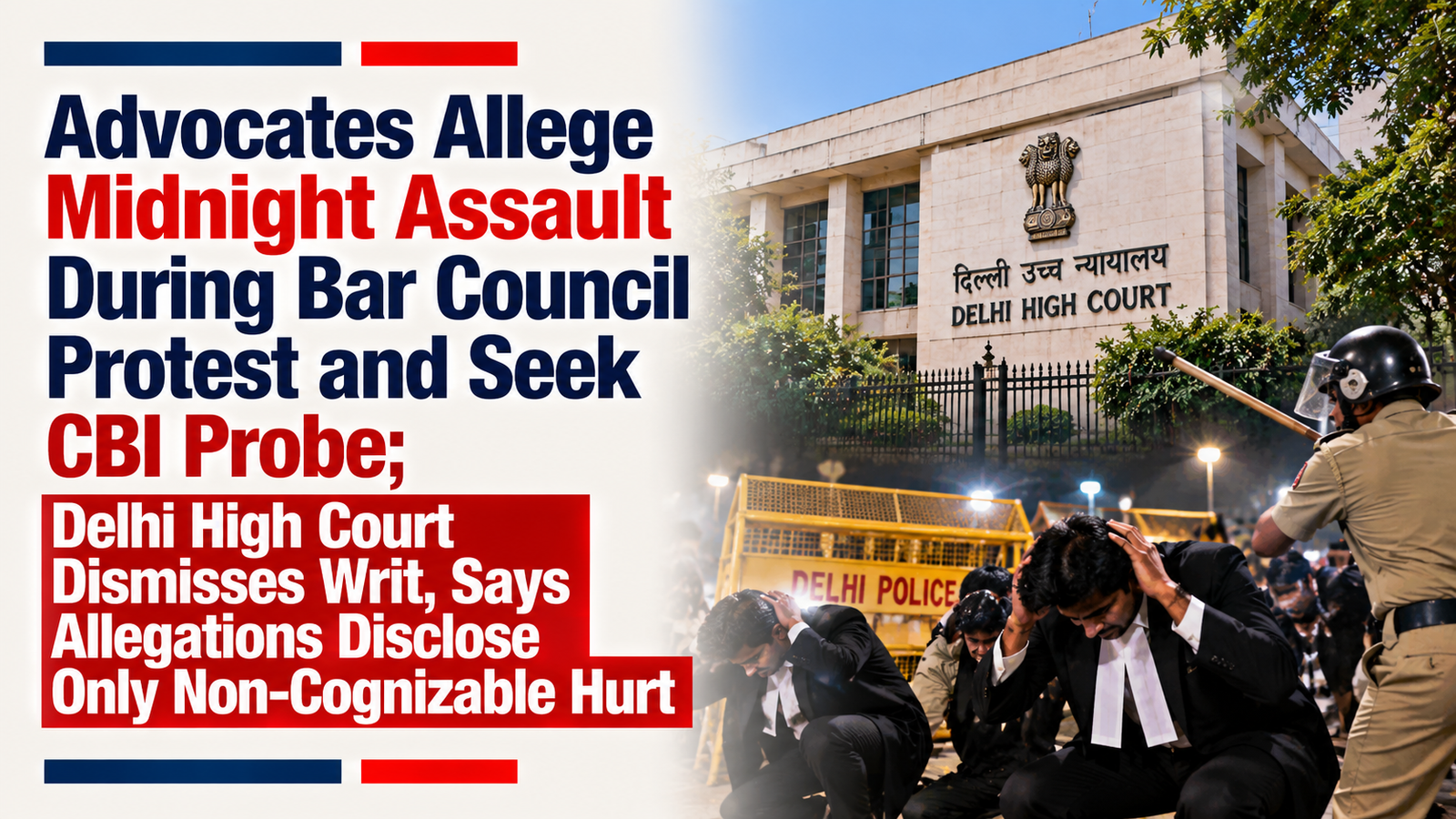
Lawyers Seek CBI Probe and Preservation of CCTV After Alleged Bar Council Assault; Delhi High Court Says Magistrate Provides Efficacious Remedy
Facts
The petitioners, practising advocates, approached the Delhi High Court seeking a direction to the CBI or another independent agency to register an FIR and investigate an alleged assault on advocates inside and outside the Bar Council of India premises during the intervening night of 20/21 August 2026. They also sought preservation and production of CCTV footage and a direction to the BCI to decide their representation.
According to the petitioners, controversy had arisen following developments concerning NALSAR University’s graduating batch and a directive issued by the Bar Council of India concerning enrolment of 2026 graduates. Thereafter, the All India Young Advocates Association called for a peaceful demonstration outside the BCI office on 20 August 2026.
The petitioners alleged that about 10–14 advocates continued a sit-in inside the BCI premises. At around 1:15–1:20 a.m., a group of approximately 25–30 men, several allegedly dressed as advocates, entered the premises. According to the petition, the protesters were surrounded, beaten, slapped, thrashed and dragged, allegedly in the presence of police personnel.
A written complaint was submitted to the SHO, P.S. I.P. Estate on 22 August 2026. The petitioners also made representations to the BCI and the Delhi High Court Bar Association, but alleged that no action followed.
Issues
The principal questions were:
- Whether the petitioners could directly invoke Article 226 seeking a mandamus for registration of an FIR and investigation by the CBI or another independent agency without first exhausting remedies under the BNSS.
- Whether the allegations in the complaints disclosed a cognizable offence permitting police investigation.
- Whether the High Court should direct preservation/seizure of CCTV footage and require the BCI to decide the petitioners’ representation.
Petitioners’ Arguments
The petitioners argued that an independent investigation was necessary because respondent No. 1 was a Member of Parliament and they apprehended that the Delhi Police would not conduct a fair investigation.
They submitted that the police had failed to act upon their complaint.
They further argued that a Magistrate could not direct investigation by the CBI and would not be able to direct seizure of the CCTV footage. The BCI representation, according to them, was intertwined with the alleged assault and therefore could also be considered in the criminal writ petition.
Respondents’ Position / Maintainability Objection
The Court primarily considered maintainability at the threshold.
It examined whether the petitioners had an alternate efficacious statutory remedy and whether the extraordinary writ jurisdiction should be invoked as the first remedy for non-registration of an FIR.
The Court noted that the petitioners had approached the SHO but had not approached the concerned DCP, equivalent to the Superintendent of Police in Delhi, nor the jurisdictional Magistrate. The petition also did not explain why these remedies were ineffective.
Analysis of the Law
The Court reiterated that Article 226 confers wide powers, but writ jurisdiction is extraordinary and discretionary. Ordinarily, where legislation creates a right and also prescribes a remedial mechanism, that statutory mechanism should first be exhausted.
Under the BNSS, grievances concerning non-registration of an FIR are addressed through a layered mechanism involving the superior police authority and thereafter the Magistrate.
The Court relied substantially on the Supreme Court’s 2026 decisions explaining that the criminal procedural framework provides an efficacious mechanism for dealing with non-registration and improper investigation.
Precedent Analysis
Ashwini Kumar Upadhyay v. Union of India
The Supreme Court recognised the CrPC/BNSS framework as a “comprehensive and multi-tiered mechanism” for grievances concerning non-registration of FIRs.
An aggrieved complainant may approach the superior police authority and thereafter the Magistrate. The Magistrate’s supervisory jurisdiction over investigation is of wide amplitude and is intended to ensure a fair, impartial and lawful investigation.
Sujal Vishwas Attavar v. State of Maharashtra
The Supreme Court held that Article 226 ordinarily should not be invoked at the first instance where equally efficacious statutory remedies exist.
The sequence contemplated by the BNSS requires approaching the officer in charge, then the Superintendent of Police under Section 173(4), and thereafter the Magistrate under Section 175(3). Constitutional intervention remains available in exceptional circumstances, but cannot routinely substitute this statutory structure.
Thansingh Nathmal v. Superintendent of Taxes
The Court also relied on the settled principle that merely because the High Court legally possesses writ jurisdiction does not mean that it should exercise it where an adequate alternative remedy exists.
Court’s Reasoning
There were two significant grounds behind the dismissal.
First, the petitioners had not exhausted the statutory remedies. After complaining to the SHO, they had neither approached the DCP nor invoked the jurisdiction of the Magistrate. There was also no pleading explaining why these remedies would be ineffective.
Second, the Court examined the allegations themselves and held that the complaints did not disclose a cognizable offence. The allegations were that unarmed persons had beaten, slapped, thrashed and dragged the petitioners.
The Court held that this would, at the highest, constitute “hurt” under Section 114 of the Bharatiya Nyaya Sanhita, which is non-cognizable. Consequently, Section 174 BNSS would apply and the matter would require recourse to the Magistrate rather than direct police investigation.
The Court also rejected the argument that a Magistrate would be powerless concerning CCTV material, describing that submission as inconsistent with the powers available under Chapter XVI of the BNSS.
Accordingly, the Court held that the petitioners had an efficacious remedy by filing a complaint case before the concerned Magistrate under Section 223 BNSS.
As regards the BCI representation, the Court noted that demands concerning resignation, accountability of BCI members, advocates’ welfare, legal-education reforms and consideration of a no-confidence motion had no bearing on the prayer seeking investigation into the alleged assault.
Finally, the Court disapproved the unsupported contention that the Delhi Police could not act fairly merely because respondent No. 1 was stated to be an MP from the ruling dispensation. It held that no factual foundation had been shown for such an apprehension.
Conclusion
The Delhi High Court dismissed the writ petition as not maintainable.
The decision rests materially on the petitioners having an alternate statutory remedy before the Magistrate and, independently, the Court’s conclusion that the allegations as pleaded amounted at most to non-cognizable hurt.
The judgment does not adjudicate whether the alleged assault actually occurred or determine the guilt of any individual. Its determination was principally on maintainability and the legal character of the allegations contained in the complaints.
Case Details
Case: Kunal Yadav & Ors. v. Manan Kumar Mishra & Ors.
Court: High Court of Delhi at New Delhi
Case No.: W.P.(CRL) 2850/2026 with CRL.M.A. 28622/2026 & 28623/2026
CNR: DLHC010438192026
Judge: Justice Girish Kathpalia
Reserved: 18 September 2026
Pronounced: 21 September 2026
Result: Writ petition dismissed as not maintainable; petitioners left to pursue the statutory remedy before the concerned Magistrate under the BNSS.