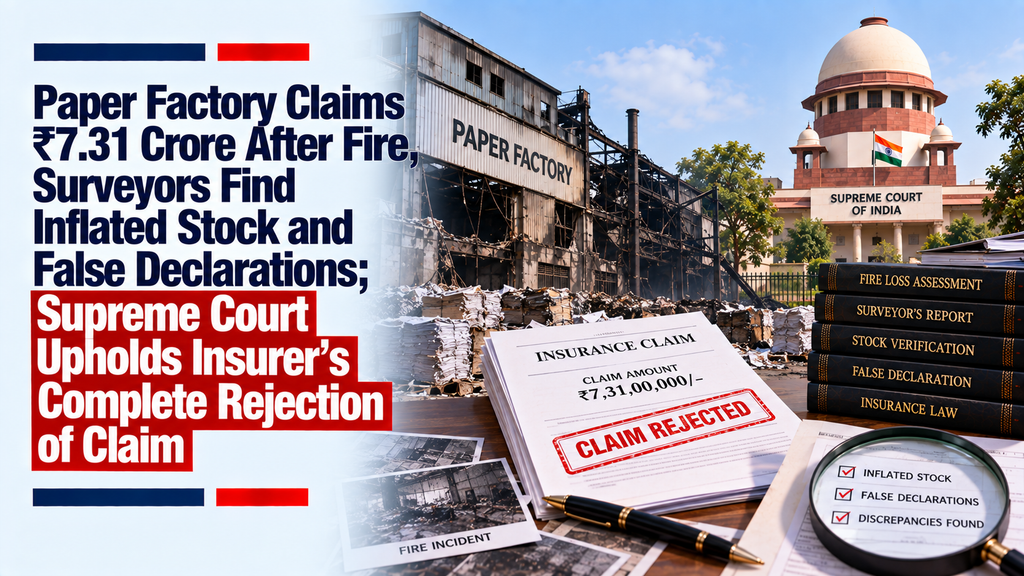
Paper Factory Claims ₹7.31 Crore After Fire, Surveyors Find Inflated Stock and False Declarations; Supreme Court Upholds Insurer’s Complete Rejection of Claim

Factory Claims Thousands of Tonnes of Stock Destroyed in Fire; Supreme Court Finds Serious Discrepancies, Restores Insurer’s Rejection of Claim
Facts
The case arose from a fire insurance dispute between M/s New India Assurance Company Ltd. and M/s Hemkund Duplex and Board Pvt. Ltd. The insured company operated a paper-board manufacturing factory at Najibabad and had two fire policies—₹13 crore covering stock and ₹14 crore covering buildings, plant and machinery.
On 7 May 2009, a fire allegedly broke out in the waste-paper yard/tin shed of the factory. The insurer was informed the same day, and the insured lodged its claim on 9 May 2009.
The insured eventually claimed approximately ₹7.31 crore, asserting substantial destruction of waste-paper stock and damage to the building. However, the preliminary surveyor, an investigating agency and the final surveyor recorded serious discrepancies regarding the origin and extent of the fire, the stock allegedly destroyed, the condition of the shed and the company’s books of account.
The final surveyor quantified the actual loss at only about ₹46.09 lakh, while also reporting that the books appeared to have been manipulated to inflate the claim.
New India Assurance consequently repudiated the claim on 28 June 2010, relying upon alleged manipulation of accounts, unreliable stock records, doubtful circumstances surrounding the fire and breach of the policy conditions.
The NCDRC, however, directed the insurer to pay ₹2.40 crore, along with interest, ₹3 lakh compensation for deficiency in service and ₹1 lakh litigation costs. Both sides approached the Supreme Court—the insurer challenging liability and the insured seeking higher compensation.
Issues
The principal issues were:
- Whether New India Assurance was justified in repudiating the entire fire insurance claim.
- Whether the NCDRC was justified in disregarding the findings of the surveyors and investigating agency.
- Whether uncertainty regarding the precise cause of fire automatically entitled the insured to recover under the policy.
- Whether false declarations, unreliable stock records and misstatements concerning the property allegedly destroyed constituted breach of the insurance policy sufficient to forfeit the claim.
Appellant–Insurance Company’s Arguments
New India Assurance relied heavily upon the reports of the preliminary surveyor, investigating agency and final surveyor.
It pointed out that the insured’s stated loss kept changing—from reports of ₹15 crore, to ₹10 crore, then ₹8.45 crore and ultimately approximately ₹7.31 crore. The preliminary surveyor also questioned the claimed eyewitness account, the lack of any identifiable source of ignition, the limited physical damage to the shed and substantial discrepancies between book stock and physical stock.
The insurer further contended that stock shown in the company’s accounts did not correspond with stock physically found at the premises and that purchase bills did not match the material actually present.
It therefore argued that the insured had breached the policy conditions requiring truthful disclosure and prohibiting fraudulent claims or false declarations.
Respondent–Insured’s Arguments
Hemkund Duplex maintained that a genuine fire had occurred and that uncertainty regarding its precise cause was not sufficient to defeat an insurance claim.
It relied upon a police report suggesting that a fire lit in a nearby sugarcane field after harvesting might have generated a spark that travelled into the factory’s waste-paper yard.
The Supreme Court, however, noted that there was no evidence establishing the distance between the sugarcane field and the factory and that photographs showed only a relatively limited patch of burnt grass.
Analysis of the Law
The Court examined Section 64UM of the Insurance Act, 1938, which assigns an important statutory role to licensed surveyors in assessing insurance losses.
At the same time, a surveyor’s report is not conclusive or binding in every circumstance. An insurer can depart from it, but cannot do so arbitrarily or whimsically.
The Court also recognised the established principle that where a fire is proved and there is no allegation or finding of fraud or involvement of the insured in causing the fire, uncertainty regarding the exact cause of the fire may not defeat the insurance claim.
But the present case was materially different because the evidence generated a reasonable basis to question not merely the precise cause of the fire, but also the genuineness and quantum of the claim and the insured’s own conduct.
Precedent Analysis
New India Assurance Co. Ltd. v. Pradeep Kumar
The Supreme Court reiterated that a licensed surveyor’s report is important but is not the last and final word. It is neither automatically binding upon the insurer nor upon the insured.
Khatema Fibres Ltd. v. New India Assurance Co. Ltd.
While an insurer has discretion regarding a survey report, that discretion cannot be exercised arbitrarily. Surveyors themselves are also subject to statutory professional standards.
Sri Venkateswara Syndicate v. Oriental Insurance Co. Ltd.
A second surveyor cannot ordinarily be appointed merely to obtain a report favourable to the insurer. Cogent reasons are required.
In this case, however, the first surveyor himself expressly recommended further investigation because of abnormalities suggesting the possibility of a deliberate fire and hypothetical loss.
Canara Bank / Orion Conmerx Principle
Ordinarily, where the insured did not cause or instigate the fire, the inability to determine whether the fire originated from a short circuit or some other accidental source does not by itself absolve the insurer.
The Court distinguished that principle because the present record contained circumstances giving rise to suspicion regarding the insured’s conduct and, independently, substantial evidence of false declarations supporting the claim.
Court’s Reasoning
The Court found several circumstances weighing heavily against Hemkund.
First, there was an admitted 50-minute delay in informing the fire brigade, although the fire station was only 6–7 kilometres away and the fire engine arrived within approximately 11 minutes after receiving the call. The Court also noted the surveyors’ findings that the factory employees’ firefighting efforts were not sincere.
Second, the physical condition of the shed was inconsistent with the magnitude of the fire claimed. There was also evidence from the JCB owner and other witnesses indicating that the tin shed had been broken down before the fire, contrary to the management’s account.
Third—and critically—the workers contradicted the management’s claim that usable raw material was stored in the burnt shed. According to their statements, only old and unusable waste material was stored there, some of which had been lying there since before the new management took over in 2005.
The surveyor additionally found that there was no stock register or stock-movement register and recorded abnormalities in consumption, yield and book stock. The Court accepted that these discrepancies materially supported the insurer’s case.
Most importantly, Policy Conditions 6 and 8 required honest and complete disclosure and provided for forfeiture where the claim was fraudulent or supported by false declarations. The Court found those conditions had been breached.
It held that where an insured makes false averments to bolster an insurance claim contrary to the policy conditions, the insurer is lawfully entitled to reject the claim.
Conclusion
The Supreme Court held that New India Assurance’s repudiation of the claim was justified because Policy Conditions 6 and 8 had been violated.
It found that the NCDRC had wrongly brushed aside the detailed survey reports and had no proper basis to give the insured a clean chit and independently award compensation far exceeding the surveyors’ assessment.
Accordingly:
- New India Assurance’s Civil Appeal No. 7221 of 2025 was allowed.
- The NCDRC’s order awarding ₹2.40 crore was set aside.
- Hemkund’s Civil Appeal No. 11416 of 2025 seeking greater compensation was dismissed.
- The ₹50 lakh deposited by the insurer pursuant to the Supreme Court’s interim order was directed to be returned with accrued interest.
Case Details
Case: M/s New India Assurance Company Ltd. v. M/s Hemkund Duplex and Board Pvt. Ltd.
Citation: 2026 INSC 1023
Court: Supreme Court of India
Case Nos.: Civil Appeal Nos. 7221 of 2025 & 11416 of 2025
Bench: Justice Sanjay Kumar and Justice Sanjeev Sachdeva
Date: 21 September 2026
Result: Insurer’s appeal allowed; NCDRC’s ₹2.40 crore award set aside; insured’s appeal dismissed; complete repudiation of fire insurance claim upheld.