

Court’s decision
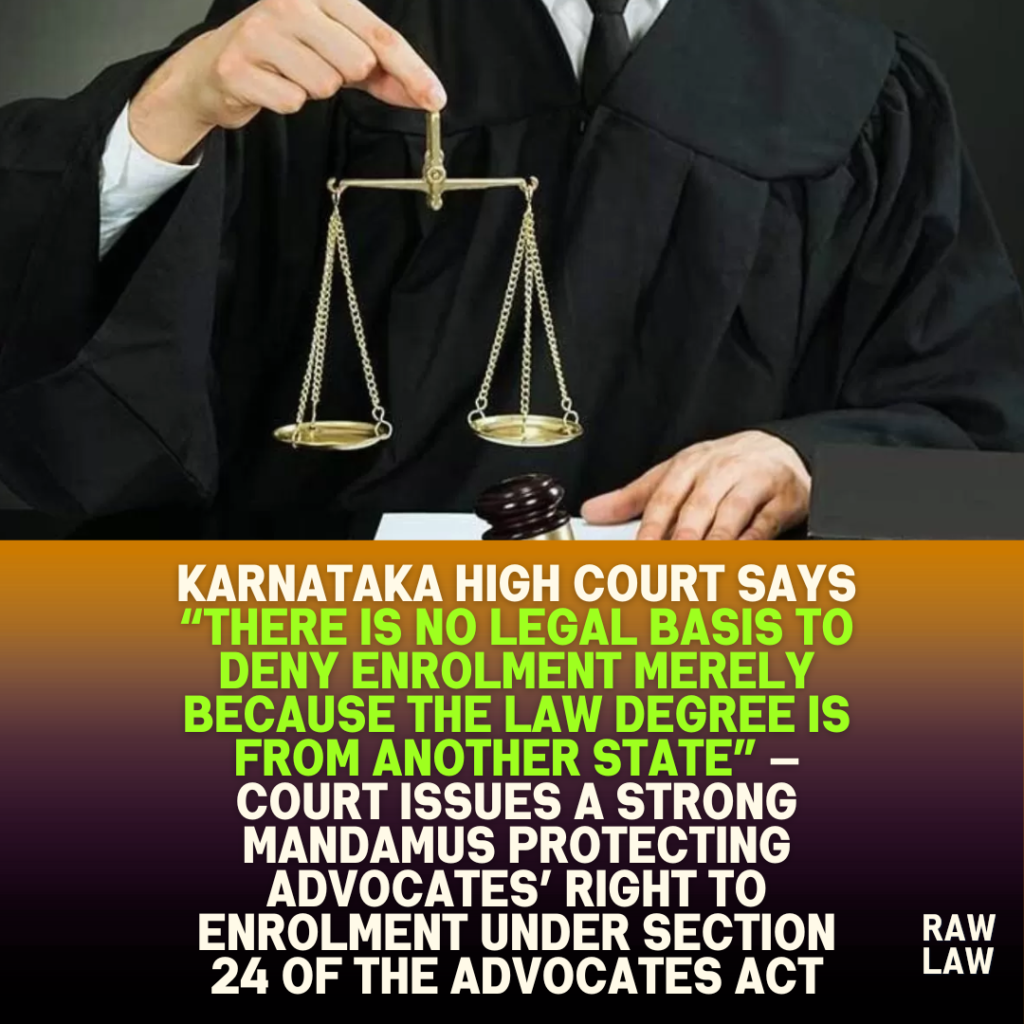
The Karnataka High Court delivered a clear and categorical mandate holding that a State Bar Council cannot refuse to enrol a law graduate solely on the ground that the degree was obtained from a university located outside that State. After examining Section 24 of the Advocates Act, 1961 and the Bar Council of India’s regulatory framework, the Court concluded that the statutory scheme does not impose any territorial restriction on enrolment. The Court emphasised that the only requirement is that the degree must be from a college affiliated to the Bar Council of India. Once this condition is met and the verification process is completed, a State Bar Council must process the enrolment application.
Relying on submissions made on behalf of the Bar Council of India, the Court noted that the petitioner’s degree from Monad University, Uttar Pradesh is duly recognised and that graduates from any BCI-affiliated institution across the country are entitled to seek enrolment in any State. The Court found the Karnataka State Bar Council’s refusal arbitrary and without statutory support. It therefore allowed the writ petition, issued a mandamus directing enrolment on the next scheduled date, and further directed the Council to consider future applications without imposing any territorial barriers.
Facts
The Petitioner completed a law degree from a college situated in the State of Uttar Pradesh. Upon applying for enrolment before the Karnataka State Bar Council, the application was not considered. The Petitioner asserted that the refusal stemmed from an internal practice or policy whereby candidates who obtained degrees from universities situated outside Karnataka were not being enrolled, irrespective of whether the degree-granting institution held affiliation from the Bar Council of India. The Petitioner contended that he fulfilled all statutory requirements under Section 24 of the Advocates Act, 1961 and that the rejection was arbitrary and violative of constitutional and statutory safeguards. The Bar Council of India confirmed that the Petitioner’s institution was duly affiliated.
Issues
The Court examined whether a State Bar Council has the authority to deny enrolment to a law graduate solely because the degree was obtained from a university located outside that State. Associated with this was whether any rule, policy or practice of the Council imposing such territorial restrictions is consistent with the Advocates Act, 1961. Another issue was whether the petitioner’s degree from an out-of-State institution, though affiliated to the Bar Council of India, met the statutory prerequisites for enrolment. The Court also considered the scope of judicial review in correcting arbitrary administrative decisions by statutory professional bodies.
Petitioner’s arguments
The Petitioner argued that the refusal of enrolment was arbitrary, discriminatory and without statutory backing. He submitted that Section 24 of the Advocates Act sets out exhaustive eligibility criteria, and none of these conditions bar candidates who have obtained degrees from institutions in other States. The Petitioner asserted that the Advocates Act creates a national framework for legal education and professional mobility, and therefore a territorial restriction would defeat the legislative intent. He maintained that he completed his degree from a Bar Council of India-affiliated university, making him fully eligible for enrolment. He urged that the State Bar Council’s approach violated constitutional guarantees of equality and the right to practice a profession.
Respondent’s arguments
The Respondent State Bar Council did not place any statutory rule justifying its refusal but suggested that applications from certain out-of-State universities required additional scrutiny due to concerns regarding affiliations and degree validity. The Respondent submitted that verification of certificates is essential to prevent fraudulent enrolments and argued that its practice was intended to safeguard professional standards. The Bar Council of India, however, clarified that the petitioner’s institution was formally affiliated and that there exists no rule prohibiting graduates of out-of-State colleges from enrolling with any State Bar Council. This clarification effectively narrowed the controversy before the Court.
Analysis of the law
The Court’s legal analysis centred on Section 24 of the Advocates Act, which prescribes statutory qualifications for enrolment. The provision requires that an applicant must be a citizen of India, hold a law degree from a BCI-recognised institution, and satisfy certain procedural requirements. The Court emphasised that the statute does not authorise State Bar Councils to create additional territorial or university-specific restrictions. It reiterated that professional entry conditions must flow strictly from legislation and cannot be imposed through administrative practice or circulars lacking statutory foundation. The Court also considered that enrolment is a professional right governed by uniform national standards, and arbitrary barriers violate Article 14 and undermine the unified legal profession envisioned under the Act.
Precedent analysis
The Court’s reasoning was supported by longstanding principles from precedents recognising that statutory bodies cannot impose eligibility criteria that exceed legislative mandates. Earlier judgments have consistently held that where a statute exhaustively defines qualifications, administrative authorities cannot read into the law additional restrictions that curtail the right to practice a profession. The Court also drew from jurisprudence emphasising that Bar Councils must implement uniform national standards in accordance with BCI affiliation norms, and cannot adopt exclusionary practices based on geography or administrative preference. These precedents collectively established that enrolment must adhere to the statutory framework without arbitrary deviation.
Court’s reasoning
The Court reasoned that the Respondent’s approach was legally untenable, particularly in light of the Bar Council of India’s categorical clarification that any graduate from a BCI-affiliated institution is eligible for enrolment in any State. It observed that the core purpose of Section 24 is to maintain uniformity and national professional mobility. The Court noted that the Respondent Council had not cited any rule, regulation or statutory amendment authorising territorial restrictions. It further held that if the BCI recognises the college and there is no dispute regarding authenticity of the degree, the State Bar Council is duty-bound to process the application. The refusal amounted to arbitrary discrimination and undermined the statutory rights of aspiring advocates.
Conclusion
The Court concluded that the Petitioner’s application had been wrongly withheld and issued a mandamus directing the Karnataka State Bar Council to enrol the Petitioner on the next enrolment date. It further directed the Council to ensure that future applications from graduates of out-of-State, BCI-affiliated institutions are considered without discrimination, subject only to standard verification procedures. The judgment reinforces statutory uniformity in legal education and professional entry and affirms that territorial restrictions have no place under the Advocates Act. The decision stands as a clear directive against arbitrary administrative practices affecting enrolment.
Implications
This ruling has significant implications for thousands of law graduates across India who study outside their home States but seek enrolment locally. It reinforces that the Advocates Act establishes a national profession and that State Bar Councils cannot impose territorial barriers inconsistent with legislative intent. The judgment may curtail informal policies that some Councils have adopted to restrict out-of-State applicants. It also strengthens the authority of the Bar Council of India as the central regulator of legal education and affiliation. Importantly, it ensures mobility, equality and predictability in professional entry, making enrolment processes uniform and constitutionally compliant.


