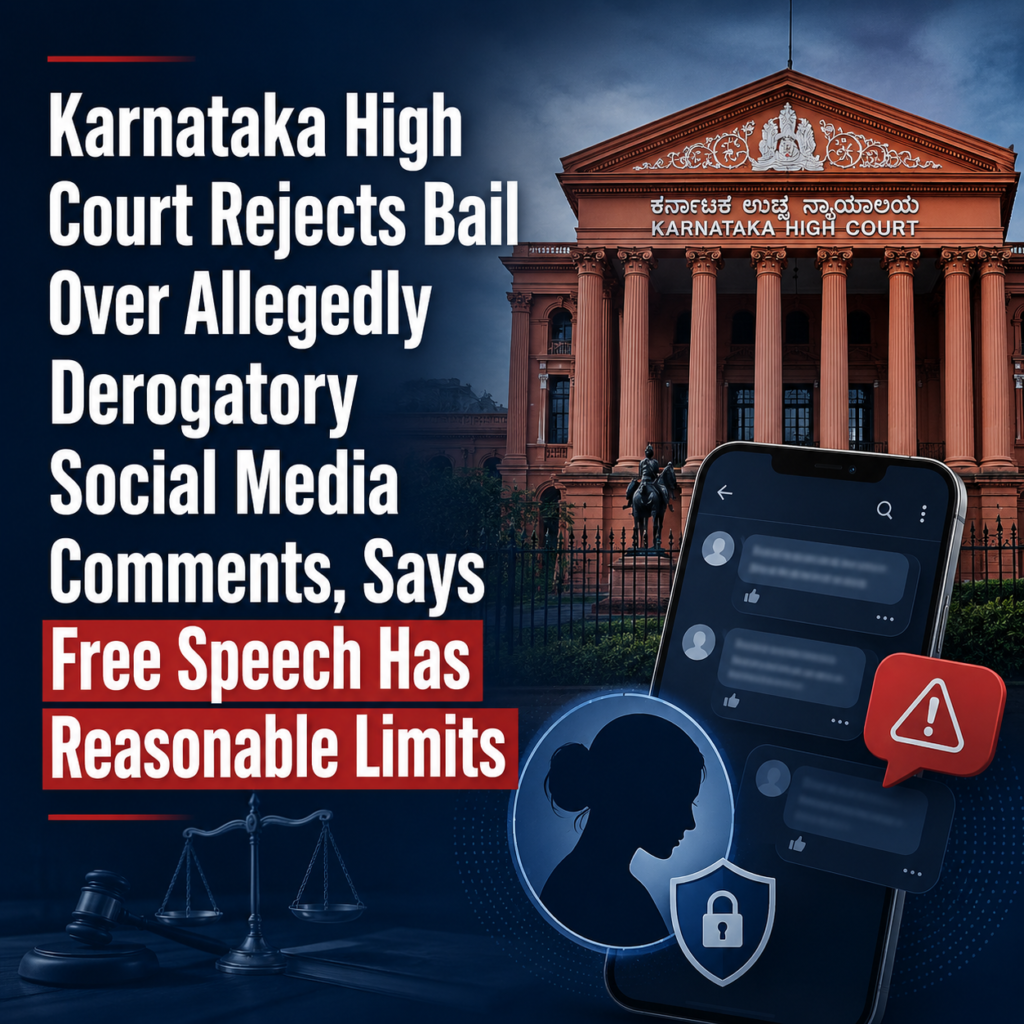
Social Media Cannot Be Used as a Tool to Attack a Woman’s Dignity: Karnataka High Court Rejects Four Bail Petitions
Facts
The Karnataka High Court considered four separate bail petitions filed by accused Nos.1 to 4 in Crime No.69 of 2025, registered by the Cyber Crime Police Station, Bengaluru City.
The complainant, described in the judgments as the wife of an eminent film actor, had participated in a programme at Davangere on 21 December 2025 concerning the promotion of a Kannada film. According to the prosecution, certain statements made by her at the event were misinterpreted, following which vulgar and derogatory comments were posted against her on social media platforms.
The petitioners were alleged to have posted comments through their respective Instagram or Facebook accounts. The comments were described as abusive, intimidating and derogatory to the complainant’s dignity. In one case, the Court noted that the language contained references to sexual assault, while in another, the petitioner’s mobile phone had been seized and the preliminary investigation allegedly connected him with the offending comment.
The police registered offences under Sections 67 and 66-C of the Information Technology Act, 2000, along with provisions of the Bharatiya Nyaya Sanhita, 2023 relating to criminal intimidation, intentional insult, sexual harassment and words or acts intended to insult the modesty of a woman, read with the provision concerning common intention.
As the investigation remained in progress, all four accused approached the High Court seeking regular bail under Section 439 of the Code of Criminal Procedure read with Section 483 of the Bharatiya Nagarik Suraksha Sanhita.
Issues
- Whether the petitioners were entitled to regular bail when the allegations concerned vulgar, abusive and intimidating social media comments against a woman.
- Whether merely posting a comment on an existing social media post, without creating or independently uploading the original content, attracted Section 67 of the Information Technology Act.
- Whether the petitioners’ right to freedom of speech and expression protected the comments allegedly posted by them.
- Whether the seriousness of the allegations, the impact upon the complainant’s dignity and the pendency of the investigation justified denial of bail.
Petitioner’s Arguments
The petitioners argued that the allegation against them was limited to posting comments on social media posts that already existed. They contended that they had neither created the original content nor independently uploaded or disseminated obscene material.
It was submitted that Section 67 of the Information Technology Act requires publication or transmission of obscene material in electronic form. According to the petitioners, merely commenting upon an existing post did not satisfy the essential ingredients of the offence.
The petitioners claimed that they were innocent and had no intention to disrespect or harass the complainant. One petitioner submitted that he was unaware of the consequences of posting such a comment.
They further argued that they were permanent residents, had roots in society and, in some cases, were earning members of their families. They assured the Court that they would comply with any conditions imposed upon their release.
On these grounds, the petitioners sought regular bail.
Respondent’s Arguments
The State opposed the bail petitions, contending that the petitioners had posted vulgar, obnoxious and derogatory comments against the complainant.
It argued that cybercrime and online harassment had become a serious social menace. Individuals using mobile devices from distant locations could not be permitted to harass innocent citizens under the belief that online platforms gave them unrestricted freedom.
The prosecution submitted that the comments caused mental agony, harmed the complainant’s dignity and, in certain instances, contained intimidation and sexually offensive references.
It also pointed out that the investigation remained in progress. In the case of accused No.4, the police had seized his mobile phone and claimed that preliminary material connected him with the alleged offence.
The State argued that granting bail in such cases would send an incorrect message and sought rejection of all four petitions in the larger interest of society.
Analysis of the Law
The Court recognised that freedom of speech and expression is constitutionally protected. However, it emphasised that the right is not absolute and remains subject to reasonable restrictions.
According to the Court, freedom of expression cannot be used to invade another person’s dignity, personal liberty or right to live without intimidation and harassment. Social media cannot be treated as an unrestricted space where individuals may publish vulgar or abusive comments without legal consequences.
The Court viewed the right to dignity of the complainant, particularly as a woman subjected to vulgar online comments, as an important constitutional consideration. It observed that courts must act to safeguard the fundamental rights and personal dignity of individuals when social media is used as a tool for harassment.
The petitioners raised a specific statutory argument that merely commenting on an existing post did not amount to publishing or transmitting obscene material under Section 67 of the Information Technology Act. However, the Court did not undertake a detailed or final interpretation of the ingredients of Section 67 at the bail stage.
The orders were based primarily on the nature and language of the comments, the alleged intimidation and harassment, their effect upon the complainant’s dignity, and the fact that the investigation was still underway.
Therefore, the judgments should not be read as conclusively holding that every comment on an existing social media post automatically attracts Section 67 of the Information Technology Act. The Court’s findings were limited to deciding whether bail should be granted on the facts and prima facie material placed before it.
Precedent Analysis
The Court did not cite or analyse any reported judgment of the Supreme Court or another High Court on:
- The ingredients of Section 67 of the Information Technology Act;
- The distinction between creating an original post and commenting upon existing content;
- The governing principles for grant or refusal of regular bail; or
- The relationship between online speech, obscenity and the right to dignity.
Instead, the Court relied upon general constitutional principles concerning reasonable restrictions on freedom of speech, protection of personal liberty and dignity, and the constitutional courts’ responsibility to intervene when individual rights are threatened.
The orders are therefore primarily fact-specific bail decisions rather than detailed precedents interpreting the Information Technology Act.
Court’s Reasoning
The Court found that the comments attributed to the petitioners were not merely critical or disagreeable expressions. They were described as filthy, vulgar, intimidating and derogatory, directly affecting the complainant’s dignity and self-esteem.
In the case of accused No.1, the Court noted that the comments allegedly amounted to intimidation and harassment and included vulgar language relating to sexual assault.
In the case of accused No.2, the Court held that social media had allegedly been used as a tool for harassment and intimidation through abusive language. It stated that the dignity and self-esteem of a woman must be protected and that such comments required strict treatment.
In the case of accused No.3, the Court found that the language was so vulgar that it was considered inappropriate to reproduce it in the order. The Court stated that the manner of commenting reflected the petitioner’s attitude towards women.
In the case of accused No.4, the Court noted that the alleged Facebook comment directly affected the complainant’s dignified life. It also took into account the seizure of the petitioner’s mobile phone and the prosecution’s assertion that preliminary investigation connected him with the offence.
The Court observed that social media platforms carry a responsibility to maintain decorum and public confidence. Baseless, false, intimidating and abusive messages must be regulated, and constitutional courts cannot remain silent spectators when social media conduct allegedly violates the fundamental rights of citizens.
Considering the nature of the comments, their alleged effect upon the complainant and the ongoing investigation, the Court concluded that the petitioners were not entitled to bail.
Conclusion
The Karnataka High Court rejected the regular bail petitions filed by all four accused persons who were alleged to have posted vulgar, abusive and intimidating comments against the wife of a film actor on Instagram and Facebook.
The Court held that freedom of speech and expression does not extend to online harassment, intimidation or attacks upon the dignity and personal liberty of another person. It stressed that the dignity and self-esteem of women must be protected and that courts should intervene when social media platforms are allegedly misused to violate individual rights.
However, the Court did not conclusively determine whether merely commenting upon an existing post, without creating the original content, independently satisfies Section 67 of the Information Technology Act. That statutory question was left open for investigation and trial.
All four bail petitions were accordingly rejected.
Case Details
Case: Chandrashekar B. v. State of Karnataka; Nithin G.B. v. State of Karnataka; Prashanth Kareepa Talavar v. State of Karnataka; and Ningaraj Gulappa Talavar v. State of Karnataka
Court: High Court of Karnataka at Bengaluru
Case Numbers: Criminal Petition Nos.1921, 1890, 1880 and 1857 of 2026
Judge: Justice S. Rachaiah
Date: 29 May 2026
Result: All four regular bail petitions were rejected.