


Court’s Decision
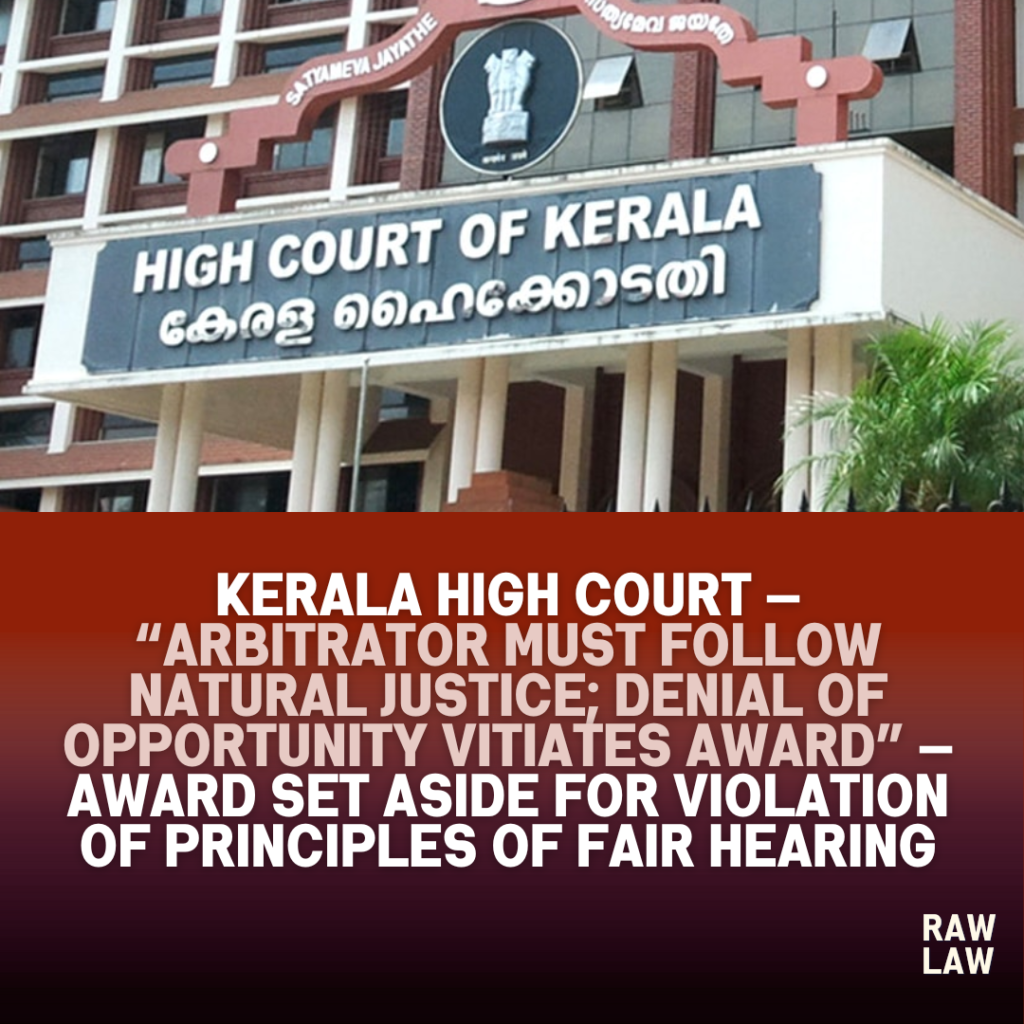
The High Court held that an arbitral award rendered without granting a fair opportunity of hearing is unsustainable in law. It emphasized that arbitral proceedings, though less formal than court proceedings, are nonetheless bound by principles of natural justice. The Court concluded that the arbitrator’s failure to properly consider the submissions of one party and refusal to permit relevant evidence amounted to a serious procedural infirmity, justifying judicial interference under Section 34 of the Arbitration and Conciliation Act, 1996. Consequently, the award was set aside.
Facts
The dispute arose from a commercial contract where one party alleged breach and claimed damages before an arbitrator. During the arbitral process, the petitioner repeatedly sought to produce additional documents and examine certain witnesses to substantiate its case. However, the arbitrator restricted the evidence, allegedly rushed the proceedings, and ultimately passed an award granting substantial sums to the respondent.
The petitioner challenged the award before the High Court, contending that the arbitrator acted in violation of natural justice and the fundamental requirement of fair opportunity. The respondent opposed, asserting that the arbitrator had discretion to regulate procedure and that the award was based on adequate material already on record.
Issues
- Whether the arbitral award suffered from violation of principles of natural justice by denying adequate opportunity to the petitioner.
- Whether such violation would justify interference by the Court under Section 34 of the Arbitration and Conciliation Act, 1996.
- Whether the arbitrator’s conduct in restricting evidence amounted to procedural irregularity or a substantive illegality affecting the award.
Petitioner’s Arguments
The petitioner argued that the very foundation of arbitration rests on fairness and impartiality. By refusing to allow the petitioner to adduce essential evidence and denying a reasonable opportunity of hearing, the arbitrator breached fundamental fairness. It was submitted that Section 18 of the Arbitration Act mandates equal treatment of parties and the right to present one’s case. The petitioner further contended that the award was passed in undue haste, without proper consideration of pleadings and submissions, making it liable to be set aside as being in conflict with the public policy of India.
Respondent’s Arguments
The respondent contended that the arbitrator acted well within his powers to regulate proceedings under Section 19 of the Arbitration Act. It was submitted that both parties were given several opportunities, and the petitioner failed to make effective use of them. The respondent also argued that the scope of interference under Section 34 is limited, and courts cannot sit in appeal over the arbitrator’s evaluation of evidence. According to the respondent, minor procedural irregularities cannot be equated with denial of natural justice, and the award was otherwise reasoned and valid.
Analysis of the Law
The Court analyzed the statutory framework of the Arbitration and Conciliation Act, 1996, particularly Sections 18, 19, and 34. Section 18 requires equal treatment of parties and full opportunity to present one’s case. Section 19 grants procedural flexibility, but such discretion cannot override fairness. Section 34 permits courts to set aside awards if a party was unable to present its case or if the award is against public policy.
The Court stressed that arbitration cannot degenerate into an arbitrary exercise where procedural shortcuts undermine substantive justice. The Court held that denial of an opportunity to lead material evidence strikes at the heart of fair procedure and vitiates the entire award.
Precedent Analysis
The Court referred to several landmark precedents:
- ONGC v. Saw Pipes Ltd. (2003) 5 SCC 705 – The Court reiterated that an award in conflict with the fundamental policy of Indian law, including natural justice principles, can be interfered with under Section 34.
- Associate Builders v. DDA (2015) 3 SCC 49 – Emphasized that arbitral awards must not violate the principles of natural justice and fairness.
- Ssangyong Engineering v. NHAI (2019) 15 SCC 131 – Held that awards contrary to natural justice or passed without proper hearing are susceptible to judicial review.
These cases established that while arbitral autonomy is respected, courts will intervene where fundamental fairness is compromised.
Court’s Reasoning
The Court reasoned that arbitration is intended to provide speedy and efficient justice but not at the cost of fairness. The arbitrator’s refusal to allow crucial evidence, combined with the hurried conduct of proceedings, deprived the petitioner of a meaningful opportunity. The Court observed that such denial was not a minor irregularity but a grave violation that rendered the award legally unsustainable.
The Court underscored: “Speed in arbitral proceedings cannot eclipse the essence of fairness. An award without fair hearing is no award in law.”
Conclusion
The High Court set aside the arbitral award, holding that it was vitiated by breach of natural justice. It remanded the matter for fresh consideration, ensuring that both parties are given adequate opportunity to present their case.
Implications
This judgment reinforces the principle that arbitration, while flexible, cannot dispense with natural justice. It clarifies that procedural discretion under Section 19 does not empower arbitrators to stifle evidence or restrict fair hearing. The decision sends a strong message that arbitral awards will not withstand judicial scrutiny if they compromise on fairness.
Cases Referred and Their Relevance
- ONGC v. Saw Pipes Ltd. – Applied to hold that an award contrary to fundamental fairness can be interfered with.
- Associate Builders v. DDA – Relied on to emphasize judicial review for breach of natural justice.
- Ssangyong Engineering v. NHAI – Reiterated that denial of fair hearing vitiates the award.
FAQs
1. Can arbitral awards be challenged for violation of natural justice?
Yes. Under Section 34 of the Arbitration and Conciliation Act, awards can be set aside if a party was denied a fair opportunity to present its case or if the award violates fundamental policy of Indian law.
2. Does an arbitrator have unlimited discretion in conducting proceedings?
No. While arbitrators have flexibility under Section 19, this power must be exercised consistent with principles of fairness and equal opportunity.
3. What happens if an award is set aside for violation of natural justice?
If set aside, the matter is generally remanded for fresh arbitration, ensuring parties get adequate hearing before a properly conducted process.