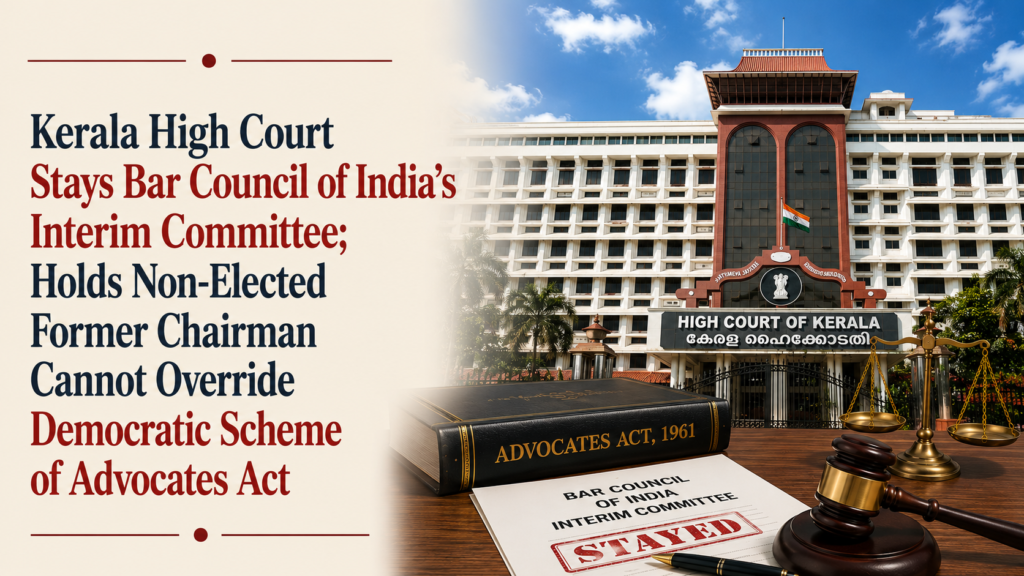
Kerala High Court Holds Bar Council of India Cannot Bypass Elected Members While Constituting Interim Authority
Facts
The petitioners, comprising practising advocates and an elected member of the Bar Council of Kerala (BCK), challenged an order dated 30 June 2026 issued by the Chairman of the Bar Council of India (BCI) constituting a Limited Interim Authority for enrolment and related functions. The principal grievance was the inclusion of the former Chairman of the Bar Council of Kerala, who had neither been elected to the newly constituted Bar Council nor contested the recent elections.
The elections to the Bar Council of Kerala were conducted in April 2026 and the results were published in the Official Gazette on 16 June 2026. Under Section 8 of the Advocates Act, 1961, the tenure of the elected members commenced from the date of publication of the results. Since proceedings relating to co-option of women members were pending before the Supreme Court, the newly elected Council had not held its first meeting and no statutory committees had yet been constituted, necessitating an interim arrangement. Earlier, on 24 June 2026, the BCI had already constituted a Limited Interim Authority comprising the Advocate General of Kerala and two elected members. However, by the subsequent order dated 30 June 2026, the BCI replaced that arrangement by including the former Chairman, giving rise to the present writ petitions.
Issues
- Whether the Bar Council of India could include a non-elected former Chairman in an interim authority after the newly elected Bar Council had assumed office.
- Whether the impugned order dated 30 June 2026 was contrary to Section 8 of the Advocates Act, 1961.
- Whether the impugned order suffered from non-application of mind, particularly in view of the earlier interim authority constituted on 24 June 2026.
- Whether interim protection was warranted pending adjudication of the writ petitions.
Petitioners’ Arguments
The petitioners contended that once the election results were published on 16 June 2026, the tenure of the newly elected members commenced automatically under Section 8 of the Advocates Act, 1961. Consequently, a person who was neither an elected member nor a member of the Bar Council could not lawfully be included in any interim authority exercising statutory functions.
It was further argued that the BCI had already constituted an interim authority through its earlier order dated 24 June 2026, comprising the Advocate General and two elected members. Without superseding or even referring to that earlier order, the BCI subsequently issued the impugned order including the former Chairman. According to the petitioners, this demonstrated complete non-application of mind and violated the democratic structure contemplated by the Advocates Act.
Respondents’ Arguments
The respondents submitted that because the newly elected Bar Council had not yet convened its first meeting and no statutory committees had been constituted, an interim arrangement was necessary to continue enrolment and related functions.
It was also suggested that the former Chairman possessed considerable experience, which justified his inclusion in the interim authority. An additional contention was raised that the Advocate General had expressed inability to act as a signatory, though the Government Pleader clarified that such communication was issued only after the former Chairman had already been included in the interim authority.
Analysis of the Law
The Court examined Section 8 of the Advocates Act, 1961, which expressly provides that the tenure of elected Bar Council members commences from the date of publication of the election results in the Official Gazette.
The Court observed that although the first meeting of the newly elected Council had not yet taken place due to pending proceedings before the Supreme Court, the elected members had already assumed office by operation of law. The necessity of an interim administrative arrangement did not authorise the BCI to disregard the statutory framework by including a person who was no longer a member of the Bar Council.
The Court emphasised that administrative convenience cannot override the democratic scheme established by Parliament under the Advocates Act. Experience of a former office-bearer may certainly be utilised in other appropriate ways, but it cannot justify conferring statutory authority contrary to the legislative framework.
Precedent Analysis
The interim order does not rely upon any judicial precedents. Instead, the Court bases its prima facie conclusions primarily upon the scheme of Section 8 of the Advocates Act, 1961 and the statutory consequences flowing from publication of the election results in the Official Gazette.
Court’s Reasoning
Justice Bechu Kurian Thomas found that the earlier order dated 24 June 2026 had already constituted an interim authority consisting of the Advocate General and two elected members, reflecting a rational statutory arrangement. The subsequent order dated 30 June 2026 neither referred to nor superseded the earlier order and offered no explanation for replacing that arrangement by including a former Chairman who had ceased to be a member of the Bar Council after publication of the election results.
The Court held that the inclusion of a non-elected person in an authority exercising statutory functions prima facie infringed the democratic scheme of the Advocates Act, 1961. While acknowledging the former Chairman’s experience, the Court observed that experience could not substitute statutory legitimacy.
The Court also rejected the argument relating to the Advocate General’s inability to act as signatory, noting that such communication was issued only after the impugned order had already been passed.
Finding prima facie non-application of mind and statutory inconsistency, the Court concluded that interim protection was warranted. It further directed that fresh enrolment certificates be printed because depicting the former Chairman as Chairman of the Enrolment Committee was inconsistent with the statutory scheme.
Conclusion
The Kerala High Court granted an interim stay of the BCI’s order dated 30 June 2026 constituting the Limited Interim Authority.
Pending disposal of the writ petitions, the Court directed that:
- the Advocate General of Kerala, being the ex officio member of the Bar Council, shall function as the Chairman of the Enrolment Committee;
- the Advocate General and the Secretary of the Bar Council shall act as authorised signatories; and
- fresh enrolment certificates be printed without showing the former Chairman as Chairman.
The matter was directed to be listed for further hearing on 14 August 2026.
Case Details
Case: Prasad Chandran & Another v. Bar Council of India & Ors. (Leading Case) along with Yeshwanth Shenoy v. Bar Council of India & Ors.
Court: High Court of Kerala
Case Number: W.P.(C) Nos. 25168 & 26232 of 2026
Judge: Hon’ble Mr. Justice Bechu Kurian Thomas
Date: 31 July 2026
Result: Interim Stay Granted. The Kerala High Court stayed the BCI’s order constituting the interim authority, held that inclusion of a non-elected former Chairman prima facie violated the Advocates Act, and directed the Advocate General to head the Enrolment Committee pending further orders.