


Court’s Decision
The Kerala High Court, in its decision dated November 21, 2024, quashed the prosecution initiated against the petitioner, who was accused of involvement in the unauthorized diversion of kerosene. The court held that the allegations against the petitioner were rooted in the concept of vicarious liability, which is inapplicable in criminal law unless explicitly provided by statute. The proceedings were deemed an abuse of the legal process.
Facts
- Incident: The case arose when police intercepted a tanker lorry transporting kerosene to a paint company in Kozhukully. The kerosene, meant for civil supply distribution, was allegedly being diverted without authorization.
- Initial Accusations: The police arrested two individuals at the scene and registered a crime under Section 7(i)(a)(ii)(c) of the Essential Commodities Act and Section 16 of the Kerala Kerosene Control Order, 1968.
- Petitioner’s Implication: During the investigation, the petitioner, a licensee of the Vizhinjam kerosene depot, was implicated based on allegations of indirect responsibility for the kerosene’s distribution.
- Administrative Background:
- The petitioner was the licensee of the depot after its prior licensee passed away. The depot’s operations, including kerosene distribution, were managed by others, including the relatives of the previous licensee.
- A government order in 2017 (Annexure VI) exonerated the petitioner, concluding he had no active involvement in the alleged diversion.
Issues
- Whether the petitioner could be held vicariously liable for the actions of others at the depot.
- Whether the continuation of the prosecution constituted an abuse of the legal process.
Petitioner’s Arguments
- No Active Role:
- The petitioner argued he had no direct control over the distribution of kerosene at the depot.
- The depot’s management had been transferred to another licensee in 2013.
- Exoneration by Government Order:
- The petitioner relied on a government inquiry (Annexure VI) which concluded that the depot’s staff and the relatives of the previous licensee managed operations.
- The government acknowledged the petitioner’s minimal involvement in the depot’s activities.
- Principle of Vicarious Liability:
- It was contended that criminal law does not recognize vicarious liability unless explicitly stated.
- The petitioner argued that the prosecution’s basis was legally flawed, as there was no evidence of direct involvement or mens rea (criminal intent).
- Abuse of Process:
- The petitioner submitted that the continuation of the case against him, despite clear findings of no involvement, was unjust and an abuse of judicial proceedings.
Respondent’s Arguments
- The prosecution contended that the petitioner’s liability should be decided during the trial and that the allegations merited consideration at this stage.
- The prosecution argued that the evidence presented could substantiate the charges against the petitioner.
Analysis of the Law
- Vicarious Liability in Criminal Law:
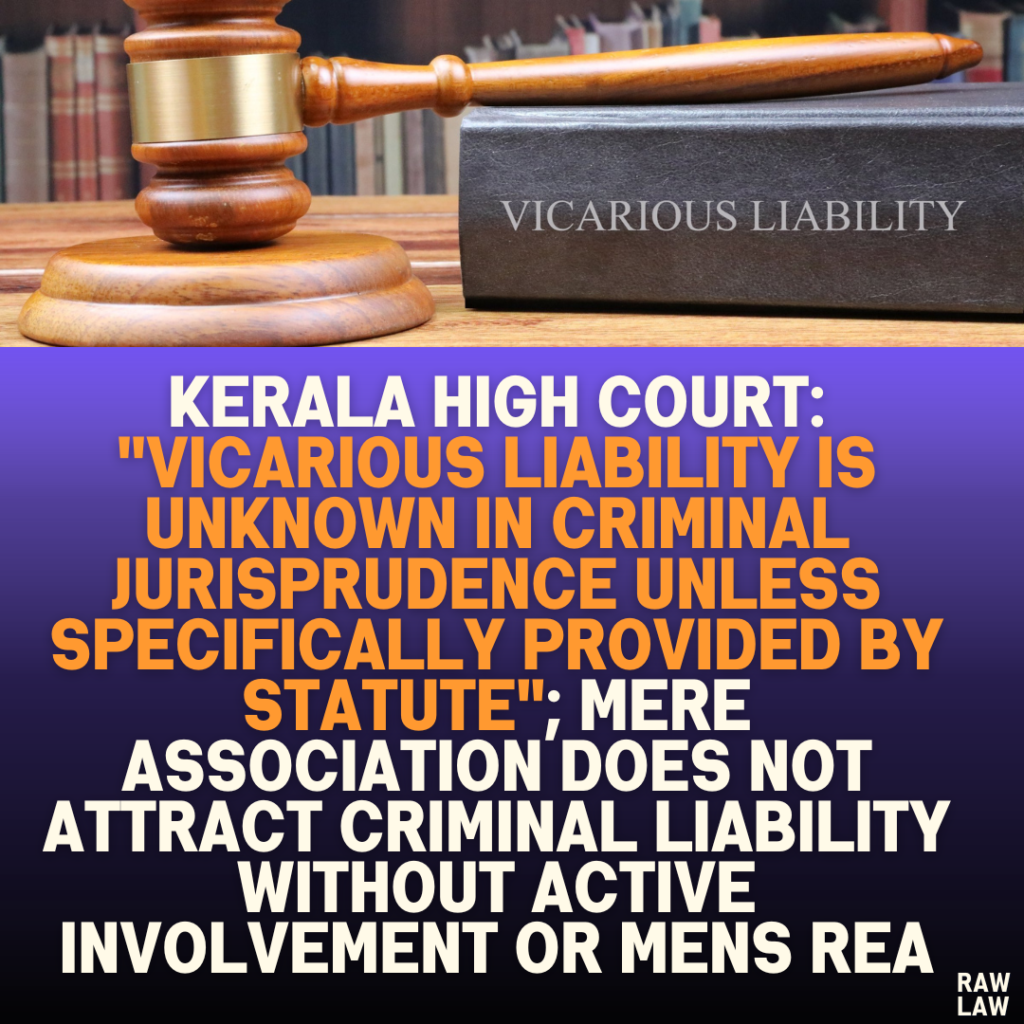
- The court underscored that vicarious liability is unknown in criminal jurisprudence unless specifically provided by statute.
- Mere association with an organization or license does not attract criminal liability without active involvement or mens rea.
- Principles of Criminal Responsibility:
- Direct and substantive evidence is required to implicate individuals in criminal cases.
- Allegations must establish the role of the accused, particularly in cases involving corporate entities or organizations.
Precedent Analysis
The court referred to Ashok Kumaran @ Sabu C. v. State of Kerala [2023 (4) KHC 545], which laid down the following principles:
- No vicarious liability exists in criminal law without express statutory provision.
- Corporate liability extends only to those who actively participate in or have control over the offense.
- Magistrates must ensure prima facie evidence exists against individuals before proceeding with criminal action.
These principles were applied to conclude that the petitioner’s implication lacked the necessary evidence to sustain the charges.
Court’s Reasoning
- Findings of the Government Inquiry:
- The court reviewed Annexure VI, which exonerated the petitioner by confirming he had no direct involvement in the alleged diversion.
- The government found that the depot’s operations were managed by others, absolving the petitioner of responsibility.
- Legal Standards for Prosecution:
- The court highlighted that attributing liability to the petitioner based solely on his licensee status violated fundamental principles of criminal law.
- It emphasized that prosecution based on vicarious liability in the absence of statutory provision was impermissible.
- Abuse of Process:
- The court found that continuing the prosecution against the petitioner, despite clear evidence of his non-involvement, would amount to an abuse of judicial process.
Conclusion
The High Court quashed the criminal proceedings against the petitioner, emphasizing that:
- The decision applies only to the petitioner and not to other accused individuals.
- The trial court may proceed against the other accused without being influenced by this decision.
Implications
- Reinforcement of Legal Principles:
- The judgment reaffirms the principle that criminal liability cannot be imposed without evidence of direct involvement or statutory provision for vicarious liability.
- Safeguard Against Misuse:
- It prevents misuse of criminal law to prosecute individuals without substantive evidence.
- Impact on Similar Cases:
- The ruling sets a precedent for quashing prosecutions where vicarious liability is improperly invoked, ensuring adherence to the principles of criminal justice.