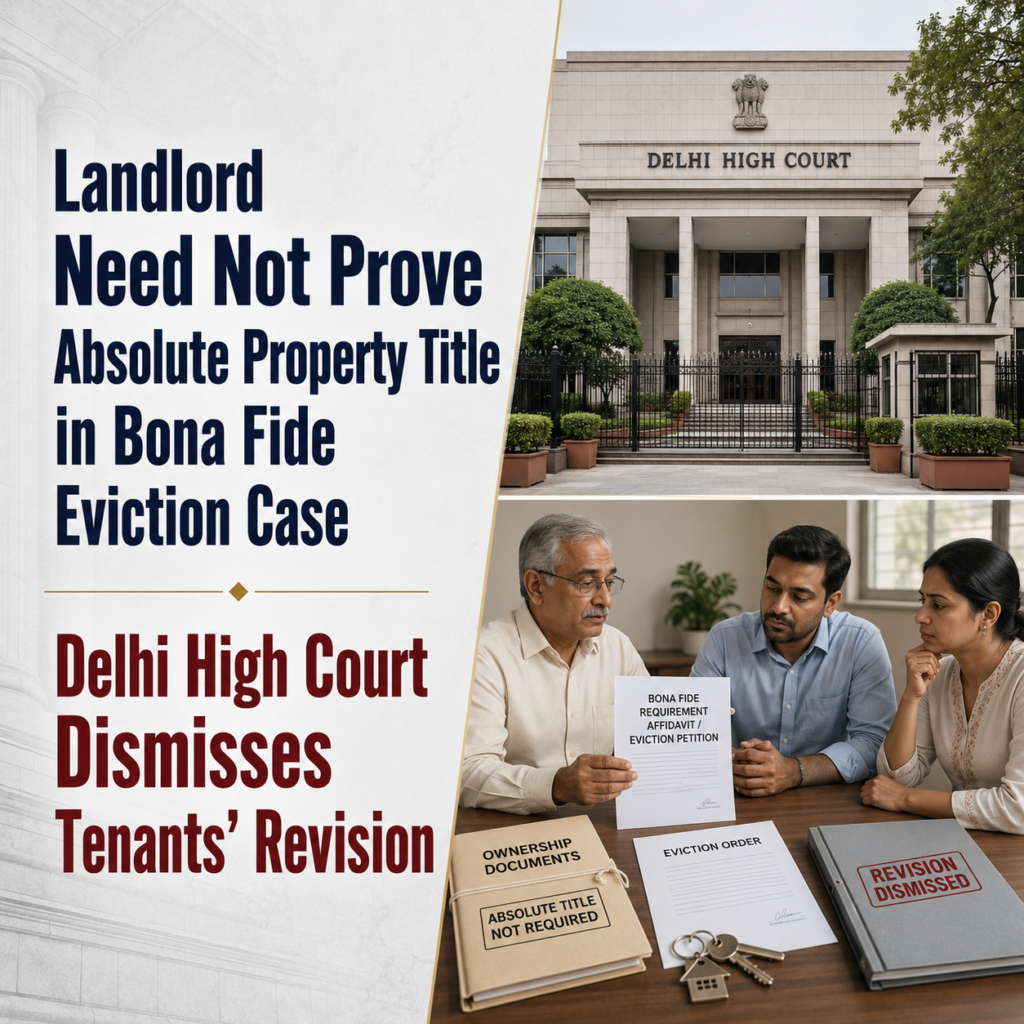
Tenants Claimed Ownership by Adverse Possession and Disputed Landlord’s Will; Delhi High Court Upholds Eviction
Facts
Sanjeev Kumar filed an eviction petition against Rajesh Kumar and another tenant concerning premises bearing No. A, 1893/A, Uday Chand Marg, Kotla Mubarakpur, New Delhi.
The eviction was sought under Section 14(1)(e) of the Delhi Rent Control Act, 1958, on the ground of the landlord’s bona fide requirement.
The landlord asserted that his father, Late Baljeet Singh, had let the property to the tenants’ grandfather. Through a registered Will dated August 22, 2008, Late Baljeet Singh bequeathed the property to his three sons, including Sanjeev Kumar.
One of Sanjeev Kumar’s brothers had already obtained an eviction order against the same tenants concerning other portions of Property No. 1893. In that earlier proceeding, the tenants had admitted that Late Baljeet Singh was the property’s original owner and landlord.
In the present proceedings, however, the tenants disputed Sanjeev Kumar’s ownership and denied having accepted him as their landlord. They claimed that their own grandfather had become the property’s owner through adverse possession and that they subsequently inherited it.
The tenants relied upon an electricity bill in their father’s name and a house-tax receipt. They also alleged that the registered Will relied upon by Sanjeev Kumar was forged.
The tenants further claimed that the landlord possessed several other properties and therefore had reasonably suitable alternative accommodation. However, they did not provide proper particulars of those properties or explain how they were suitable for the landlord’s stated requirement.
They also objected to the maintainability of the eviction petition because the landlord had included a claim for arrears of rent and mesne profits along with the eviction relief. According to them, such a combined petition could not proceed under the summary procedure prescribed by Section 25B.
On November 11, 2025, the Additional Rent Controller rejected the tenants’ application for leave to defend and passed an eviction order.
The Rent Controller found that:
- The landlord had established a title superior to that of the tenants.
- The adverse-possession claim was vague and unsupported.
- The tenants’ earlier admissions contradicted their present denial of the landlord-tenant relationship.
- No reasonably suitable alternative accommodation had been identified.
- No relief concerning arrears or mesne profits would be granted in the summary proceedings.
The tenants challenged this order before the Delhi High Court under Section 25B(8) of the Delhi Rent Control Act.
Issues
- Whether the landlord had sufficiently established ownership for an eviction petition under Section 14(1)(e).
- Whether the tenants’ failure to formally accept or attorn to Sanjeev Kumar defeated the landlord-tenant relationship.
- Whether the tenants’ claim of ownership through their grandfather’s adverse possession raised a genuine triable issue.
- Whether the challenge to the registered Will required grant of leave to defend.
- Whether the landlord possessed reasonably suitable alternative accommodation.
- Whether an eviction petition became non-maintainable because it also contained a claim for arrears of rent or mesne profits.
- Whether the Rent Controller ignored any material evidence or applied an incorrect legal principle.
- Whether the High Court could reappreciate the evidence as if deciding a regular appeal.
Petitioner’s Arguments
The tenants argued that the eviction order could not be sustained because Sanjeev Kumar failed to establish ownership over the tenanted premises.
They submitted that even if he was one of the property’s co-owners, they had never accepted or attorned to him as their landlord.
The tenants claimed that their grandfather had acquired the property through adverse possession. After the deaths of their grandfather and father, ownership allegedly passed to them.
They relied upon an electricity bill in their father’s name and a house-tax receipt to support their claim. They also disputed the registered Will under which Sanjeev Kumar claimed ownership, alleging that it was forged.
The tenants further asserted that the landlord possessed other properties which were sufficient and reasonably suitable for his requirement. Therefore, the essential condition of bona fide need was not satisfied.
They also challenged the eviction petition as a composite proceeding. Since the landlord sought eviction together with arrears of rent and mesne profits, the tenants argued that the summary procedure under Section 25B could not be used.
Accordingly, they sought setting aside of the eviction order and grant of leave to defend.
Respondent’s Arguments
The landlord supported the Rent Controller’s judgment and submitted that every objection raised by the tenants had already been comprehensively considered.
He argued that absolute title need not be established in a rent-control proceeding. It was sufficient to demonstrate a title or legal position superior to that of the tenants.
The registered Will and the tenants’ admissions in the connected eviction proceedings established his status as landlord and owner for the purposes of Section 14(1)(e).
The tenants’ claim of adverse possession was vague. They provided no details about when their grandfather’s possession allegedly became hostile or how the legal requirements of adverse possession were satisfied.
The landlord also argued that the tenants had merely alleged the existence of other properties without identifying them or explaining how they were reasonably suitable for his requirement.
Regarding the additional claim for arrears and mesne profits, the Rent Controller had expressly clarified that no such relief was being granted. Therefore, its inclusion did not invalidate the eviction proceedings.
The landlord maintained that the tenants were seeking a fresh factual examination which was impermissible under the High Court’s limited revisional jurisdiction.
Analysis of the Law
Ownership under Section 14(1)(e)
A landlord seeking eviction under Section 14(1)(e) is not required to establish absolute and flawless title as if litigating a comprehensive title suit.
For rent-control purposes, the landlord must demonstrate that his legal interest in the premises is superior to that of the tenant.
A tenant who denies the landlord’s ownership is ordinarily expected to disclose who the true owner is and produce a credible factual foundation for that assertion.
Landlord-tenant relationship and attornment
A tenant’s refusal to formally recognise or attorn to a successor landlord does not necessarily destroy the relationship where succession or transfer of the landlord’s interest is otherwise established.
Here, the tenants had previously admitted that the respondent’s father was the original owner and landlord. The property was subsequently bequeathed through a registered Will.
The tenants could not avoid eviction merely by refusing to recognise one of the beneficiaries as landlord.
Adverse possession
Adverse possession must be specifically pleaded and established through clear facts. A claimant must ordinarily disclose:
- When possession began.
- When it became hostile to the true owner.
- The nature and continuity of that possession.
- Whether it was open, uninterrupted and to the owner’s knowledge.
- Completion of the legally prescribed period.
A vague claim that a deceased grandfather “used to say” the property belonged to him does not establish adverse possession.
Electricity bills and house-tax receipts may show occupation or payment of charges, but they do not by themselves prove hostile ownership.
Bona fide requirement and alternative accommodation
A tenant may raise a triable issue by identifying premises actually available to the landlord which are reasonably suitable for the stated requirement.
Merely asserting that the landlord owns several other properties is insufficient. Ownership and suitability are different concepts.
The tenant must provide particulars and explain why the alleged premises satisfy the landlord’s need. The tenant cannot dictate how the landlord should rearrange his affairs or adjust himself elsewhere.
Composite claim for eviction and rent arrears
The landlord had included claims for arrears of rent or mesne profits in the eviction petition. However, the Rent Controller expressly declined to grant those monetary reliefs under the summary procedure.
The presence of an additional, non-granted prayer did not invalidate the otherwise maintainable claim for eviction under Section 14(1)(e).
Scope of revision under Section 25B(8)
The High Court’s jurisdiction under Section 25B(8) is supervisory and revisional, not appellate.
The Court may interfere where the Rent Controller’s decision suffers from:
- Jurisdictional error.
- Manifest illegality.
- Material irregularity.
- Perversity.
- An error apparent on the record.
- Failure to consider a material plea.
- Application of an incorrect legal principle.
It cannot conduct a fresh factual inquiry or replace the Rent Controller’s reasonable view merely because another view is possible.
Precedent Analysis
Sarla Ahuja v. United India Insurance Co. Ltd., (1998) 8 SCC 119
The Supreme Court held that when a landlord establishes a prima facie case of personal requirement, the Rent Controller may presume that the need is bona fide.
A tenant cannot dictate how the landlord should adjust himself without recovering possession of the tenanted premises.
The decision also supports the limited nature of revisional interference with rent-control findings.
Hindustan Petroleum Corporation Ltd. v. Dilbahar Singh, (2014) 9 SCC 78
The Supreme Court distinguished revisional jurisdiction from appellate jurisdiction.
Although a revisional court may examine the legality and propriety of a decision, it cannot routinely reassess evidence and substitute its own factual findings.
Abid-Ul-Islam v. Inder Sain Dua, (2022) 6 SCC 30
The Supreme Court explained that the absence of a regular appeal against an order under Section 25B is deliberate.
The High Court exercises superintendence over the decision-making process. It should interfere only where there is an apparent error, procedural illegality or failure of adjudication. A wide-ranging factual inquiry would impermissibly convert the revision into a first appeal.
Pankaj Pahwa v. Prem Wati, 2024:DHC:9322
The Delhi High Court reiterated that scrutiny under Section 25B(8) is limited to the Rent Controller’s decision-making process.
The High Court cannot substitute its view unless the decision contains an apparent error or another recognised revisional defect.
Sanjeev Hiranandani v. Sunny Grover, 2025:DHC:11285
This decision similarly affirms that rent revision is not an opportunity for complete reappreciation of the evidence already examined by the Rent Controller.
Sheela v. Firm Prahlad Rai Prem Prakash
The Supreme Court held that the burden of proving ownership in rent proceedings is lighter than in a title suit. A lesser degree of proof may be sufficient to establish the landlord’s ownership for eviction purposes.
Jiwan Lal v. Gurdial Kaur, 1995 RLR 162
The Delhi High Court observed that tenants frequently deny ownership in proceedings under Section 14(1)(e). To test whether such a denial is genuine, courts may require the tenant to identify the alleged true owner.
An eviction proceeding is not a title suit, and ownership need not be proved in absolute terms.
Shanti Sharma v. Ved Prabha, AIR 1987 SC 2028
The Supreme Court explained that “owner” under rent-control law is understood in relation to the tenant. The landlord must show that his legal position is something more than that of the tenant; absolute title is unnecessary.
Court’s Reasoning
The High Court found that the Rent Controller had expressly examined every objection raised by the tenants.
On ownership, the Rent Controller considered the registered Will dated August 22, 2008, through which Late Baljeet Singh bequeathed the property to his sons.
The tenants had admitted in an earlier connected eviction proceeding that Late Baljeet Singh was the original owner and landlord. One of his other sons had already obtained an eviction order against the same tenants concerning other portions of the property.
Against this record, the tenants’ new assertion that their grandfather owned the property through adverse possession was vague and inconsistent.
The electricity bill and house-tax receipt did not establish ownership. The tenants also provided no material supporting their allegation that the registered Will was forged.
The Rent Controller correctly applied the principle that a landlord need only show a title superior to that of the tenant. No genuine triable issue arose regarding ownership or the landlord-tenant relationship.
The tenants’ alternative-accommodation plea was equally vague. They neither identified the alleged properties nor explained their suitability for the landlord’s requirement. The existence of another property could not automatically be equated with reasonably suitable accommodation.
The maintainability objection also failed. Although monetary relief had been mentioned, the Rent Controller expressly clarified that arrears of rent and mesne profits were not being granted in the summary proceedings.
The High Court found that the Rent Controller’s conclusions were supported by cogent reasons. No material document was ignored, and no incorrect legal principle was applied.
The tenants were essentially seeking another factual appraisal of issues already decided. That exercise was outside the limited jurisdiction under Section 25B(8).
Conclusion
The Delhi High Court held that the tenants failed to raise any genuine triable issue concerning ownership, the landlord-tenant relationship, bona fide requirement or alternative accommodation.
A landlord seeking eviction under Section 14(1)(e) need not prove absolute title. The registered Will, earlier admissions and connected eviction proceedings sufficiently established Sanjeev Kumar’s superior legal interest.
The adverse-possession claim was vague, while the allegation of alternative accommodation lacked particulars. The additional claim for rent arrears did not invalidate the eviction petition because no monetary relief was granted.
Finding no jurisdictional error, manifest illegality, material irregularity or perversity in the Rent Controller’s judgment, the High Court dismissed the revision petition and disposed of the pending applications.
Case Details
Case: Rajesh Kumar and Another v. Sanjeev Kumar
Court: High Court of Delhi at New Delhi
Case Number: Rent Control Revision 121/2026 with CM Applications 23950/2026 and 23951/2026
Judge: Justice Harish Vaidyanathan Shankar
Date: July 17, 2026
Result: Tenants’ revision petition dismissed; eviction order passed on the landlord’s bona fide requirement upheld