


Court’s decision
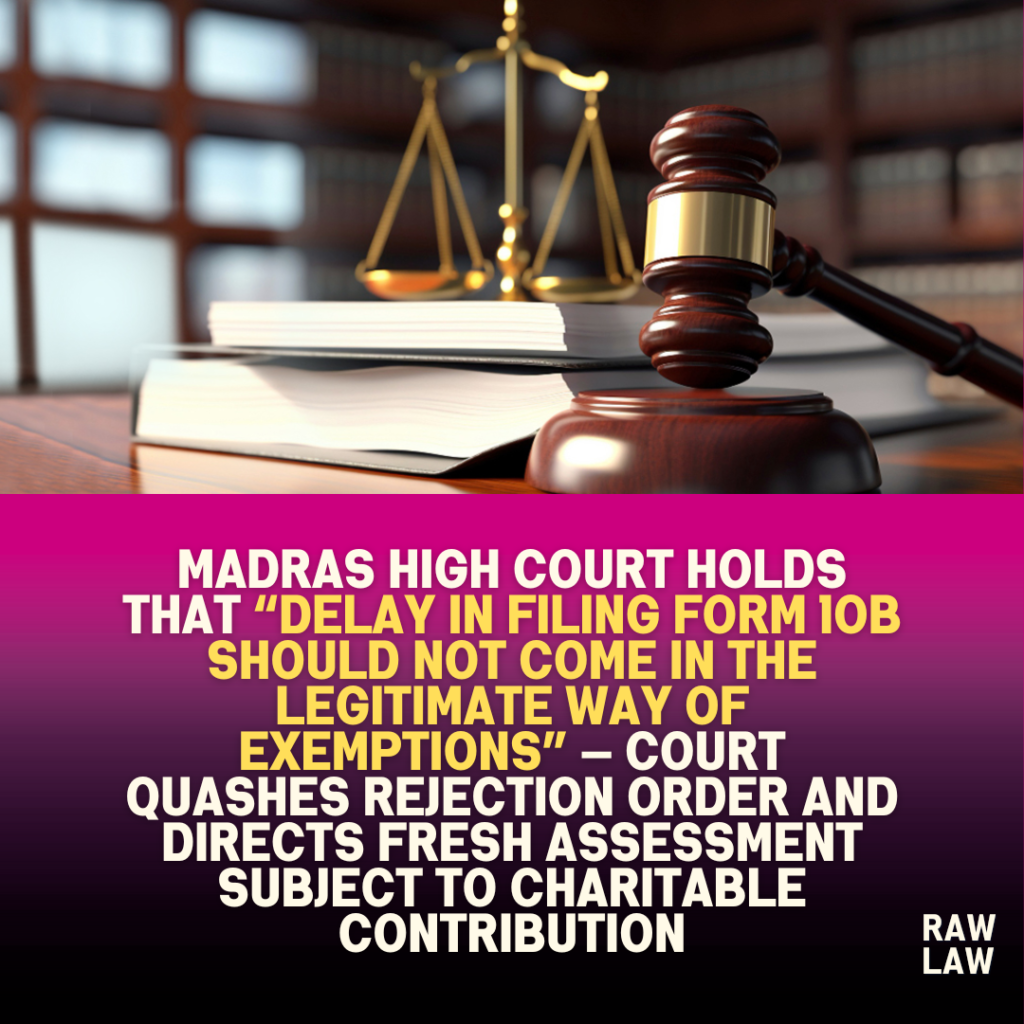
The Madras high court allowed the writ petition and set aside the rejection of the Petitioner’s application for condonation of delay in filing Form 10B. It held that the delay, particularly when occurring in the very first year of the Trust’s operation, should not defeat legitimate statutory exemptions available under the Income Tax Act. After extensively analyzing the reasoning adopted by the Respondent and the judicial precedents cited by both sides, the Court concluded that the Respondent erred in overlooking settled principles that procedural lapses cannot override substantive entitlement.
The Court noted that the Respondent relied mechanically on generic documents sourced from Wikipedia to reject the claim that the “Gaja Cyclone” disrupted statutory compliance. It emphasized that the Income Tax Department must act fairly and cannot deprive an assessee of benefits merely on procedural grounds when the law mandates that exemptions/deductions are to be extended if the assessee is substantively eligible. The Court invoked binding precedents emphasising that procedures are “handmaids of justice” and not tools to deny lawful benefits.
Exercising equitable jurisdiction, the Court allowed the writ petition on the condition that the Petitioner remits ₹25,000 to a charitable organization. Upon such compliance, the impugned order would stand quashed, and the assessing authority was directed to complete assessment in accordance with law. This direction reflects the Court’s balanced approach—correcting an unjust administrative action while encouraging responsible compliance. The Court emphasised that condonation of delay under Section 119(2)(b) must be interpreted liberally when substantive rights are at stake.
Facts
The Petitioner, a charitable trust registered under Section 12A, was required to file its income tax return and Form 10B audit report for the relevant assessment year by the statutory due date of 31 October 2018. The Petitioner filed both documents belatedly, on 31 March 2019, resulting in a delay of 151 days. The Petitioner asserted that the “Gaja Cyclone,” which affected large parts of Tamil Nadu in November 2018, disrupted its operations and led to the delay. After receiving an intimation under Section 143(1), the Petitioner applied to the Respondent authority under Section 119(2)(b) seeking condonation of delay. The Respondent rejected the application, holding that the Petitioner had not shown reasonable cause and that the cyclone occurred after the due date. Aggrieved, the Petitioner approached the High Court seeking certiorarified mandamus relief.
Issues
The principal issues before the Court were whether the Petitioner had demonstrated reasonable cause for delay in filing Form 10B; whether the Respondent applied the correct legal test under Section 119(2)(b); whether procedural lapses should bar a Trust from availing statutory exemptions; and whether the Respondent’s reasoning adhered to binding judicial principles regarding condonation of delay and substantive justice.
Petitioner’s arguments
The Petitioner argued that the Respondent failed to appreciate that the Trust was in its very first year of operation and that the delay was neither intentional nor beneficial to the Petitioner. It contended that the GST-related after-effects of the “Gaja Cyclone” caused severe administrative dislocation, preventing timely filing. The Petitioner emphasised that filing Form 10B is not a tax-avoidance mechanism but a compliance requirement essential for availing exemptions legitimately owing to the charitable nature of the Trust. The Petitioner relied on multiple decisions of the High Court, including those in RBS Students Welfare Trust, Coromondel Cabeles Private Limited, and St. Thomas Charitable Trust, to assert that procedural non-compliance must yield to substantive justice when charitable entities substantively meet statutory criteria.
Respondent’s arguments
The Respondent contended that the Petitioner had not shown any compelling cause for delay and that the cyclone struck only after the statutory due date. The Respondent emphasized that the CBDT’s circular allows condonation only upon demonstration of reasonable cause. It further argued that statutory deadlines must be strictly complied with, especially when audit reports are expected to be prepared and e-filed by qualified professionals. The Respondent relied on several precedents, including decisions in B.U. Bhandari and Lava International, contending that exemptions and compliance conditions must be strictly construed. It was submitted that the Petitioner’s explanation was vague and unsupported by reliable evidence.
Analysis of the law
The Court examined the scope of Section 119(2)(b), which empowers authorities to condone delays to avoid genuine hardship. It emphasized that for charitable trusts, Form 10B plays a crucial role in determining eligibility for exemption, and denial solely due to delay would contradict legislative intent. The Court reiterated that procedural rules cannot defeat substantive rights, citing the Supreme Court’s formulation that rules are “handmaids of justice.” The Court found that the Respondent’s reasoning did not align with this principle and instead fixated on procedural timelines without assessing the broader circumstances. The Court noted that the Petitioner’s first year of operation warranted a more liberal approach, particularly when no revenue loss was caused.
Precedent analysis
The Court referred extensively to binding precedents. It noted that in Coromondel Cabeles Private Limited, the Supreme Court reaffirmed that procedures must serve justice, not hinder it. The Court also relied on Auriya Chambers of Commerce, where the Supreme Court held that procedural rules cannot override substantive entitlements. It cited Formica India Division and Unichem Laboratories to reinforce that authorities must not deny lawful benefits merely to augment revenue. While the Respondent relied on Wipro Limited, the Court distinguished that case on the basis that strict interpretation applies to exemption provisions, whereas condonation under Section 119(2)(b) involves equitable jurisdiction intended to prevent hardship.
Court’s reasoning
The Court reasoned that the Respondent’s approach was mechanical and failed to appreciate that the Petitioner’s explanation was offered in good faith. The Court observed that the delay occurred in the first year of the Trust’s operations, a factor to be considered while evaluating compliance challenges. It stated that even if documents were not filed on time, the law requires authorities to grant all lawful deductions during assessment. The Court held that the Petitioner did not gain any advantage by delaying and that the Respondent’s reliance on Wikipedia excerpts to reject the cyclone explanation was untenable. The Court held that substantive justice demanded condonation, subject to a balancing condition of charity.
Conclusion
The Court concluded that the Petitioner was entitled to condonation of delay and that denial of exemptions solely on procedural grounds was unjust. The impugned order was set aside subject to the Petitioner donating ₹25,000 to a recognised charitable organization. Upon compliance, the Assessing Officer was directed to complete assessment in accordance with law. The Court thus reaffirmed the principle that statutory procedures must yield to equitable justice when substantive tax benefits are lawfully due.
Implications
This judgment significantly reinforces liberal interpretation of Section 119(2)(b) in favour of charitable trusts. It establishes that mechanical rejection of delay condonation, especially in first-year operations, contravenes the equitable principles governing income tax administration. Authorities must evaluate condonation applications holistically rather than purely on procedural timelines. The decision re-affirms that charitable entities cannot be denied exemptions for technical lapses when there is no revenue loss and when statutory entitlements exist. It also warns authorities against relying on generic internet-sourced material for factual findings. Overall, this judgment strengthens the jurisprudence protecting charitable institutions from hyper-technical administrative barriers.