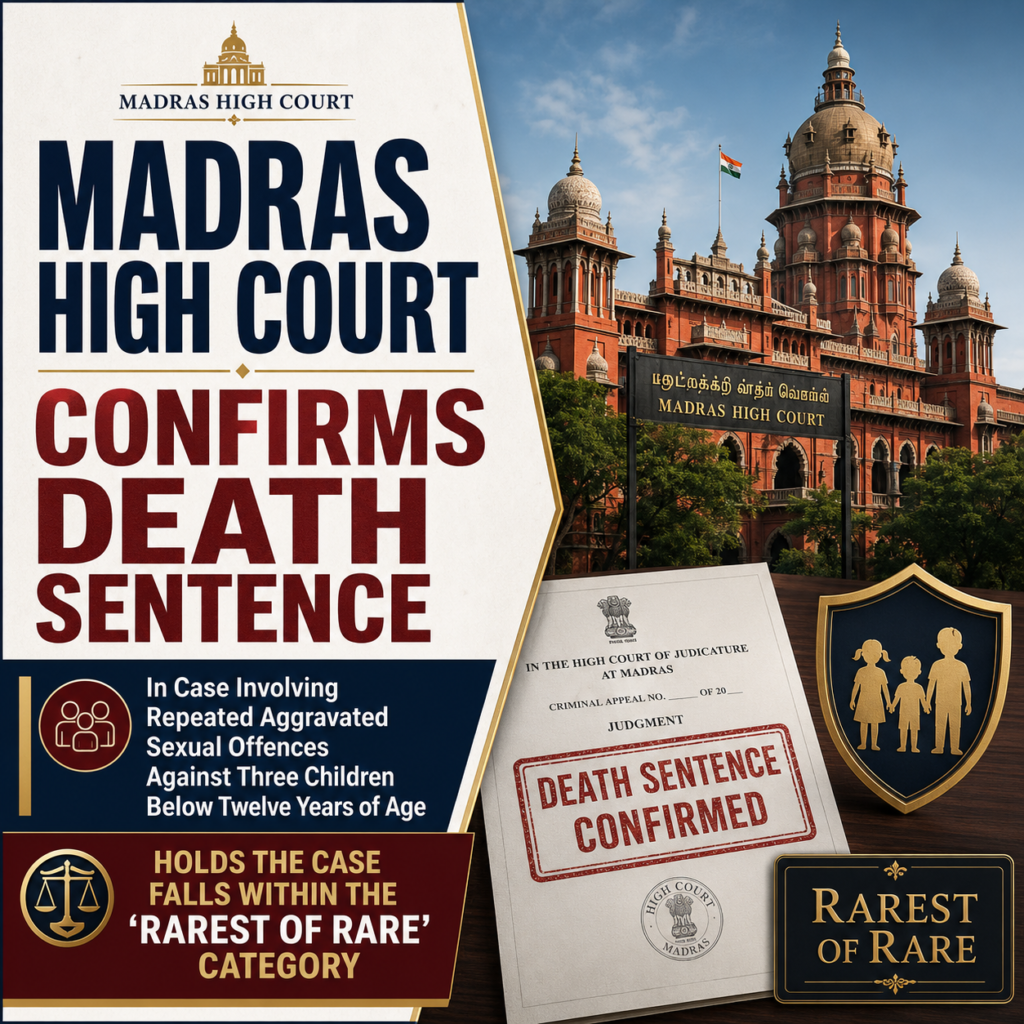
Madras High Court Confirms Death Sentence in POCSO Case Involving Repeated Sexual Abuse of Three Children by a Trusted Neighbour
Facts
The case concerned three minor girls, anonymised by the Court as “X,” “Y” and “Z,” aged approximately six, eight and seven years. The accused was their neighbour and was known to them as a trusted family acquaintance.
The children’s parents were daily-wage workers who generally left home early and returned in the evening. The prosecution alleged that, over approximately one year, the accused repeatedly took the children inside a nearby house, confined them and subjected them to aggravated sexual offences under the Protection of Children from Sexual Offences Act, 2012. He allegedly threatened the children with serious consequences if they disclosed the incidents to their families.
The matter came to light on 26 February 2023 when the mother of one child overheard a conversation between the children. After questioning them, she informed the other families and lodged a police complaint.
Crime No. 7 of 2023 was registered at the All Women Police Station, Palayamkottai. The accused was arrested on 27 February 2023. The children were medically examined, and their statements were recorded before a Magistrate under Section 164(5) of the Code of Criminal Procedure.
The prosecution examined 21 witnesses and produced 42 documents along with material evidence. The accused denied the allegations but did not examine any defence witness or produce any documentary evidence.
The Special Court for POCSO Act cases, Tirunelveli, convicted the accused under:
- Section 450 of the Indian Penal Code;
- Section 366 of the Indian Penal Code on three counts;
- Section 342 of the Indian Penal Code on three counts;
- Section 506(II) of the Indian Penal Code on three counts; and
- Sections 5(l) and 5(m), punishable under Section 6 of the POCSO Act, on three counts.
The Trial Court awarded the death sentence for the POCSO offences and separate terms of imprisonment for the Indian Penal Code offences.
The death sentence was referred to the Madras High Court for confirmation under Section 407 of the Bharatiya Nagarik Suraksha Sanhita, 2023, corresponding to Section 366 of the Code of Criminal Procedure. The accused separately filed an appeal challenging both his conviction and sentence.
Issues
- Whether the testimony of the three child victims was natural, reliable and sufficient to sustain the conviction.
- Whether variations between their statements before the Magistrate and their evidence during trial indicated tutoring or material improvement.
- Whether the delay in disclosure and registration of the complaint weakened the prosecution’s case.
- Whether the delay in forwarding the statements recorded under Section 161 of the Code of Criminal Procedure affected the investigation.
- Whether the absence of conclusive physical findings in the medical reports disproved the aggravated offence charged under the POCSO Act.
- Whether the prosecution had established the foundational facts necessary to invoke the presumptions under Sections 29 and 30 of the POCSO Act.
- Whether the proved acts constituted aggravated penetrative sexual assault under Sections 5(l) and 5(m), or only aggravated sexual assault under Sections 9 and 10 of the POCSO Act.
- Whether the offences under Sections 450, 366, 342 and 506(II) of the Indian Penal Code were independently established.
- Whether the case fell within the “rarest of rare” category warranting confirmation of the death sentence.
Petitioner’s Arguments
The State argued that delayed disclosure is common in cases involving sexual offences against children because of fear, threats, social stigma and the inability of young children to immediately understand or communicate what happened.
The children were only six to eight years old and could not be expected to describe the incidents with the vocabulary, precision or chronological consistency expected from adults. Their evidence had to be assessed from the perspective of children who had undergone repeated abuse and intimidation.
The State submitted that minor variations between the children’s earlier statements and their trial testimony were natural. The central features of their accounts remained consistent:
- the accused was known to them;
- he repeatedly isolated and confined them;
- he committed sexual offences against them; and
- he threatened them against disclosure.
There was no plausible reason for three young children and their families to falsely implicate the accused. The defence had not suggested or proved any motive for such false implication.
The State contended that the prosecution had established the foundational facts, thereby activating the statutory presumptions under Sections 29 and 30 of the POCSO Act. The accused had failed to rebut those presumptions.
It further argued that the statutory definition of penetrative sexual assault under Section 3 of the POCSO Act is broad and is not confined to one particular form of physical act. The absence of visible injuries or conclusive medical findings did not contradict the children’s credible testimony.
On sentence, the State relied upon:
- the age and vulnerability of the three children;
- the repeated nature of the offences;
- the prolonged period over which they occurred;
- the betrayal of the children’s trust;
- the use of threats;
- the confinement of the victims; and
- the serious psychological consequences.
The State therefore sought confirmation of the death sentence.
Respondent’s Arguments
The accused argued that the children’s accounts were unnatural and contained improvements at different stages. According to him, the variations between their statements before the Magistrate and their evidence in Court showed that they had been tutored.
He relied upon the delay in disclosure and contended that the prosecution had not adequately explained why no complaint was lodged earlier despite the alleged conduct continuing for nearly one year.
The accused also relied upon the medical reports, which did not disclose conclusive physical findings establishing the aggravated penetrative offence. It was argued that the prosecution had failed to prove the charge under Sections 5(l), 5(m) and 6 of the POCSO Act.
He further pointed out that the statements recorded under Section 161 of the Code of Criminal Procedure were forwarded to the Court only when the final report was filed. According to him, this created doubt regarding the investigation.
The sentencing procedure was also challenged. The accused submitted that the Trial Court had relied upon the probation officer’s report without adequately supplying or confronting him with its contents and had not conducted a proper sentencing inquiry.
Alternatively, it was argued that the evidence, at its highest, established aggravated sexual assault punishable under Sections 9 and 10 of the POCSO Act and not aggravated penetrative sexual assault punishable under Section 6.
The accused contended that the case did not satisfy the stringent “rarest of rare” test and that imprisonment, including imprisonment for the remainder of his natural life, would adequately serve the ends of justice.
Analysis of the Law
Evidence of child witnesses
The Court held that the testimony of a child cannot be assessed by applying the same standards used for adult witnesses.
A young child may not possess the vocabulary, emotional maturity or understanding required to give a legally precise account. Minor differences in expression, sequence or detail do not necessarily make the evidence unreliable.
The Court must examine whether the child’s narration appears natural and whether the essential allegations remain consistent. It must simultaneously remain alert to the possibility of tutoring.
In the present case, the three children consistently identified the accused and described repeated offences, confinement and threats. The Court found that the fundamental account remained intact despite minor variations.
Alleged tutoring and improvements
The Court acknowledged that there were some differences between the statements recorded under Section 164(5) and the testimony subsequently given during trial.
However, the children had been required to recount the incidents on several occasions before family members, police officers, the Magistrate, prosecutors and the Trial Court. Additional details or differences in language were therefore not unnatural.
The appropriate test was whether the substratum of the allegations remained consistent. The Court found that it did.
Delay in disclosure
The Court rejected the contention that delayed disclosure was fatal to the prosecution.
Children may remain silent because of fear, threats, confusion and their inability to fully understand the conduct. Families may also hesitate to initiate criminal proceedings because of social stigma and the additional trauma of investigation and trial.
The evidence showed that the complaint was lodged promptly after the allegations came to the attention of the child’s mother. The earlier silence was consistent with the threats allegedly made by the accused.
Delay in forwarding witness statements
The investigation was completed and the final report was filed within approximately three months.
The Court held that delay in forwarding statements recorded under Section 161 does not automatically invalidate the prosecution. The decisive question is whether the delay caused prejudice or materially weakened the substantive evidence.
Since the evidence given before the Court was independently found reliable, the procedural objection did not affect the prosecution case.
Presumptions under Sections 29 and 30 of the POCSO Act
The prosecution was first required to prove foundational facts connecting the accused with the offences.
Once those facts were established, Section 29 raised a presumption regarding the commission of the offence, while Section 30 raised a presumption concerning the culpable mental state.
The Court found that the consistent testimony of the children, their identification of the accused and the supporting circumstances established the foundational facts beyond reasonable doubt.
The accused did not rebut the presumptions or provide a credible explanation for the allegations.
Medical evidence
The Court held that medical evidence is relevant but is not invariably conclusive.
The absence of visible injuries or definitive medical findings does not automatically disprove an offence under Section 3 of the POCSO Act. The statutory definition is wider than the conventional understanding of penetration, and certain acts falling within it may not leave lasting physical evidence.
Moreover, a complete internal examination had not been conducted because consent was not given by the children’s mothers.
Credible testimony of a child victim does not require compulsory medical corroboration in every case.
Sections 3, 5 and 6 of the POCSO Act
Section 3 gives penetrative sexual assault an intentionally broad definition. It covers different forms of prohibited conduct and does not require proof of only one conventional form of penetration.
The Court held that the evidence accepted by it satisfied Section 3.
Section 5(l) applies where the offence is committed more than once or repeatedly. Section 5(m) applies where the victim is below 12 years.
Both provisions were attracted because all three victims were below 12 years and the conduct was repeated over an extended period. The offence was consequently punishable under Section 6.
Indian Penal Code offences
The Court separately upheld the convictions under the Indian Penal Code:
- Section 450: The house was entered for the purpose of committing a serious offence.
- Section 366: The children were taken from the place where they were playing for the purpose of committing the offence.
- Section 342: The children were confined inside the house.
- Section 506(II): Serious threats were used to prevent disclosure.
Confirmation of a death sentence
The Court held that a death-reference proceeding is not a routine confirmation exercise.
The High Court must independently reassess the entire evidence, determine whether guilt is established beyond reasonable doubt and separately decide whether the death sentence is legally justified.
The Trial Court’s conclusions are relevant but do not bind the High Court.
Sentencing structure under Section 6
The amended Section 6 of the POCSO Act creates a three-level sentencing framework:
- rigorous imprisonment for a minimum of 20 years;
- imprisonment for life, which may extend to the remainder of the convict’s natural life; and
- death.
The Court recognised that death is not the normal punishment. It is reserved for the most exceptional cases where the alternative sentence is unquestionably inadequate.
Precedent Analysis
Bachan Singh v. State of Punjab
The Constitution Bench held that life imprisonment is the rule and death is the exception. The death penalty may be imposed only in the “rarest of rare” cases where the alternative option is unquestionably foreclosed.
The High Court applied this test while separately considering whether natural-life imprisonment would be sufficient.
Machhi Singh v. State of Punjab
The Supreme Court identified factors relevant to capital sentencing, including the manner of commission, motive, magnitude of the offence and vulnerability of the victim.
The Court considered the repeated and planned nature of the conduct, the number and age of the victims and the misuse of a position of trust.
Masalti v. State of Uttar Pradesh
The Supreme Court held that a death sentence imposed by a Sessions Court is not executable unless confirmed by the High Court.
The High Court must independently examine the evidence and determine whether both conviction and sentence are justified.
State of Tamil Nadu v. Rajendran
This decision reiterated that the High Court must reassess the entire evidence in a death reference and reach an independent conclusion.
The confirmation proceeding serves as an additional safeguard for life and personal liberty.
Manoj v. State of Madhya Pradesh
The Supreme Court emphasised the requirement of a structured sentencing inquiry involving consideration of aggravating and mitigating factors, personal circumstances and the possibility of reformation.
The High Court considered the accused’s age, occupation, family circumstances and possibility of rehabilitation before determining the sentence.
Mohd. Arif v. Supreme Court of India
The Court referred to the cautious approach required in death-penalty cases because of the irreversible nature of the punishment.
Capital punishment cannot be imposed mechanically or merely in response to public outrage.
State v. Murugan
The Madras High Court had examined the three-tier sentencing framework under Section 6 of the POCSO Act and distinguished between:
- cases warranting the minimum term;
- cases requiring imprisonment for the remainder of natural life; and
- the most exceptional cases warranting death.
The same graded approach was applied in the present case.
Bhanei Prasad alias Raju
The Supreme Court had imposed imprisonment for the remainder of natural life in a case involving repeated offences.
The High Court distinguished that outcome because the present case involved three very young victims, prolonged repetition, confinement, threats and betrayal of a relationship of trust.
Madan Gopal Kakkad v. Naval Dubey
The Supreme Court recognised that the sentence must reflect the gravity of the offence where the circumstances demand the strictest lawful response.
The High Court relied upon this principle while confirming the maximum punishment.
Court’s Reasoning
The Court found the evidence of all three children natural, consistent and trustworthy.
Their accounts could not be rejected merely because they used simple language or provided some additional details during trial. The central features of their testimony remained consistent at every stage.
The defence failed to establish any motive for false implication. The circumstances in which the disclosure was made and the evidence of the family members supported the prosecution case.
The Court held that the absence of conclusive medical findings did not contradict the children’s evidence. The statutory definition under Section 3 was broad, and the medical examination conducted was not sufficient to conclusively rule out the offence.
The foundational facts were therefore proved, and the accused failed to rebut the presumptions under Sections 29 and 30 of the POCSO Act.
On sentence, the Court considered the following aggravating circumstances:
- there were three victims;
- all were between six and eight years old;
- the offences were repeated for approximately one year;
- the accused was known and trusted by the children;
- the conduct was planned and systematic;
- the children were isolated and confined;
- serious threats were used to prevent disclosure; and
- the conduct caused grave and continuing psychological harm.
The Court considered the accused’s age, occupation, family responsibilities and potential for reformation as mitigating factors.
It nevertheless held that these factors did not outweigh the exceptional gravity, repetition and circumstances of the offences. The Court concluded that imprisonment for the remainder of natural life would be inadequate and that the case fell within the “rarest of rare” category.
Conclusion
The Madras High Court confirmed the conviction and sentence imposed by the Special Court.
The death sentence for the three counts under Sections 5(l) and 5(m), punishable under Section 6 of the POCSO Act, was confirmed.
The convictions and sentences under Sections 450, 366, 342 and 506(II) of the Indian Penal Code were also upheld.
Accordingly:
- Referred Trial (MD) No. 4 of 2026 was answered by confirming the death sentence;
- Criminal Appeal (MD) No. 616 of 2026 filed by the accused was dismissed;
- the judgment was directed to be immediately communicated to the Trial Court;
- the names of the minor victims were directed to be redacted from the Trial Court records;
- a free copy of the judgment was directed to be supplied to the accused; and
- the prison authorities were directed to provide legal assistance for a further appeal, should the accused choose to pursue one.
Case: State of Tamil Nadu v. Anandhasekar, with Anandhasekar v. State of Tamil Nadu
Court: Madurai Bench of the Madras High Court
Case Number: Referred Trial (MD) No. 4 of 2026 and Criminal Appeal (MD) No. 616 of 2026
Judge: Justice N. Anand Venkatesh and Justice K.K. Ramakrishnan
Date: 30 June 2026
Result: Death sentence confirmed; criminal appeal dismissed; all convictions and sentences under the POCSO Act and the Indian Penal Code upheld.