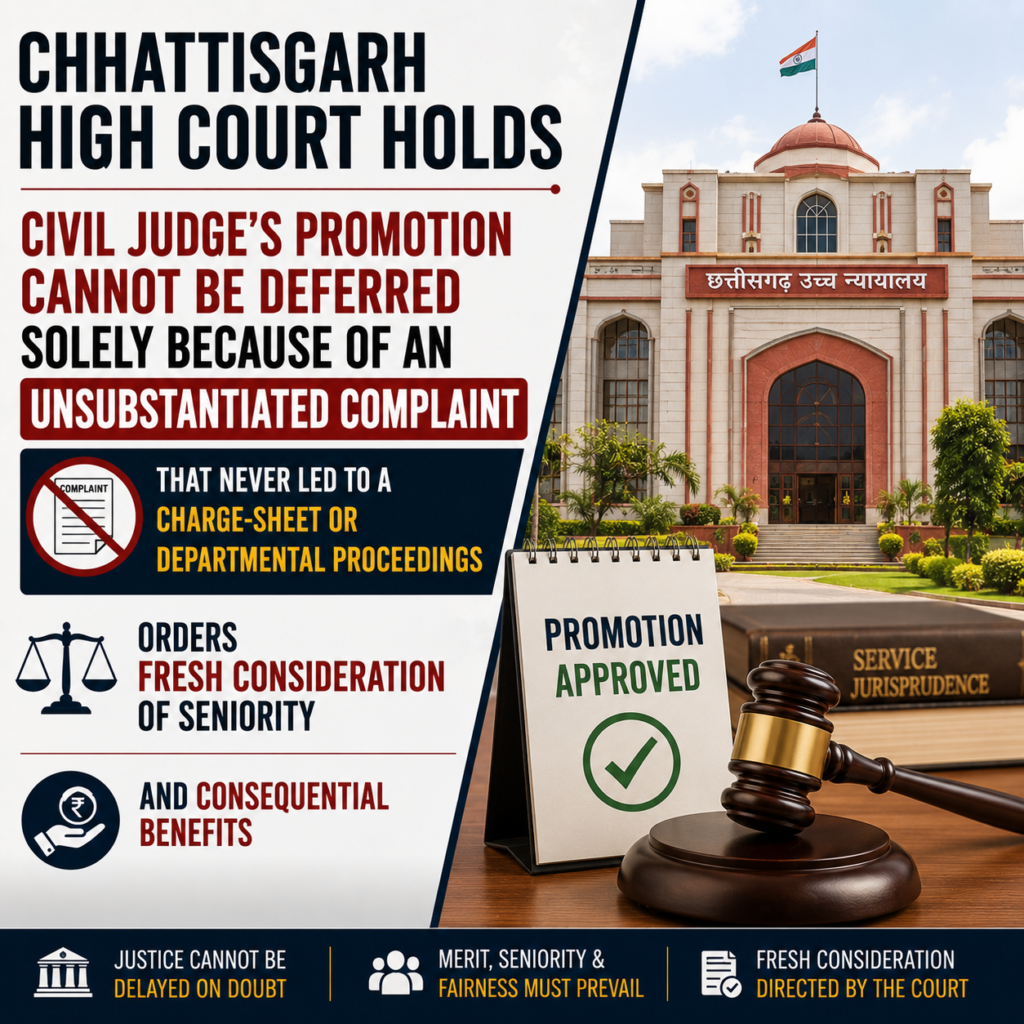
Chhattisgarh High Court Holds Civil Judge’s Promotion Cannot Be Deferred Solely Because of an Unsubstantiated Complaint That Never Led to a Charge-Sheet or Departmental Proceedings, Orders Fresh Consideration of Seniority and Consequential Benefits


Mere Complaint Without Charge-Sheet or Departmental Proceedings Cannot Be Used to Deny Promotion to a Judicial Officer, Chhattisgarh High Court Holds
Facts
The petitioner, Chhaya Singh, was appointed as a Civil Judge Class-II (Junior Division) on 26 December 2008 after securing the 14th position among 60 selected candidates. Her service conditions were governed by the Chhattisgarh Lower Judicial Service (Recruitment and Conditions of Service) Rules, 2006.
She was confirmed in service on 1 September 2012 while retaining her original merit position. After completing the prescribed five years of service, she became eligible for promotion to Civil Judge Class-I (Senior Division) under Rule 5(2), read with Schedule II of the 2006 Rules.
At the relevant time, the petitioner’s Annual Confidential Reports were satisfactory. She had received “C” gradings between 2009-10 and 2012-13 and a “B” grading for 2013-14. No adverse remark or disciplinary proceeding was pending against her.
While the petitioner was posted at Durg, the Superintendent of Police submitted a complaint concerning certain judicial orders passed by her in proceedings under Sections 156(3), 200 and 202 of the Code of Criminal Procedure. The petitioner had directed registration of an FIR against certain officials. She submitted her explanation to the complaint on 4 March 2013.
No departmental enquiry, disciplinary proceeding, charge-sheet, punishment or adverse finding followed the complaint.
On 14 August 2014, 45 officers belonging to the petitioner’s batch were promoted from Civil Judge Class-II to Civil Judge Class-I. Five officers, including the petitioner, were placed in the “deferred” category, while three officers were expressly declared unfit.
The petitioner submitted a representation on 15 April 2015 seeking promotion and consequential benefits. The representation was neither decided nor formally communicated to her.
On 12 August 2016, the petitioner was promoted to Civil Judge Class-I. However, she was not assigned seniority from 14 August 2014, when the other eligible officers of her batch had been promoted.
The petitioner relied upon Rule 12(D) of the Chhattisgarh Civil Services (General Conditions of Service) Rules, 1961, to claim restoration of her original seniority on the ground that her case had only been deferred and she had subsequently been found fit.
She submitted another representation on 9 November 2017 seeking original seniority and consequential benefits. The representation was rejected through a memorandum dated 21 February 2018, which merely stated that her request had been considered and rejected without giving any reasons.
The petitioner was subsequently promoted as Chief Judicial Magistrate on 2 July 2019. However, because her seniority was calculated from the 2016 promotion, she was placed below several batchmates who had already obtained further promotion to the Higher Judicial Service.
The petitioner approached the Chhattisgarh High Court under Article 226 of the Constitution, seeking restoration of seniority from 14 August 2014 and consequential service benefits.
Issues
- Whether the petitioner’s promotion could lawfully be deferred merely because a complaint had been submitted against her when no charge-sheet, departmental enquiry or disciplinary proceeding had been initiated.
- Whether the petitioner’s subsequent promotion in 2016 established that she was otherwise fit and eligible for promotion in 2014.
- Whether the petitioner was entitled to restoration of seniority from 14 August 2014 under Rule 12(D) of the Chhattisgarh Civil Services (General Conditions of Service) Rules, 1961.
- Whether the non-speaking order dated 21 February 2018 rejecting the petitioner’s representation was legally sustainable.
- Whether the writ petition was liable to be dismissed because of delay, laches, acquiescence or waiver.
- Whether granting the petitioner retrospective seniority would unlawfully disturb the settled rights of other judicial officers.
- Whether subsequent adverse Annual Confidential Report gradings could be relied upon to assess the petitioner’s entitlement in the promotion exercise conducted in 2014.
- Whether the petitioner was entitled to consequential consideration for further promotion to the Higher Judicial Service.
Petitioner’s Arguments
The petitioner submitted that she had completed the requisite qualifying service and possessed satisfactory Annual Confidential Reports when the promotion exercise was undertaken in 2014.
She had not been declared unfit by the Departmental Promotion Committee. Her case was merely deferred because of a complaint submitted by the Superintendent of Police concerning judicial orders passed by her in the discharge of her official duties.
Although an explanation was sought and furnished, no departmental enquiry or disciplinary proceeding was initiated. No charge-sheet was issued, and the complaint did not result in any finding of misconduct.
The petitioner argued that the subsequent promotion order dated 12 August 2016 demonstrated that she was fit and suitable for promotion. Her promotion was granted substantially on the basis of the same service profile and Annual Confidential Reports that were available in 2014.
No new favourable material had emerged between 2014 and 2016, nor had any adverse circumstance existing in 2014 ceased to exist. Therefore, there was no lawful justification for permanently denying her the seniority she would have received had her promotion not been deferred.
The petitioner relied upon Rule 12(D) of the 1961 Rules and contended that an officer whose promotion is deferred, but who is subsequently found fit, is entitled to restoration of the original position relative to the officer’s immediate juniors.
She also relied upon an earlier administrative decision dated 17 May 2006, under which similarly situated judicial officers whose promotions had been deferred were allegedly granted restoration of their original seniority.
The denial of the same benefit to her was asserted to be discriminatory and contrary to Articles 14 and 16 of the Constitution.
The petitioner argued that the memorandum dated 21 February 2018 rejecting her representation was a wholly non-speaking order. It disclosed no reason for rejecting a claim that directly affected her seniority, promotional prospects and entire service career.
On delay, she submitted that she had continuously pursued her claim through representations. The denial of seniority continued to affect every subsequent promotion exercise and therefore produced recurring civil consequences.
She further explained that she had initially hesitated to institute proceedings against her own institution because of an apprehension that litigation might adversely affect her future promotional prospects.
The petitioner also submitted that a judicial officer should not be penalised merely because a complaint arose from judicial orders passed in the discharge of official functions. Unless mala fides, corruption or extraneous considerations were established, an adverse service consequence could not be founded merely upon disagreement with a judicial order.
She sought notional promotion from 14 August 2014, restoration of seniority and all consequential benefits, including reconsideration for further promotion on the corrected seniority position.
Respondent’s Arguments
The High Court administration, the State and the private respondents opposed the petition principally on the grounds of delay, acquiescence, waiver and prejudice to settled seniority.
They submitted that the petitioner’s case had been consciously considered by the Departmental Promotion Committee in 2014 and deferred because of the pending complaint.
According to the respondents, the petitioner was not found suitable for promotion in that particular promotion exercise. The fact that no departmental enquiry was later instituted did not automatically invalidate the Departmental Promotion Committee’s decision.
The respondents argued that promotion is not a vested right. An employee is entitled only to consideration for promotion and cannot demand retrospective promotion merely because juniors were promoted earlier.
The petitioner had not challenged the promotion order dated 14 August 2014 when her case was deferred. She thereafter accepted promotion in 2016 and availed herself of all benefits arising from it.
By accepting the subsequent promotion without instituting timely proceedings, she had acquiesced in the seniority position assigned to her and could not reopen the matter nearly nine years later.
The respondents further relied upon the rejection of the petitioner’s representation on 21 February 2018. Since that decision was not separately challenged within a reasonable period, it was argued to have attained finality.
They submitted that repeated representations do not revive a stale cause of action or extend the time for invoking writ jurisdiction.
Any retrospective alteration of seniority would affect the rights of several judicial officers who had received promotions and higher postings on the basis of the existing gradation list. Such rights had crystallised over the years and could not be unsettled through a delayed petition.
Some respondents also objected on the grounds of non-joinder of necessary parties and misjoinder of causes of action.
It was further argued that Rule 12(D) did not create an automatic right to retrospective seniority. Seniority ordinarily follows actual promotion and entry into the promoted cadre, and it could not be granted from a date on which the petitioner had not been promoted.
Analysis of the Law
Right to fair consideration for promotion
The Court recognised that promotion itself is not a vested right. However, an eligible employee possesses a fundamental right to fair and non-arbitrary consideration for promotion under Articles 14 and 16 of the Constitution.
A promotion decision cannot be based on irrelevant, inconclusive or legally impermissible material.
The distinction was therefore between:
- a claim to automatic promotion, which does not ordinarily exist; and
- a right to fair consideration based upon the applicable rules and material lawfully available to the Departmental Promotion Committee.
Effect of a mere complaint
The Court found that the petitioner’s promotion was deferred solely because of a complaint made by the Superintendent of Police.
The complaint never resulted in:
- a charge-sheet;
- a departmental enquiry;
- disciplinary proceedings;
- suspension;
- punishment; or
- an adverse finding of misconduct.
The Departmental Promotion Committee had also not declared the petitioner unfit. It had only deferred her case.
The Court held that deferment on the basis of a preliminary complaint could, at the highest, have been temporary and precautionary. Once the complaint resulted in no adverse action, it ceased to possess legal significance capable of permanently affecting the petitioner’s career.
Sealed-cover and deferred-promotion principles
The Court referred to the principles governing the sealed-cover procedure and held that adverse promotional treatment ordinarily becomes permissible only after formal initiation of disciplinary or criminal proceedings.
A preliminary complaint, enquiry or investigation, before issuance of a charge memorandum or filing of a charge-sheet, is insufficient to indefinitely withhold promotional benefits.
Although the petitioner’s case was described as “deferred” rather than formally placed in a sealed cover, the same underlying principle applied: an employee cannot be made to suffer permanently because of an allegation that never matures into formal proceedings.
Relevance of subsequent promotion
The petitioner was promoted in 2016 on substantially the same service record and Annual Confidential Reports available in 2014.
The respondents did not identify:
- any new favourable circumstance arising after 2014;
- any adverse circumstance that ceased to exist before 2016; or
- any material on which the petitioner had been found unsuitable in 2014.
The Court therefore inferred that she was otherwise fit and eligible in 2014 and that the only obstacle was the inconclusive complaint.
Her eventual promotion materially weakened the respondents’ assertion that she was unsuitable during the earlier exercise.
Requirement of a reasoned decision
The memorandum dated 21 February 2018 merely recorded that the petitioner’s request had been considered and rejected.
The Court held that reasons are the “heartbeat” of administrative and quasi-judicial decision-making. They ensure:
- transparency;
- application of mind;
- accountability;
- fairness; and
- effective judicial review.
A decision affecting seniority and promotional prospects could not be sustained when it contained no reasons explaining why the claim had been rejected.
Delay and continuing consequences
The Court accepted that delay and laches are relevant considerations in proceedings under Article 226. A court may refuse relief where a claimant remains inactive for an unreasonable period and third-party rights have crystallised.
However, delay is not applied as an inflexible or purely technical rule.
The petitioner’s loss of seniority continued to affect her eligibility and position in every subsequent promotion exercise. The grievance therefore had recurring service consequences.
The Court considered that the petitioner remained in service and continued to experience prejudice in relation to future promotions. In those circumstances, the claim could not be rejected solely on a mechanical application of delay and laches.
Relevant date for assessment
The petitioner’s entitlement in the 2014 promotion exercise had to be determined on the basis of her eligibility, Annual Confidential Reports and service material existing at that time.
Adverse gradings recorded in subsequent years could not retrospectively justify deferment in 2014.
Later service material might be relevant to later promotion exercises, but it could not be used to validate an earlier decision retrospectively.
Judicial independence
The Court also recognised that complaints against judicial officers arising from orders passed in judicial proceedings require careful scrutiny.
A judicial officer cannot be subjected to adverse disciplinary or service consequences merely because an order is considered incorrect. Some material indicating mala fides, dishonesty or extraneous considerations is ordinarily required before judicial decision-making can form the foundation of disciplinary action.
Precedent Analysis
Major General H.M. Singh v. Union of India
The Supreme Court held that an eligible officer has a fundamental right to be considered for promotion and, if found suitable, to be promoted against an available vacancy.
The Chhattisgarh High Court relied upon this decision to hold that arbitrary denial or non-consideration affects the guarantees of equality under Articles 14 and 16.
Union of India v. K.V. Jankiraman
The Supreme Court held that disciplinary or criminal proceedings are treated as initiated for promotional purposes only when a charge memorandum is issued in departmental proceedings or a charge-sheet is filed in a criminal prosecution.
A preliminary investigation or mere pendency of allegations is insufficient to invoke the sealed-cover procedure.
The Court applied this principle because no charge memorandum, disciplinary proceeding or criminal charge-sheet existed against the petitioner when her promotion was deferred.
Union of India v. Doly Loyi
The Supreme Court reiterated that mere investigation or sanction for prosecution does not amount to the commencement of criminal prosecution for adopting the sealed-cover procedure.
The decision reinforced the conclusion that an unconverted complaint could not indefinitely obstruct the petitioner’s promotion.
Union of India v. Sangram Keshari Nayak
The Supreme Court held that where no charge-sheet or disciplinary proceeding was pending when the Departmental Promotion Committee met, the employee’s promotion could not be withheld by relying upon subsequent events.
The Court applied the same principle to the petitioner’s case, where no formal proceeding existed during the 2014 promotion exercise.
Kanvar Lal Yadav v. State of Madhya Pradesh
The Madhya Pradesh High Court held that a deferred Departmental Promotion Committee exercise relates back to the original date and an employee cannot be prejudiced because of administrative lapses or material that did not legally justify withholding promotion.
This supported the proposition that deferment should not permanently alter an employee’s seniority when the original impediment proves inconsequential.
S.N. Mukherjee v. Union of India
The Constitution Bench held that administrative and quasi-judicial authorities must ordinarily record reasons for their decisions.
Reasons demonstrate due consideration, minimise arbitrariness and permit effective judicial review.
The Chhattisgarh High Court applied this principle to hold that the 2018 memorandum rejecting the petitioner’s representation was unsustainable because it contained no reasons.
P.N. Premachandran v. State of Kerala
The Supreme Court held that an employee should not be prejudiced because of negligence, inaction or procedural lapses attributable to the employer.
The Court relied upon this principle to hold that the petitioner could not permanently lose seniority because the administration had deferred her case on the basis of a complaint that was never taken to its logical conclusion.
Krishna Prasad Verma v. State of Bihar
The Supreme Court emphasised that judicial independence is a basic constitutional feature and that an incorrect judicial order does not by itself constitute misconduct.
The decision was relevant because the complaint against the petitioner arose from judicial orders passed by her, and no mala fide or extraneous consideration was established.
Ajit Singh (II) v. State of Punjab
The Supreme Court recognised that fair consideration for promotion and seniority rights are connected with the equality guarantees under Articles 14 and 16.
The Court relied upon this principle in examining whether the petitioner’s supersession was arbitrary.
State of Kerala v. E.K. Bhaskaran Pillai
The Supreme Court held that where an employee is wrongly denied promotion because of arbitrary or illegal administrative action, notional promotion and consequential service benefits may be granted.
The Court treated this as supporting reconsideration of the petitioner’s entitlement from the date her batchmates were promoted.
Delay and laches authorities
The respondents relied upon decisions including P.S. Sadasivaswamy v. State of Tamil Nadu, State of Uttaranchal v. Shiv Charan Singh Bhandari, K.R. Mudgal v. R.P. Singh and Union of India v. N. Murugesan to contend that belated seniority claims should not be entertained.
The Court accepted the general principle but held that delay had to be examined equitably in the factual context. The petitioner remained in service, and the disputed seniority continued to affect her in successive promotion exercises.
Court’s Reasoning
The Court found that the petitioner satisfied the prescribed eligibility conditions when the promotion exercise was conducted in 2014.
Her service record was satisfactory, and she was not declared unfit. Her case was merely deferred because of a complaint.
After the petitioner submitted her explanation, no enquiry, charge-sheet, disciplinary action, punishment or adverse finding followed. The complaint therefore remained an unsubstantiated preliminary allegation.
When the petitioner was promoted in 2016, the administration relied upon substantially the same service record available in 2014. No material was placed before the Court to show what had changed between the two promotion exercises.
The subsequent promotion therefore indicated that the petitioner was otherwise fit and suitable when her batchmates had been promoted.
The Court held that an inconclusive complaint could not be allowed to permanently alter the petitioner’s seniority and promotional prospects.
It also rejected the respondents’ reliance upon the 2018 rejection of her representation. Since the communication contained no reasons, it did not constitute a legally sustainable determination of her valuable service rights.
The Court did not itself issue an unconditional declaration granting promotion or seniority from 14 August 2014. Instead, it directed the competent authority to reconsider the petitioner’s case in light of the Court’s findings.
The authority was required to determine whether any genuine legal impediment existed. In the absence of such an impediment, the petitioner was to receive the consequential benefits, including proper fixation of seniority.
Conclusion
The Chhattisgarh High Court allowed the writ petition.
Respondent Nos. 1 to 3 were directed to consider the petitioner’s case for promotion to Civil Judge Class-I (Senior Division) with effect from 14 August 2014, the date on which the other eligible officers of her batch were promoted.
The respondents were also directed to examine her claim for:
- restoration of seniority;
- consequential service benefits; and
- fixation of seniority under the applicable service rules.
The competent authority was directed to determine whether any legal impediment existed that would disentitle the petitioner from receiving the benefits.
In the absence of such an impediment, appropriate orders granting all consequential benefits were required to be passed.
The entire exercise was directed to be completed through a reasoned and speaking order within three months from receipt of a certified copy of the judgment.
No order as to costs was passed.
Case: Smt. Chhaya Singh v. Hon’ble High Court of Chhattisgarh and Others
Court: High Court of Chhattisgarh at Bilaspur
Case Number: Writ Petition (Service) No. 7379 of 2023
Judge: Justice Amitendra Kishore Prasad
Date: 29 June 2026
Result: Writ petition allowed; competent authority directed to reconsider the petitioner’s promotion from 14 August 2014, restoration of seniority and consequential service benefits, and to pass a reasoned order within three months.