


1. Court’s decision
The Madras High Court disposed of a criminal original petition filed by an individual alleging harassment by the police.
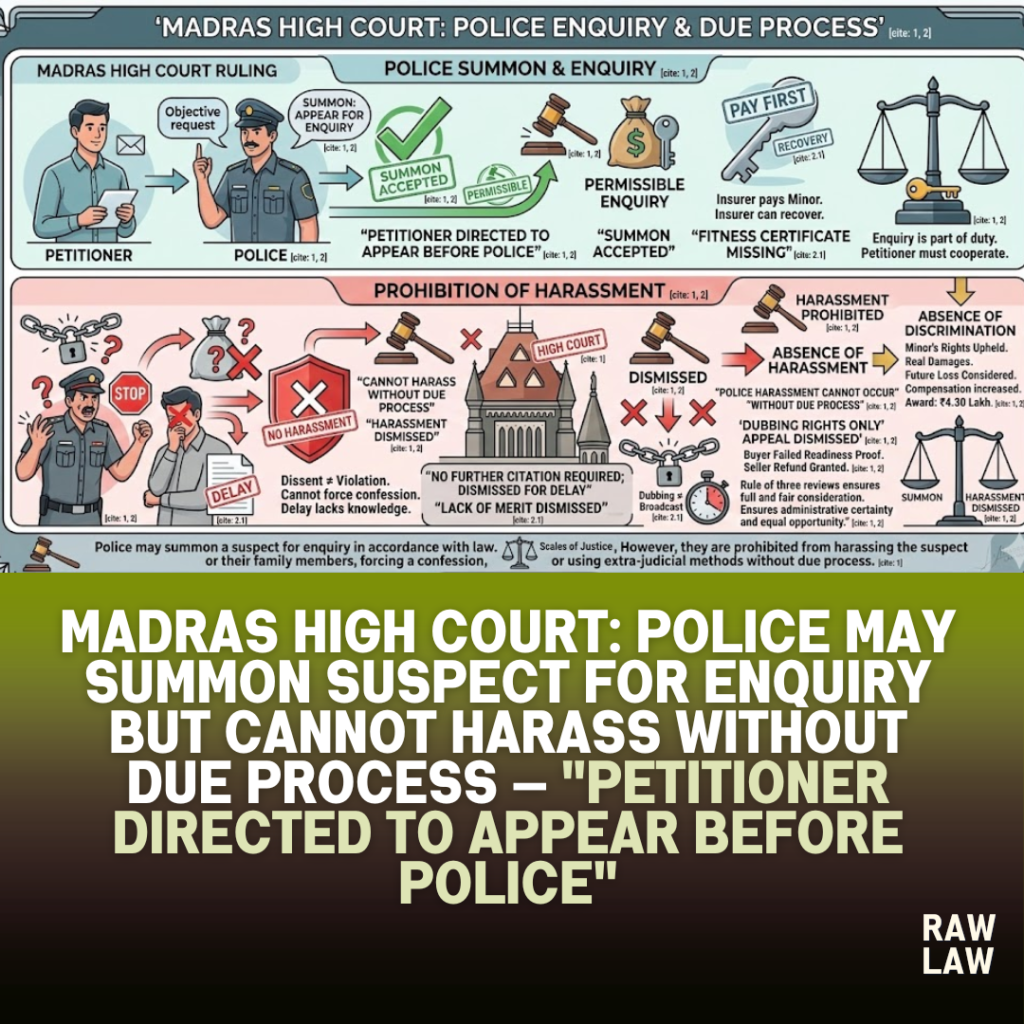
The Court directed the petitioner to appear before the concerned police officer on a specified date and provide his explanation during the enquiry.
The Bench clarified that the police may proceed in accordance with law if the petitioner fails to appear or cooperate with the investigation.
2. Facts
The petitioner approached the High Court seeking a direction to the police not to harass him or his family members without following due process of law.
According to the petitioner, he had submitted a representation dated 25 February 2026 to the Commissioner of Police complaining about alleged harassment by the police.
The representation was forwarded to the concerned police station for appropriate action. However, the petitioner alleged that no response was received and apprehended possible harassment by the police authorities.
Consequently, he filed the present petition seeking judicial intervention.
3. Issues
The High Court examined whether the petitioner was entitled to protection from alleged police harassment and whether directions were required to regulate the conduct of the police during the enquiry.
The Court also considered whether the petitioner should cooperate with the police investigation by appearing before them and providing his explanation.
4. Petitioner’s arguments
The petitioner argued that despite submitting a representation to the Commissioner of Police seeking protection from harassment, no action had been taken by the authorities.
He submitted that he was willing to cooperate with the police and appear before them whenever required for enquiry.
The petitioner therefore requested the Court to direct the police not to harass him or his family members and to ensure that any investigation or enquiry was conducted strictly in accordance with law.
5. Respondent’s arguments
The State opposed the petition and placed certain information before the Court regarding the petitioner’s alleged involvement in criminal activities.
According to police records, the petitioner was described as a habitual offender with multiple criminal cases registered against him.
The authorities also indicated that the petitioner had been placed under surveillance due to intelligence inputs suggesting that he might be involved in planning retaliatory violence connected to an earlier murder case.
6. Analysis of the law
The Court analysed the scope of judicial intervention in matters relating to police enquiry and investigation.
It noted that while individuals are entitled to protection against harassment and illegal action by police authorities, courts must also ensure that legitimate investigations are not obstructed.
Therefore, courts generally strike a balance by directing individuals to cooperate with police enquiries while simultaneously requiring the police to follow due process of law.
7. Precedent analysis
Although the order was brief and procedural in nature, the Court relied on established legal principles governing police investigation and judicial oversight.
Courts have consistently held that police authorities are empowered to conduct enquiries and investigations into suspected criminal activity.
At the same time, such powers must be exercised within the framework of law and cannot result in unlawful harassment of individuals.
8. Court’s reasoning
The Court observed that the petitioner had already sent a representation to the Commissioner of Police and that the matter had been forwarded to the concerned police officer for action.
During the hearing, the petitioner expressed his willingness to appear before the police and cooperate with the enquiry.
Considering these circumstances, the Court directed the petitioner to appear before the police on 12 March 2026 and provide his explanation if required.
The Court also noted the petitioner’s undertaking that he would not indulge in any criminal activities affecting public peace and tranquillity.
9. Conclusion
The High Court disposed of the criminal original petition with directions to the petitioner to appear before the police and cooperate with the enquiry.
The Court clarified that if the petitioner failed to appear on the specified date, the police authorities would be at liberty to initiate appropriate action in accordance with law.
10. Implications
The ruling reflects the judiciary’s balanced approach when dealing with petitions alleging police harassment.
While courts safeguard individuals from unlawful police conduct, they also ensure that investigative authorities are not hindered from performing their duties.
The judgment reiterates that cooperation with lawful police enquiries is essential, particularly where allegations of serious criminal activity are under investigation.
Case Law References
The order primarily addressed procedural issues relating to police enquiry and did not rely on detailed case law precedents. It reaffirmed general principles governing lawful police investigation and judicial oversight.
FAQs
1. Can someone approach the High Court if they fear police harassment?
Yes. Individuals can file petitions before High Courts seeking protection against unlawful police harassment or directions ensuring due process.
2. Can courts direct a person to appear before police for enquiry?
Yes. Courts often direct individuals to cooperate with police investigations while ensuring that the enquiry is conducted lawfully.
3. What happens if a person fails to appear before police despite court directions?
If a person fails to comply with court directions to appear before the police, authorities may take appropriate legal action in accordance with law.