


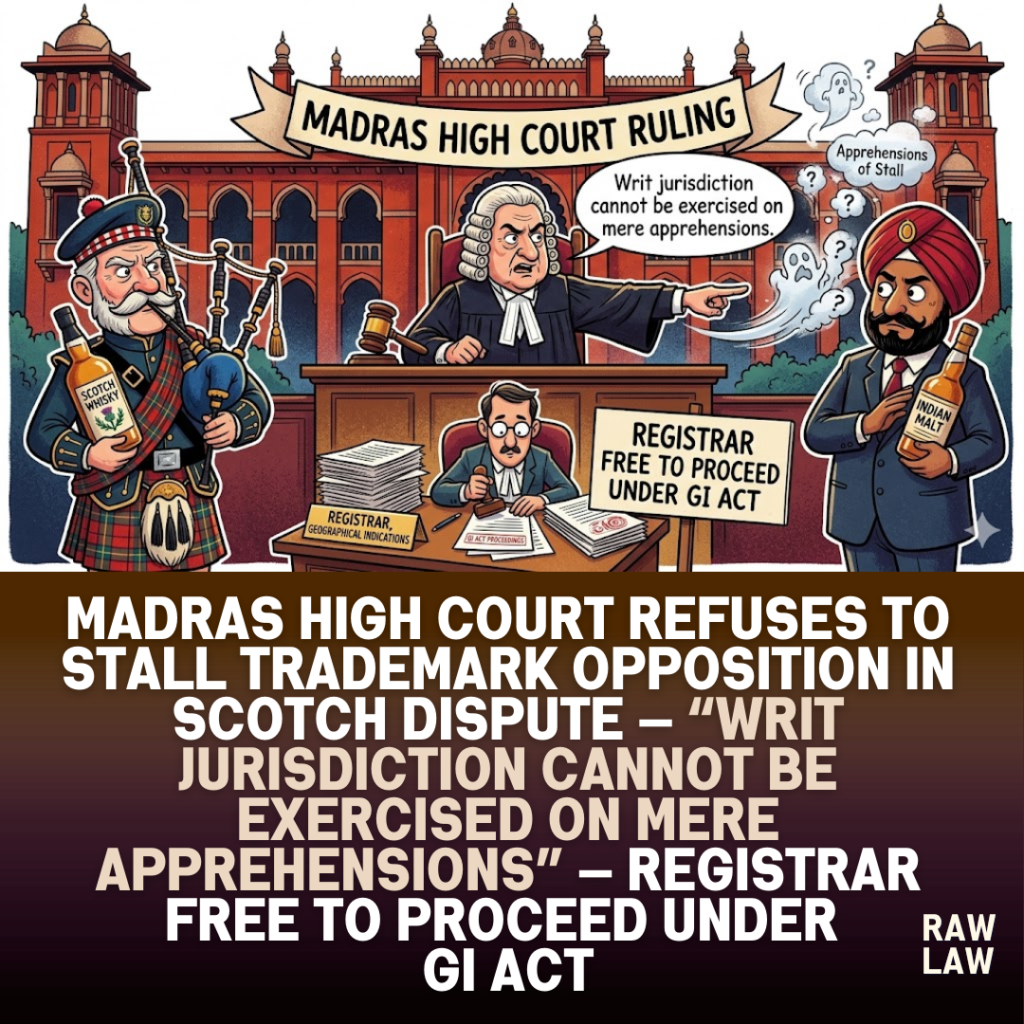
Court’s decision
The Madras High Court dismissed a batch of writ petitions filed by The Scotch Whisky Association seeking a direction to the Registrar of Trade Marks to adjourn trademark opposition proceedings sine die, pending adjudication of a long-pending commercial IP suit before the Bombay High Court.
Holding that writ jurisdiction under Article 226 cannot be invoked on speculative apprehensions, the Court refused to pre-empt the statutory authority from discharging its functions. It clarified that the Registrar is presumed to act strictly in accordance with the Geographical Indications of Goods (Registration and Protection) Act, 1999 and the Trade Marks Act.
Facts
The Scotch Whisky Association, based in Scotland, had filed oppositions against four trademark applications (two word marks and two label marks) filed by Khoday India Limited in 1998–1999.
These oppositions (MAS-737983, MAS-721701, MAS-721066 and MAS-108630) had remained pending before the Trade Marks Registry since 2018, with annual adjournments being granted awaiting the outcome of Commercial IP Suit No. 296 of 2021 (originally filed in 1987) pending before the Bombay High Court.
The petitioner sought two reliefs:
- A writ of mandamus directing the Registrar to adjourn the opposition proceedings sine die until the Bombay High Court delivers its final judgment; and
- Consolidation of the oppositions for joint adjudication.
The suit before the Bombay High Court was stated to be at the stage of defendant’s evidence.
Issues
The Court framed the following core issues:
- Whether the High Court can direct the Registrar of Trade Marks to adjourn opposition proceedings indefinitely pending adjudication of a civil suit before another High Court.
- Whether writ jurisdiction under Article 226 can be exercised on the basis of apprehension that the Registrar may decide the oppositions contrary to the petitioner’s interest.
- Whether the Registrar is bound to keep his hands off opposition proceedings when a related civil suit is pending.
Petitioner’s arguments
The petitioner relied on Whirlpool Corporation v. Registrar of Trade Marks to argue that where proceedings are pending before a civil court, the Registrar must refrain from deciding related issues.
It was contended that substantive issues between the parties are sub judice before the Bombay High Court and therefore, the Registrar ought not to adjudicate the oppositions.
The petitioner also attempted to distinguish the Supreme Court’s earlier ruling in Khoday Distilleries Limited v. Scotch Whisky Association (2008) 10 SCC 723, arguing that the Apex Court had not decided the matter on merits but had applied the “Bollinger test.”
According to the petitioner, the Bombay High Court is now examining the substantive merits and therefore administrative adjudication should await that outcome.
Respondents’ arguments
The second respondent relied on the Supreme Court’s judgment in Khoday Distilleries Limited v. Scotch Whisky Association, where the earlier round of litigation between the parties culminated in interference with orders passed by the Madras High Court.
The respondents contended that the Registrar had not yet taken any decision adverse to the petitioner and had merely adjourned the matter repeatedly.
It was argued that the writ petitions were premature and founded only on apprehensions, not on any concrete action by the Registrar.
Analysis of the law
The Court emphasized that writ jurisdiction under Article 226 is discretionary and cannot be invoked on speculative grounds.
It observed that the Registrar had adjourned the opposition proceedings annually since 2018, effectively keeping the matter pending for eight years.
The Court declined to presume that the Registrar would act contrary to law. It noted that if and when the Registrar adjudicates the oppositions, he is bound to apply the provisions of the Geographical Indications of Goods (Registration and Protection) Act, 1999, including statutory prohibitions against registration of geographical indications as trademarks.
The Court rejected the argument that mere pendency of a civil suit automatically bars the Registrar from exercising statutory functions.
Precedent analysis
The Court considered Whirlpool Corporation v. Registrar of Trade Marks (1998) 8 SCC 1, which dealt with Section 56 of the old Trade and Merchandise Marks Act. It distinguished that decision, noting that the present case involved mere apprehension without any parallel adjudicatory conflict.
The Court also referred to Khoday Distilleries Limited v. Scotch Whisky Association (2008) 10 SCC 723, recognizing that the Supreme Court had previously intervened in litigation between the same parties.
However, it declined to enter into merits or revisit that judgment, holding that such substantive issues are for statutory authorities or civil courts to decide.
Court’s reasoning
The Court held that the writ petitions were based purely on apprehension that the Registrar might proceed with the opposition hearings.
Since no adverse order had been passed and the Registrar had, in fact, deferred adjudication for nearly eight years, there was no cause for pre-emptive judicial intervention.
The Court emphasized that it cannot assume that the Registrar will disregard the Geographical Indications Act or fail to consider the petitioner’s objections.
Pre-emptive restraint of statutory authority, in the absence of demonstrable illegality, would amount to unwarranted interference.
The Court therefore declined to exercise discretionary jurisdiction under Article 226.
Conclusion
The Madras High Court disposed of the writ petitions, declining to direct sine die adjournment or consolidation of opposition proceedings.
It clarified that the Registrar of Trade Marks must act strictly in accordance with law and statutory provisions.
The decision reinforces judicial reluctance to intervene in administrative trademark proceedings absent concrete action or illegality.
Implications
This ruling carries significant implications for intellectual property litigation in India:
- Pendency of civil suits does not automatically freeze trademark opposition proceedings.
- Writ jurisdiction cannot be invoked on mere apprehension of adverse action.
- The Registrar’s statutory autonomy in adjudicating oppositions is preserved.
- Geographical Indications protection must be considered within statutory framework, not through pre-emptive writ control.
The judgment underscores the principle that administrative adjudication and civil litigation can proceed within their respective statutory spheres unless direct conflict is established.
Case Law References
- Khoday Distilleries Limited v. Scotch Whisky Association (2008) 10 SCC 723
Supreme Court decision in earlier litigation between the same parties; interference with Madras High Court order applying the Bollinger test. - Whirlpool Corporation v. Registrar of Trade Marks (1998) 8 SCC 1
Held that Registrar must refrain from parallel adjudication in certain circumstances under the old Act; distinguished in present case.
FAQs
1. Can trademark opposition proceedings be stayed because a civil suit is pending?
Not automatically. Courts will not pre-empt statutory authorities unless clear legal conflict or illegality is demonstrated.
2. What is sine die adjournment?
It means postponement without a fixed future date. Courts are cautious in directing indefinite adjournments of statutory proceedings.3. Can High Courts intervene before the Registrar passes an order?
Generally no. Writ jurisdiction is discretionary and not exercised on mere apprehension