


1. Court’s decision
A Division Bench of the Madras High Court allowed an Original Side Appeal challenging the dismissal of a trademark infringement suit concerning a Siddha medicinal product marketed under the mark “777 Oil”.
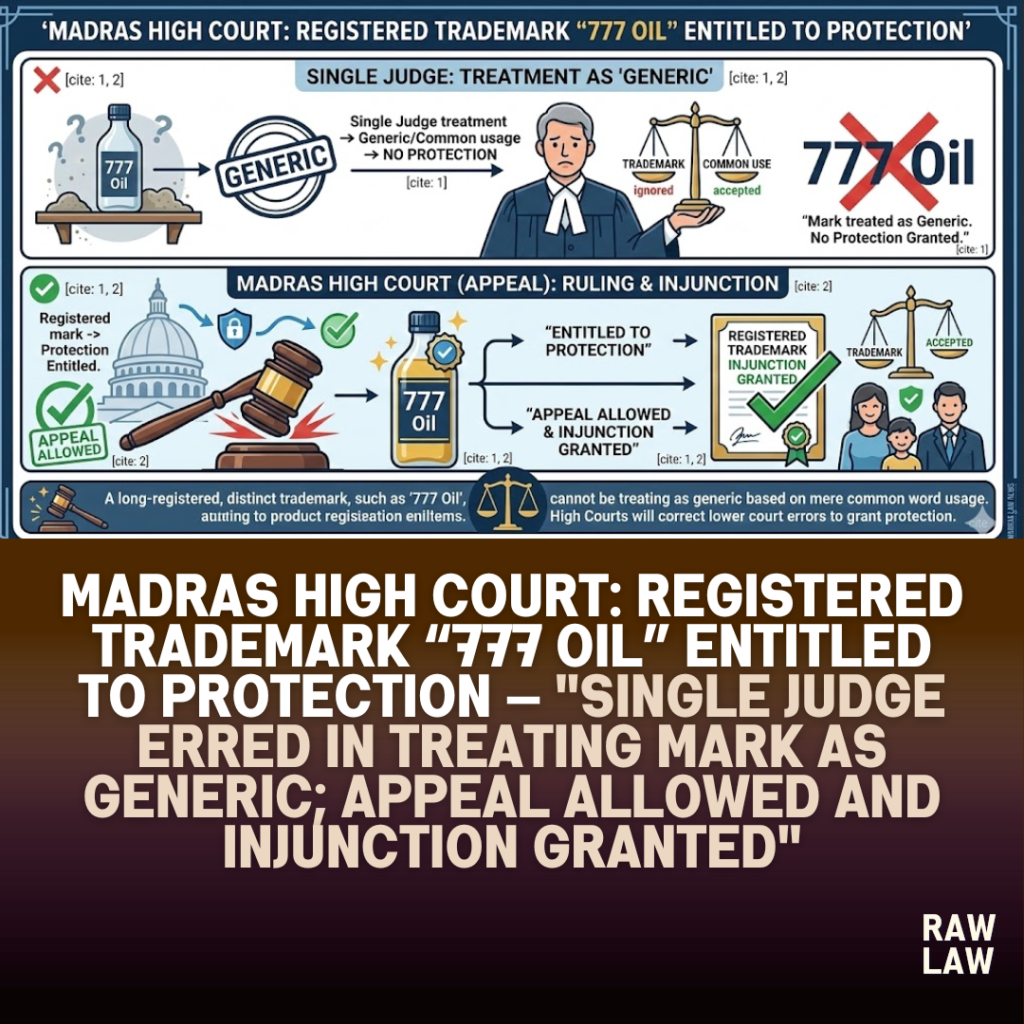
The Court held that the earlier judgment dismissing the suit suffered from serious legal errors and perversity in appreciation of evidence.
The Bench ruled that the appellant, being the registered proprietor of the trademark “777 Oil”, continued to enjoy statutory rights over the mark. Consequently, the Court granted permanent injunction restraining the respondent from using deceptively similar marks and ordered an account of profits earned from the infringing products.
2. Facts
The dispute concerned a Siddha medicinal oil formulated for the treatment of psoriasis and marketed under the brand name “777 Oil”.
The appellant company claimed that its promoter had been using the mark “777 Oil” since 1992 and later secured registration of the trademark in 2001. The product was developed in collaboration with the National Research Development Corporation through licensing arrangements concerning manufacturing processes and technical know-how.
The dispute arose when the respondent company adopted the mark “SANJEEVI 777 OIL” for similar products.
The appellant initiated rectification proceedings before the Intellectual Property Appellate Board, which ordered removal of the respondent’s trademark from the register. The respondent’s challenge to that order was dismissed by the High Court.
Despite this, a civil suit seeking permanent injunction was dismissed by a Single Judge of the High Court in 2023, prompting the present appeal.
3. Issues
The appellate court examined several key issues arising from the dispute:
- Whether the appellant was entitled to exclusive rights over the trademark “777 Oil”.
- Whether the expression “777 Oil” had become generic or publici juris in the field of Siddha medicine.
- Whether the respondent’s mark “SANJEEVI 777 OIL” infringed the appellant’s registered trademark.
- Whether the Single Judge erred in dismissing the infringement suit.
4. Petitioner’s arguments
The appellant argued that it was the registered proprietor and prior user of the trademark “777 Oil” and had continuously marketed its product under that mark for decades.
It was contended that the respondent’s adoption of the mark “SANJEEVI 777 OIL” was deceptive and likely to cause confusion among consumers, particularly since both products were medicinal oils used for similar purposes.
The appellant further argued that the respondent’s trademark had already been removed from the trademark register through rectification proceedings and that such removal had attained finality after the dismissal of the respondent’s challenge in the High Court.
The appellant also contended that the Single Judge had wrongly relied on an email communication to infer that the appellant intended to abandon the mark “777 Oil” in favour of a modified brand name.
5. Respondent’s arguments
The respondent contended that it had been using the mark “SANJEEVI 777 OIL” since the early 1990s and that the expression “777” was adopted due to features associated with the product’s preparation and use.
It was argued that the numerical expression reflected stages of preparation involving repeated seven-day cycles in the manufacturing process and therefore had descriptive significance.
The respondent further argued that multiple manufacturers in the Siddha medicine sector were using the expression “777”, making it common to the trade and incapable of exclusive ownership by any single entity.
Additionally, the respondent contended that the appellant was focusing on promoting a modified brand name and therefore could not claim exclusive rights over the earlier mark.
6. Analysis of the law
The Court examined the legal framework governing trademark protection and infringement.
The Bench emphasised that a registered trademark confers statutory rights on its proprietor unless the registration is successfully challenged or cancelled.
In the present case, the appellant’s trademark registrations remained valid and subsisting on the trademark register.
The Court also examined the evidentiary standards governing reliance on electronic records under the Indian Evidence Act, 1872.
The Bench noted that electronic records must comply with Section 65B of the Act for admissibility, including certification requirements.
Since the email relied upon by the Single Judge lacked the required certification, it could not legally be relied upon to draw adverse conclusions.
7. Precedent analysis
While addressing the issue of trademark rights, the Court reaffirmed established principles of trademark law that registered marks are entitled to protection unless successfully challenged.
The Bench also reiterated evidentiary principles relating to electronic records under Section 65B of the Evidence Act, emphasising that courts cannot rely upon electronic communications unless statutory requirements are satisfied.
These principles guided the appellate court in reassessing the findings of the Single Judge.
8. Court’s reasoning
The Court observed that the appellant’s trademark registrations for “777 Oil” and the modified mark “Dr. JRK’s 777 Oil” continued to remain valid on the trademark register.
At the same time, the respondent’s mark had already been removed from the register following rectification proceedings that had attained finality.
Therefore, the respondent could not legally continue to use the impugned mark.
The Court also held that the Single Judge had wrongly relied on an unproven email communication to infer abandonment of the trademark. Since the document was not proved in accordance with statutory requirements for electronic evidence, reliance upon it was legally unsustainable.
9. Conclusion
The Court concluded that the judgment dismissing the infringement suit suffered from serious legal errors and required interference in appeal.
Accordingly, the Division Bench allowed the appeal, set aside the earlier judgment, and decreed the suit in favour of the appellant.
Permanent injunction was granted restraining the respondent from infringing the trademark “777 Oil”, along with directions for surrender of infringing goods and accounting of profits.
10. Implications
The ruling reinforces the principle that registered trademarks enjoy statutory protection unless their validity is successfully challenged.
It also highlights the importance of proper evidentiary compliance when relying on electronic communications in court proceedings.
The judgment further clarifies that courts must carefully assess evidence before concluding that a trademark has become generic or that a proprietor has abandoned its rights.
Case Law References
- IPAB Rectification Order (2011)
The Intellectual Property Appellate Board ordered removal of the respondent’s mark “SANJEEVI 777 OIL” from the trademark register due to lack of proof of bona fide use. - High Court decision in W.P. No. 20195 of 2011
The High Court dismissed the respondent’s challenge to the IPAB order, confirming the rectification and removal of the respondent’s trademark.
FAQs
1. Can a registered trademark still be protected if similar marks exist in the market?
Yes. A registered trademark continues to enjoy statutory protection unless the registration is cancelled or successfully challenged before the appropriate authority.
2. When can a trademark be considered generic or publici juris?
A trademark becomes generic only when it is widely used in the trade to describe a product rather than its source. Courts require strong evidence before declaring a registered trademark generic.
3. Are emails admissible as evidence in court proceedings?
Electronic records such as emails must comply with Section 65B of the Indian Evidence Act. Without the required certificate, such documents cannot be relied upon as evidence.