


1. Court’s decision
The Madras High Court partly allowed a first appeal filed by a property owner challenging a decree for specific performance passed by the District Court in Karaikal.
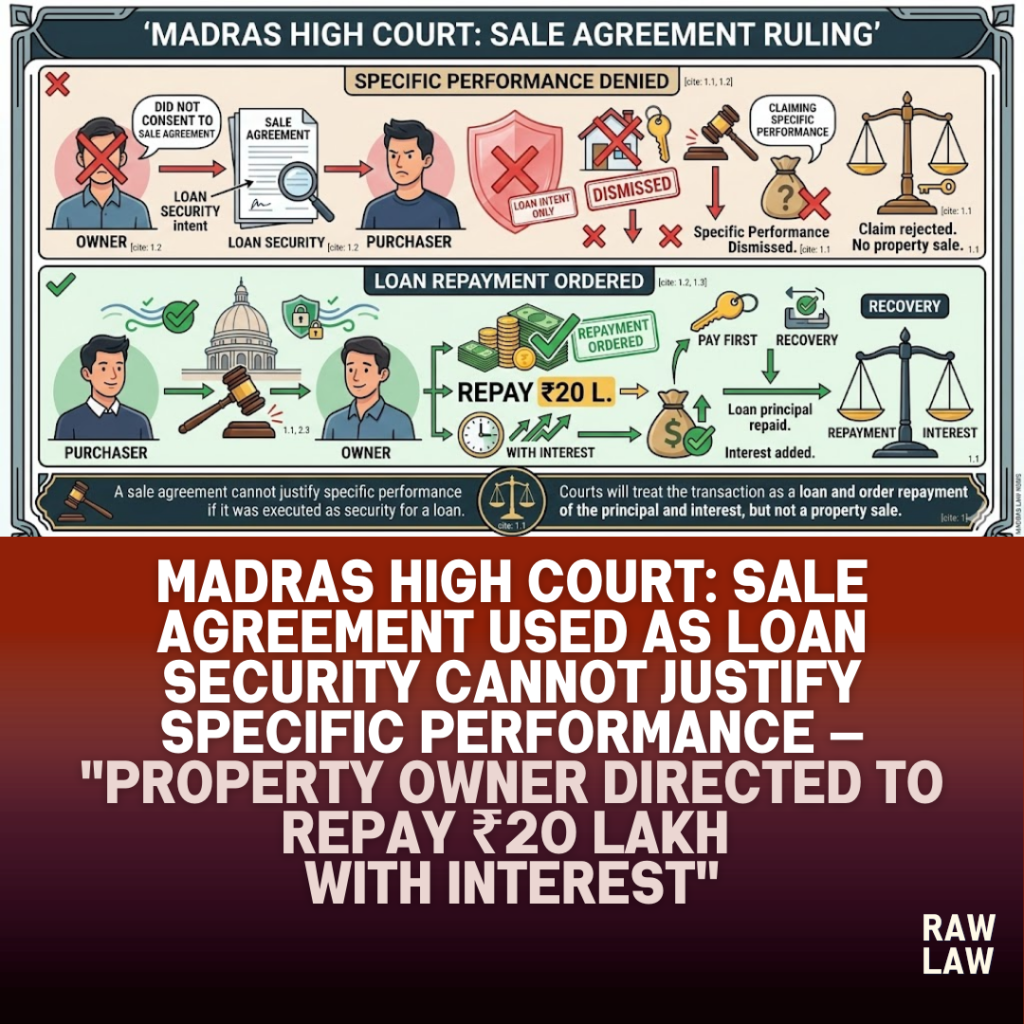
The High Court concluded that the agreement relied upon by the plaintiff had been executed as security for a financial transaction rather than as a genuine contract for sale of immovable property.
Consequently, the Court set aside the trial court’s decree directing execution of a sale deed. However, considering the admitted financial transaction between the parties, the Court granted an alternative money decree directing repayment of ₹20,00,000 with interest.
2. Facts
The dispute arose from a sale agreement allegedly executed on 17 December 2013 concerning a property in Karaikal.
Under the agreement, the defendant agreed to sell the suit property to the plaintiff for a total sale consideration of ₹22,00,000. On the date of agreement, the plaintiff claimed to have paid ₹20,00,000 as advance, with the balance ₹2,00,000 payable within three months.
The plaintiff alleged that despite repeated requests and a legal notice dated 20 March 2014, the defendant failed to complete the sale transaction. Consequently, the plaintiff filed a suit seeking specific performance of the agreement and, alternatively, refund of the advance amount with interest.
3. Issues
The High Court examined three principal issues in the appeal.
First, whether the execution of the alleged sale agreement had been proved by the plaintiff.
Second, whether the agreement had genuinely been intended as a contract for sale of the property.
Third, whether the plaintiff was entitled to the equitable remedy of specific performance under the law governing contractual enforcement.
4. Petitioner’s arguments
The defendant argued that the alleged sale agreement had been fabricated by misusing signed blank stamp papers obtained during a loan transaction.
According to the defendant, he had purchased jewellery from a shop owned by the plaintiff’s brother and had also borrowed ₹5,00,000 from him at high interest.
At the time of the loan, the plaintiff and his brother allegedly obtained blank signed documents including promissory notes, cheque leaves and stamp papers as security.
The defendant contended that the plaintiff later used one such blank stamp paper to create the disputed sale agreement. He also argued that the property was worth around ₹70,00,000 and that no rational owner would sell such property for ₹22,00,000.
5. Respondent’s arguments
The plaintiff argued that the agreement had been genuinely executed by the defendant with the intention of selling the property.
It was contended that the defendant’s wife had signed the document as an attesting witness and that the plaintiff’s brother had also attested the agreement.
The plaintiff examined both himself and the attesting witness to prove the execution of the agreement.
According to the plaintiff, he had always been ready and willing to perform his part of the contract and had even deposited the balance sale consideration in court. Therefore, he argued that the decree of specific performance granted by the trial court was justified.
6. Analysis of the law
The Court examined the legal framework governing suits for specific performance under the Specific Relief Act, 1963.
Specific performance is an equitable remedy granted when a valid and enforceable contract exists and when monetary compensation is inadequate to remedy the breach.
However, courts must carefully examine whether the agreement relied upon was genuinely intended as a contract for sale or merely executed for some collateral purpose such as securing a loan.
If the evidence suggests that the document was intended only as security for a financial transaction, the court may refuse specific performance and instead grant appropriate monetary relief.
7. Precedent analysis
The Court referred to several judgments of the Supreme Court of India addressing evidentiary standards in contractual disputes.
In cases such as Roop Kumar v. Mohan Thedani and Vidhyadhar v. Manikrao, the Supreme Court emphasised the importance of examining the conduct of parties and the surrounding circumstances to determine the true nature of a transaction.
These precedents guided the High Court in evaluating whether the disputed document was a genuine sale agreement.
8. Court’s reasoning
The High Court first held that the plaintiff had successfully proved the execution of the document by examining himself and an attesting witness.
However, the Court found several circumstances suggesting that the agreement was not intended for sale of the property.
The plaintiff admitted that the alleged advance payment of ₹20,00,000 had not been reflected in his income-tax returns. He also failed to produce bank statements demonstrating that he had accumulated such savings.
Additionally, evidence showed that the defendant had prior financial dealings with the plaintiff’s brother involving jewellery purchases and loans.
Considering these factors collectively, the Court concluded that the agreement had been executed only as security for a financial transaction rather than as a genuine sale contract.
9. Conclusion
The High Court allowed the appeal in part and set aside the trial court’s decree granting specific performance of the property sale agreement.
Instead, the Court passed a money decree directing the defendant to repay ₹20,00,000 with simple interest at 9% per annum from the date of filing of the suit until realization.
The Court also created a charge over the suit property to secure repayment of the decretal amount, enabling the plaintiff to enforce the decree if the amount is not paid.
10. Implications
The judgment underscores the careful scrutiny courts apply when examining property sale agreements in specific performance suits.
Even if the execution of a document is proved, courts will examine the surrounding circumstances to determine the true intention of the parties.
The ruling also illustrates that courts may deny specific performance when the agreement appears to function merely as security for a loan, while still protecting the financial interests of the claimant through a monetary decree.
Case Law References
- Roop Kumar v. Mohan Thedani (2003)
The Supreme Court discussed principles governing documentary evidence and the interpretation of written agreements. - Vidhyadhar v. Manikrao (1999)
The Supreme Court held that adverse inference may be drawn when a party who is capable of giving evidence fails to enter the witness box.
FAQs
1. Can a sale agreement be treated as security for a loan instead of a real sale contract?
Yes. If evidence shows that the agreement was executed only as collateral security for a loan transaction, courts may refuse specific performance and instead order repayment of the loan amount.
2. What must a plaintiff prove in a specific performance suit?
The plaintiff must prove the existence of a valid agreement, its execution, and continuous readiness and willingness to perform the contractual obligations.
3. What happens if specific performance is denied by the court?
Courts may grant alternative relief such as a money decree ordering refund of the advance amount with interest.