


1. Court’s decision
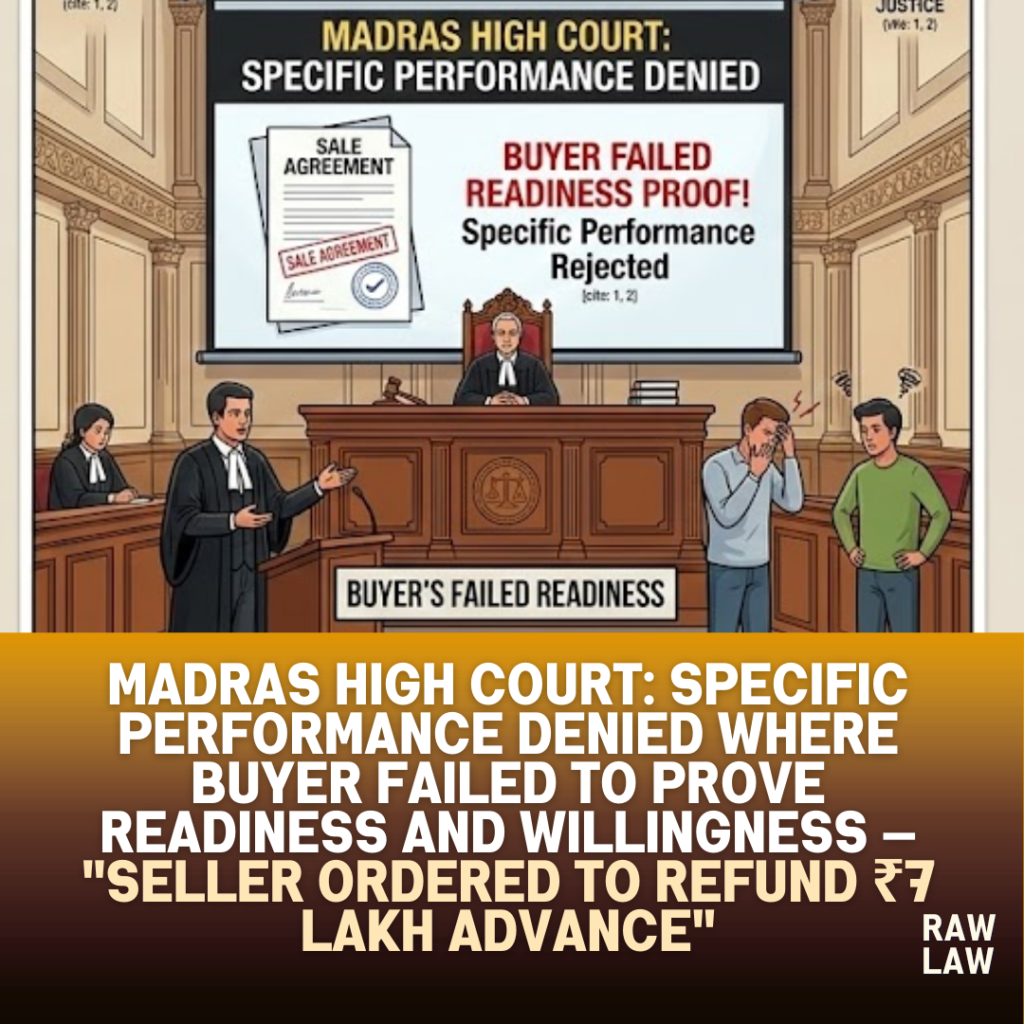
The Madras High Court partly allowed an appeal filed by the defendant challenging a trial court decree that had granted specific performance of a sale agreement in favour of the plaintiff.
After re-evaluating the evidence, the Court concluded that the plaintiff had not demonstrated the mandatory requirement of readiness and willingness to perform his contractual obligations within the stipulated period.
Accordingly, the Court set aside the trial court’s decree directing execution of the sale deed. However, considering the admitted receipt of advance money by the defendant, the Court granted a money decree ordering refund of ₹7,00,000 with interest.
2. Facts
The dispute concerned an agreement for sale of immovable property entered into on 20 December 2010. The defendant owned several parcels of land purchased through registered sale deeds.
The parties agreed to a total sale consideration of ₹13,00,000. On the date of the agreement, the plaintiff paid ₹4,00,000 as advance and the parties agreed on a schedule for payment of the remaining amount.
Under the agreement, the plaintiff was required to pay ₹3,00,000 on or before 30 April 2011 and the remaining ₹6,00,000 on or before 30 April 2012. However, disputes arose regarding compliance with these payment obligations, leading to litigation between the parties.
3. Issues
The High Court examined several questions arising in the appeal.
The primary issue was whether the plaintiff had established continuous readiness and willingness to perform his obligations under the sale agreement.
Another issue was whether the trial court was justified in granting specific performance despite delays and failure to comply with the payment schedule.
The Court also examined whether the plaintiff could claim protection of possession based on the unregistered sale agreement.
4. Petitioner’s arguments
The defendant argued that the plaintiff had clearly failed to comply with the terms of the agreement.
Under the contract, the plaintiff was required to pay ₹3,00,000 by April 2011, but instead remitted ₹2,95,000 only on 25 February 2012—well beyond the agreed time.
The defendant further contended that the balance amount of ₹6,00,000 was not paid within the stipulated period and was deposited in court only in 2016 during the pendency of the suit.
These circumstances, according to the defendant, clearly demonstrated that the plaintiff lacked readiness and willingness to perform the contract and was therefore not entitled to specific performance.
5. Respondent’s arguments
The plaintiff argued that he had always been ready and willing to perform the contract and had repeatedly requested the defendant to execute the sale deed.
He also contended that he had paid additional amounts to the defendant and remained in possession and enjoyment of the property since the date of the agreement.
The plaintiff relied on revenue records and agricultural documents to claim that he had been cultivating the land and therefore had a legitimate expectation that the agreement would be honoured.
6. Analysis of the law
The Court analysed the statutory requirement under Section 16(c) of the Specific Relief Act, 1963.
This provision requires a plaintiff seeking specific performance to both plead and prove continuous readiness and willingness to perform the essential terms of the contract.
The requirement is mandatory and applies regardless of whether the defendant specifically raises it as a defence. Courts must examine the conduct of the plaintiff throughout the transaction to determine whether the condition has been satisfied.
7. Precedent analysis
The Court relied on the judgment of the Supreme Court of India in J.P. Builders v. A. Ramadas Rao.
In that decision, the Supreme Court clarified that readiness and willingness must be demonstrated through clear conduct and evidence showing the plaintiff’s financial capacity and genuine intention to complete the transaction.
The Court also noted precedents emphasizing that delayed payments and lack of evidence regarding financial capacity are strong indicators that the plaintiff may not have been ready and willing to perform the contract.
8. Court’s reasoning
The High Court found that the plaintiff had failed to comply with the payment schedule specified in the agreement.
The second instalment of ₹3,00,000 was paid late and even that payment was incomplete. The balance consideration of ₹6,00,000 was neither paid within the contractual period nor deposited when the suit was filed.
The Court also noted the absence of any evidence demonstrating that the plaintiff had sufficient funds available during the relevant period.
Additionally, the plaintiff had not issued any legal notice to the defendant expressing readiness to complete the transaction. These cumulative factors convinced the Court that the plaintiff had failed to prove readiness and willingness.
9. Conclusion
The High Court concluded that the trial court had erred in granting specific performance without properly evaluating the evidence relating to readiness and willingness.
The decree granting specific performance was therefore set aside. However, since the defendant had admitted receipt of ₹7,00,000 from the plaintiff, the Court directed refund of that amount along with interest at 6% per annum from the date of filing of the suit until realization.
The Court also created a charge over the suit properties to secure recovery of the amount.
10. Implications
The judgment reinforces the strict standard applied by courts when granting the equitable remedy of specific performance.
Even when the existence of a valid agreement is admitted, courts will deny specific performance if the plaintiff fails to prove continuous readiness and willingness to perform contractual obligations.
The decision also highlights that courts may grant alternative relief such as refund of advance money to ensure fairness and avoid multiplicity of litigation between the parties.
Case Law References
- J.P. Builders v. A. Ramadas Rao (2011)
The Supreme Court held that readiness and willingness to perform contractual obligations must be clearly pleaded and proved in suits seeking specific performance. - Bhinka v. Charan Singh (1959)
The Supreme Court discussed evidentiary principles relating to admissibility of revenue records and documentary evidence.
FAQs
1. What must a buyer prove to obtain specific performance of a property agreement?
The buyer must prove that the agreement is valid and that they were continuously ready and willing to perform their obligations, including payment of the balance consideration.
2. Can courts deny specific performance even if a sale agreement is admitted?
Yes. Specific performance is an equitable remedy and can be denied if the plaintiff fails to prove readiness and willingness to perform the contract.
3. What happens if specific performance is denied by the court?
Courts may grant alternative relief such as refund of the advance amount with interest.