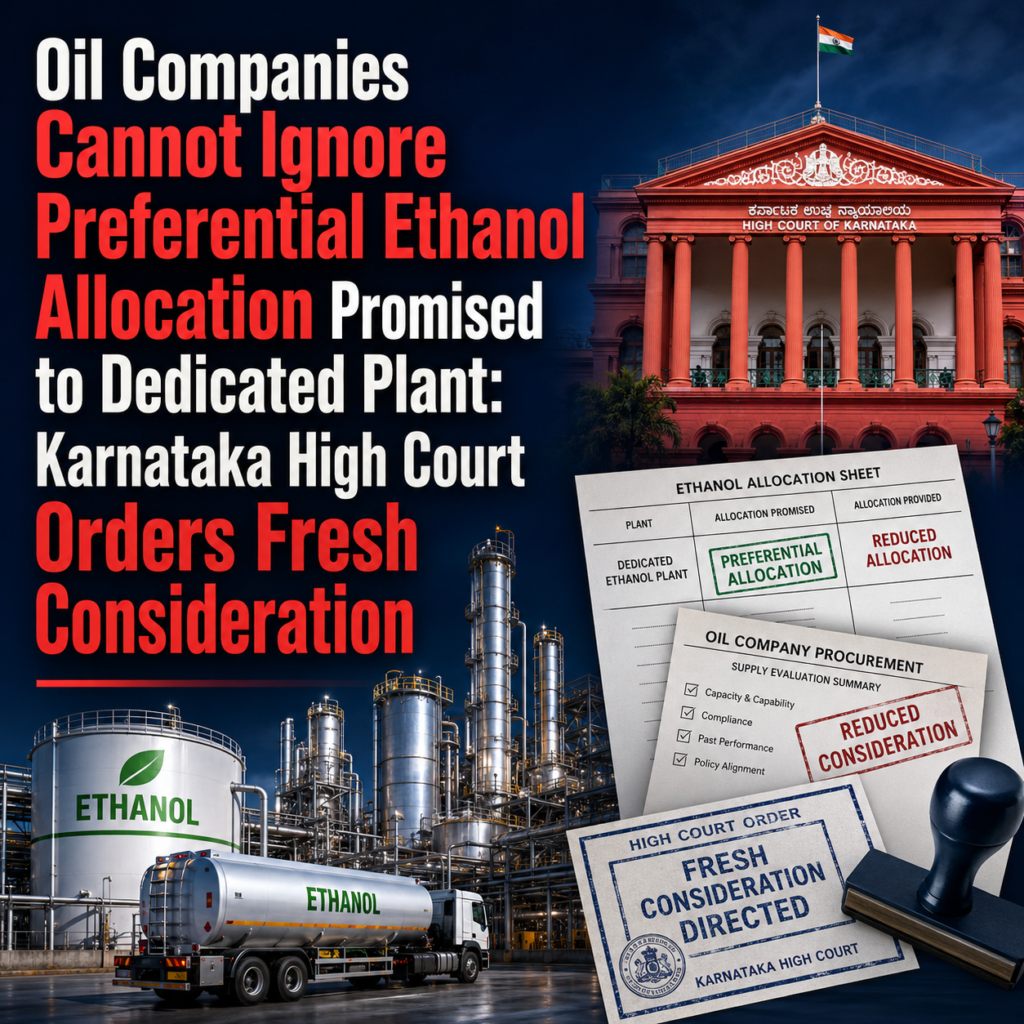
Karnataka High Court Directs Oil Companies to Reconsider Reduced Ethanol Allocation Given to Plant Set Up Under Government Programme
Facts
The petitioner, M/s VINP Distilleries and Sugars Pvt. Ltd., established a Dedicated Ethanol Plant for manufacturing and supplying denatured anhydrous ethanol to Bharat Petroleum Corporation Limited, Hindustan Petroleum Corporation Limited and Indian Oil Corporation Limited, collectively referred to as the Oil Marketing Companies or “OMCs.”
In August 2021, the OMCs issued an Expression of Interest inviting private entities to establish dedicated ethanol plants in ethanol-deficit States and enter into Long-Term Offtake Agreements. The petitioner was selected, received a Letter of Intent and entered into a Long-Term Offtake Agreement on 13 January 2022.
Under the agreement:
- Clause 6.2 contemplated an annual offtake quantity of 1.44 crore litres on a best-endeavour basis.
- Clause 6.5 permitted the petitioner to establish a plant up to the design capacity disclosed in its application, subject to the additional capacity continuing as a dedicated ethanol plant.
- Clause 6.8 provided that additional quantities beyond the base offtake could be offered through preferential allocation, up to the plant’s design capacity, on a best-endeavour basis.
- The contractual framework effectively required the petitioner to supply its production to the OMCs and restricted it from entering into similar arrangements with third parties.
For the Ethanol Supply Year 2025-26, the OMCs issued Tender No.22376 dated 23 September 2025 for procurement of 1,050 crore litres of ethanol. A tender condition stated that additional quantities offered by dedicated ethanol plants beyond their long-term offtake quantity would not receive preferential allocation and would instead be treated under the criteria applicable to non-dedicated plants.
The petitioner bid to supply 9.26 crore litres but was allocated only 3.92 crore litres. It submitted a representation on 27 October 2025 seeking enhancement of the allocation, contending that the reduced procurement departed from the Long-Term Offtake Agreement and threatened the financial viability of its dedicated plant.
As the representation was not acted upon, the petitioner approached the High Court under Article 226 of the Constitution.
Initially, the Single Judge granted interim relief in the petitioner’s favour. The Division Bench declined to interfere with that order. The Supreme Court, however, set aside both interim orders because tender allocations had already progressed and directed the High Court to decide the writ petition expeditiously on its own merits, without being influenced by the setting aside of interim relief.
Issues
- Whether a writ petition under Article 226 was maintainable when the dispute arose from a contractual arrangement between the petitioner and State-owned Oil Marketing Companies.
- Whether Clause 6.8 of the Long-Term Offtake Agreement created an obligation to consider the petitioner’s additional production through preferential allocation.
- Whether the expression “best endeavour” gave the OMCs unrestricted discretion to deny preferential allocation.
- Whether the 2025 tender condition, which treated additional quantities offered by dedicated plants on par with quantities offered by non-dedicated plants, was contrary to the Long-Term Offtake Agreement.
- Whether the petitioner had a legitimate expectation, arising from the contractual assurances and consistent past practice, that its additional capacity would receive preferential consideration.
- Whether the OMCs’ departure from their earlier course of conduct was arbitrary and violative of Article 14 of the Constitution.
Petitioner’s Arguments
The petitioner argued that its plant had been established exclusively in response to the Government-backed ethanol programme and the EOI issued by the OMCs. It had invested several hundred crores of rupees and incurred substantial financial liabilities based on the assurances contained in the Long-Term Offtake Agreement.
It contended that it could not freely manufacture other products or sell its ethanol to third parties. Since the OMCs exercised overwhelming control over procurement from dedicated ethanol plants, a substantial reduction in allocation would leave the plant idle for much of the year and threaten its continued operation.
The petitioner relied particularly on Clause 6.8, submitting that additional production beyond the base annual quantity had to be considered through preferential allocation. The words “best endeavour” did not permit the OMCs to ignore the clause or reduce it to an empty contractual assurance.
It pointed out that, in previous years, the OMCs had procured quantities above the base allocation by applying Clause 6.8. Even under the disputed tender, the petitioner had received more than the base quantity of 1.44 crore litres. The OMCs could not partially invoke Clause 6.8 to enhance the quantity to 3.92 crore litres while denying its application to the remaining quantity.
The petitioner further argued that the demand for ethanol had substantially increased because of the Government’s policy of blending up to 20% ethanol with petrol. There was, therefore, no genuine absence of demand that could justify drastically reducing its allocation.
According to the petitioner, the tender condition excluding preferential treatment for additional quantities directly contradicted the Long-Term Offtake Agreement. The contract, repeated past allocations and the OMCs’ consistent conduct created a legitimate expectation that its production would continue to receive preferential consideration.
Since the OMCs were instrumentalities of the State under Article 12, they were required to act fairly, reasonably and non-arbitrarily even in contractual matters.
Respondent’s Arguments
The Union Government and the OMCs argued that the controversy was essentially a private contractual dispute involving interpretation of the Long-Term Offtake Agreement. The petitioner should pursue the contractual dispute-resolution mechanism rather than invoke Article 226.
They submitted that the allocation process involved complex factual and policy considerations, including State-wise demand, quarterly requirements, the total quantity offered by suppliers, blending targets and the necessity of supplying ethanol from surplus States to deficit States.
According to the respondents, Karnataka was not an ethanol-deficit State. The allocation methodology was intended to balance national requirements and ensure adequate supplies across different regions.
The respondents maintained that Clause 6.8 used expressions such as “may offer,” “preferential allocation” and “best endeavour.” These expressions did not confer an absolute or enforceable right upon the petitioner to require procurement of its full production capacity.
They contended that the petitioner’s interpretation would convert a conditional and discretionary clause into a guaranteed purchase obligation. This would interfere with the Government’s economic policy and displace allocations already made to other dedicated and non-dedicated suppliers.
The doctrines of legitimate expectation and promissory estoppel, they argued, could not create a contractual right where none existed. They also could not be used to compel a public authority to act contrary to public interest, Government policy or the national ethanol procurement framework.
The private respondents and industry representatives broadly supported the OMCs, arguing that additional allocation to the petitioner could reduce the quantities available to other suppliers and disturb the completed tender process.
Analysis of the Law
The Court first examined whether a contractual dispute involving State-owned entities could be considered under Article 226.
It held that the mere existence of a contract does not exclude judicial review. When the State or its instrumentality enters the contractual field, its actions remain subject to Article 14. A writ court may intervene where the State’s conduct is arbitrary, unreasonable, discriminatory or contrary to a solemn representation upon which the other party has acted.
The Court distinguished an ordinary private contractual breach from a dispute involving a public-law element. In the present case, the OMCs were public-sector entities, exercised overwhelming control over procurement from dedicated ethanol plants and were implementing a national biofuel policy. The dispute therefore extended beyond a purely private commercial disagreement.
The Court next considered the contractual scheme. Clause 6.2 prescribed the base annual quantity, while Clauses 6.5 and 6.8 contemplated the establishment of greater capacity and preferential consideration of additional production. The agreement also restricted the petitioner’s ability to supply third parties.
Although Clause 6.8 used the expression “best endeavour,” the Court held that it could not be treated as giving the OMCs an unstructured or arbitrary discretion. Best-endeavour obligations had to be performed honestly, reasonably and consistently with the purpose of the agreement.
The Court also applied the doctrine of legitimate expectation. Such an expectation may arise from:
- An express or implied promise;
- A regular and consistent past practice; or
- An established course of dealing by a public authority.
Legitimate expectation does not invariably create an absolute right. A public authority may depart from an earlier policy or practice where overriding public interest or another rational justification exists. However, the departure must be supported by lawful and relevant reasons and must satisfy Article 14.
In this case, the petitioner’s expectation was not based on a mere hope. It arose from the contractual terms, the exclusivity restrictions, the substantial investments made for establishing the plant and the OMCs’ consistent conduct in procuring quantities above the base allocation.
Precedent Analysis
Gujarat State Financial Corporation v. Lotus Hotels Pvt. Ltd., (1983) 3 SCC 379
The Supreme Court held that a State instrumentality cannot give a solemn contractual undertaking, induce the other party to alter its position and subsequently argue that the aggrieved party is confined to a claim for damages. In appropriate circumstances, mandamus may be issued to require performance of the public authority’s obligation.
The Karnataka High Court relied upon this principle because the petitioner had established the plant and invested substantial sums based on the OMCs’ assurances.
ABL International Ltd. v. Export Credit Guarantee Corporation of India Ltd., (2004) 3 SCC 553
This decision established that a writ petition arising from a contractual obligation may be maintainable against the State or its instrumentality. The presence of disputed facts or a monetary consequence does not create an absolute bar where arbitrary State action is alleged.
The Court used this precedent to reject the respondents’ objection that the petitioner had to be relegated exclusively to contractual remedies.
Noble Resources Ltd. v. State of Orissa, (2006) 10 SCC 236
The Supreme Court reiterated that contractual State action may be judicially reviewed when it contains a public-law element or violates the requirement of fairness under Article 14.
The judgment supported the High Court’s finding that the ethanol procurement arrangement was not insulated from constitutional scrutiny merely because it was governed by an agreement.
Mahabir Auto Stores v. Indian Oil Corporation, (1990) 3 SCC 752
The Supreme Court held that an instrumentality enjoying monopoly power could not abruptly discontinue a long-standing course of dealings without reason, fairness or an opportunity to the affected party.
The Karnataka High Court found this principle particularly relevant because the OMCs controlled procurement from dedicated ethanol plants and the petitioner had no equivalent alternative market.
Navjyoti Cooperative Group Housing Society v. Union of India, (1992) 4 SCC 477
The Supreme Court recognised that a consistent past practice may create a legitimate expectation. A public authority should not defeat such an expectation without an overriding public-policy reason and procedural fairness.
The High Court applied this principle to the OMCs’ previous implementation of Clause 6.8 and their established course of procuring quantities above the base allocation.
Union of India v. Hindustan Development Corporation, (1993) 3 SCC 499
This decision explained that legitimate expectation is not equivalent to an enforceable private-law right. Nevertheless, arbitrary, discriminatory or unfair denial of such an expectation may attract Article 14 and judicial review.
The Court found that the petitioner’s case involved more than a bare commercial expectation because it was founded upon express contractual provisions and established conduct.
IFGL Refractories Ltd. v. Orissa State Financial Corporation, 2026 SCC OnLine SC 28
The Supreme Court explained that legitimate expectation and promissory estoppel are distinct doctrines. Legitimate expectation is broader and may operate substantively where a public authority’s representation or consistent past conduct induces reliance.
The High Court relied on this recent exposition to hold that the petitioner’s expectation was grounded in both the agreement and the OMCs’ conduct.
Army Welfare Education Society v. Sunil Kumar Sharma, (2024) 16 SCC 598
The Supreme Court reiterated that legitimate expectation may arise from a promise or an established and predictable practice. It may operate in both procedural and substantive matters, though it remains subject to overriding public interest and bona fide policy considerations.
The decision supported the Court’s conclusion that the OMCs’ departure from the established arrangement had to be justified by fair and rational reasons.
Court’s Reasoning
The Court found that the petitioner had not established its plant independently of the OMCs’ policy framework. The plant was established in response to the EOI, and its capacity was disclosed at the outset. The petitioner had thereafter invested several hundred crores of rupees and remained subject to restrictions preventing it from freely selling its production elsewhere.
The OMCs had applied Clause 6.8 during previous ethanol supply years and procured quantities exceeding the base annual offtake. Even for ESY 2025-26, the allocation of 3.92 crore litres was greater than the base quantity of 1.44 crore litres. The respondents had therefore themselves recognised the continued operation of Clause 6.8.
The Court held that the OMCs could not selectively invoke Clause 6.8 to procure some additional quantity while simultaneously claiming that the clause was entirely discretionary when the petitioner sought further enhancement.
The 2025 tender condition marked a clear departure from the contractual arrangement because it denied preferential consideration to the additional quantity offered by dedicated plants and treated that quantity under criteria applicable to non-dedicated suppliers.
Dedicated ethanol plants and ordinary ethanol-producing units were not similarly situated. An ordinary producer could manufacture or market other products, whereas the petitioner’s plant was created exclusively for the OMCs and was restricted from supplying third parties.
The Court found that the petitioner had a legitimate expectation that Clause 6.8 and the past procurement practice would not be abruptly abandoned without adequate justification. The respondents failed to establish a sufficiently convincing reason for such a sudden departure.
It observed that State instrumentalities enjoying monopoly power must comply with standards of fairness and reasonableness. Discretion could not become a matter of whim, and arbitrariness could not be defended merely by describing the dispute as contractual or policy-based.
The Court therefore held that the petitioner was entitled to a mandamus requiring a fresh and lawful consideration of its representation.
Conclusion
The Karnataka High Court held that State-owned Oil Marketing Companies remain subject to Article 14 even when acting under a commercial contract. A contractual dispute may be examined under Article 226 where the State’s action is alleged to be arbitrary and the dispute contains a substantial public-law element.
The petitioner’s claim was founded not only upon its commercial expectations but also upon Clause 6.8 of the Long-Term Offtake Agreement, the exclusivity imposed upon its dedicated plant, its substantial investments and the OMCs’ consistent past practice of procuring additional quantities through preferential allocation.
The Court held that the OMCs could not selectively rely upon Clause 6.8 or abruptly depart from their established practice without lawful, reasonable and non-arbitrary justification.
Accordingly, the writ petition was allowed. The OMCs were directed to consider the petitioner’s representation dated 27 October 2025 for enhancement of ethanol procurement in light of the Court’s findings and to pass an appropriate order within four weeks. Such consideration was required to precede the decision on the tender then issued.
The Court did not directly direct the OMCs to purchase the full 9.26 crore litres claimed by the petitioner; it ordered a fresh, reasoned and constitutionally compliant consideration of the request.
Case Details
Case: M/s VINP Distilleries and Sugars Pvt. Ltd. v. Union of India & Others
Court: High Court of Karnataka, Dharwad Bench
Case Number: Writ Petition No.109133 of 2025 (GM-RES)
Judge: Justice M. Nagaprasanna
Date: 16 June 2026
Result: Writ petition allowed. The respondent Oil Marketing Companies were directed to consider the petitioner’s representation dated 27 October 2025 seeking enhanced ethanol procurement, keeping the Court’s observations in mind. The decision was required to be taken within four weeks and before a decision was made on the tender then under consideration. The Court did not directly order allocation of the entire quantity claimed by the petitioner.