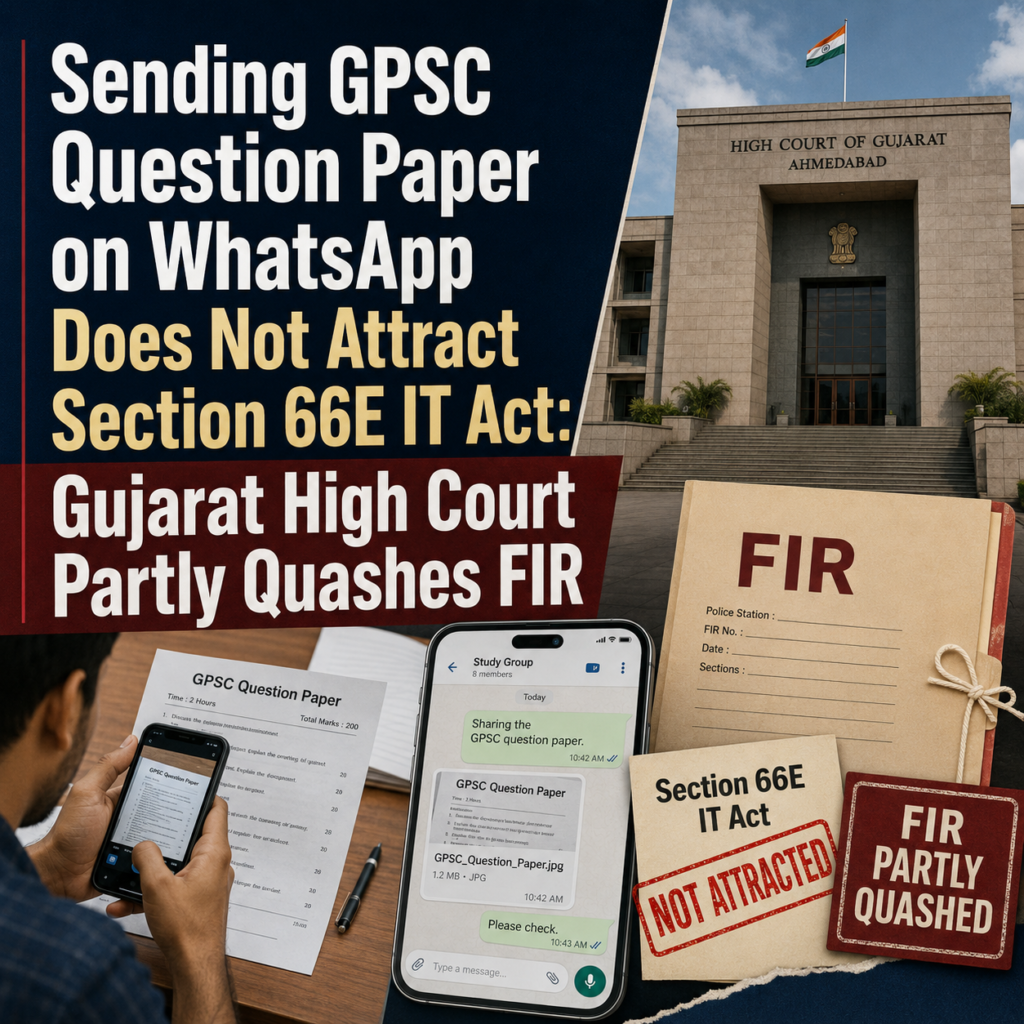
Gujarat High Court Quashes Section 66E Charge for WhatsApp Sharing of Exam Question Paper, Allows Other Offences to ContinueFacts
A GPSC examination was being conducted at an examination centre in Gandhinagar. During the examination, an invigilator noticed that one candidate, Hardik Babulal Purohit, was allegedly using a mobile phone to photograph the question paper and send the photographs through WhatsApp to his brother, Rahul Babulal Purohit.
On the basis of this allegation, FIR No. Part-II/117/2018 was registered at Sector 7 Police Station, Gandhinagar, for offences under Sections 188 and 120-B of the Indian Penal Code and Section 66-E of the Information Technology Act, 2000.
The applicants approached the Gujarat High Court seeking quashing of the FIR, particularly the invocation of Section 188 IPC and Section 66-E of the IT Act.
Issues
- Whether violation of GPSC examination instructions prohibiting possession or use of mobile phones amounted to disobedience of an order duly promulgated by a public servant under Section 188 IPC.
- Whether an FIR for Section 188 IPC was maintainable in view of the bar under Section 195 CrPC.
- Whether photographing a question paper and sending it through WhatsApp attracted Section 66-E of the IT Act.
- Whether the entire FIR was liable to be quashed or only the legally unsustainable offences under Sections 188 IPC and 66-E of the IT Act.
Petitioner’s Arguments
The applicants argued that Section 188 IPC could not be invoked merely because GPSC had issued examination instructions prohibiting candidates from carrying mobile phones.
They contended that such instructions did not amount to an “order duly promulgated by a public servant” within the meaning of Section 188 IPC.
It was further submitted that, even assuming Section 188 IPC was otherwise attracted, Section 195 CrPC prohibited a court from taking cognizance except on a written complaint by the concerned public servant. Since the criminal proceedings had originated through an FIR, the prosecution under Section 188 IPC was legally defective.
Regarding Section 66-E of the IT Act, the applicants argued that the provision relates to violation of privacy through capture, publication or transmission of images of a person’s private area. Sending a photograph of an examination question paper through WhatsApp did not satisfy any ingredient of the offence.
Respondent’s Arguments
The original complainant argued that GPSC had issued clear instructions prohibiting candidates from carrying mobile phones into the examination hall. The alleged act of using a phone and transmitting the question paper therefore amounted to violation of those instructions and attracted Section 188 IPC.
However, counsel for the complainant was unable to explain how Section 66-E of the IT Act applied to the transmission of photographs of a question paper.
The Additional Public Prosecutor fairly conceded that neither Section 188 IPC nor Section 66-E of the IT Act was attracted. It was also acknowledged that, because of Section 195 CrPC, prosecution under Section 188 IPC could not proceed merely on the basis of an FIR.
Analysis of the Law
Section 188 IPC
Section 188 IPC applies where a person knowingly disobeys an order lawfully promulgated by a public servant and such disobedience causes, or tends to cause, obstruction, annoyance, injury, danger to human life, health or safety, or a riot or affray.
The Court distinguished between a statutory or legally promulgated public order and ordinary administrative instructions issued to examination candidates. GPSC instructions prescribing what candidates may or may not carry into an examination hall did not, by themselves, amount to an order promulgated in the manner contemplated by Section 188 IPC.
The Court further noted that even where Section 188 IPC is otherwise attracted, Section 195 CrPC restricts cognizance. Proceedings must originate from a written complaint by the public servant concerned or another public servant to whom that officer is administratively subordinate. An ordinary police FIR cannot independently overcome this statutory bar.
Section 66-E of the IT Act
Section 66-E criminalises intentional or knowing capture, publication or transmission of an image of the private area of a person, without consent and under circumstances violating that person’s privacy.
The statutory definition of “private area” is restricted to specified intimate parts of the human body. The provision is therefore concerned with image-based privacy violations involving a person, not with unauthorised photographing or transmission of documents.
A question paper is not an image of the private area of any person. Consequently, photographing and sending it through WhatsApp could not attract Section 66-E.
Partial Quashing
The Court held that the invalid invocation of Section 188 IPC did not necessarily destroy the entire FIR. The alleged conduct of taking and transmitting photographs of the question paper could still be investigated under other provisions, if legally applicable.
Accordingly, the Court adopted a limited approach and quashed only Sections 188 IPC and 66-E of the IT Act, leaving the investigation open in relation to any other sustainable offence.
Precedent Analysis
Govardhandas Thakoresdas Asrani v. State of Gujarat
The Gujarat High Court relied upon its earlier decision in Govardhandas Thakoresdas Asrani v. State of Gujarat, Criminal Miscellaneous Application No. 24632 of 2015.
The precedent was relevant to the operation of Section 195 CrPC in cases involving Section 188 IPC. It recognised that cognizance of an offence under Section 188 IPC cannot ordinarily be taken on the basis of a police report where the statutory requirement of a written complaint by the competent public servant has not been satisfied.
The Court applied this principle to hold that, even if the GPSC instructions were assumed to constitute a duly promulgated order, the Section 188 charge could not survive in the absence of compliance with Section 195 CrPC.
Court’s Reasoning
The Court accepted that the allegations, on their face, indicated that a candidate had photographed the question paper and sent it outside the examination centre through WhatsApp.
However, the Court held that legal liability must be tested against the precise ingredients of the offences invoked.
The GPSC examination instructions were not equivalent to an order duly promulgated by a public servant under Section 188 IPC. They were ordinary instructions governing conduct during an examination.
Additionally, Section 195 CrPC created a procedural bar against prosecution under Section 188 IPC through a regular FIR alone.
On Section 66-E of the IT Act, the Court found a complete mismatch between the allegation and the statutory provision. The subject of the photograph was a question paper, not the private area of any person. Therefore, the essential ingredients of the privacy offence were wholly absent.
At the same time, the Court did not approve or legitimise the alleged act of transmitting the question paper. It clarified that the FIR could continue in respect of any other offences which the investigating officer considered applicable on the facts.
Conclusion
The Gujarat High Court partly allowed the quashing application.
The Court quashed the FIR insofar as it invoked:
- Section 188 of the Indian Penal Code; and
- Section 66-E of the Information Technology Act, 2000.
The Court held that GPSC examination instructions did not amount to a duly promulgated order for the purposes of Section 188 IPC and that prosecution under that provision was also barred by Section 195 CrPC in the absence of a written complaint by the competent public servant.
It further held that photographing and sending an examination question paper through WhatsApp did not amount to capturing, publishing or transmitting an image of a person’s private area and therefore could not attract Section 66-E of the IT Act.
The remaining FIR was permitted to continue in relation to any other offence that might lawfully apply to the alleged conduct.
Case Details
Case: Rahul Babulal Purohit & Another v. State of Gujarat & Another
Court: High Court of Gujarat at Ahmedabad
Case Number: R/Criminal Miscellaneous Application No. 8320 of 2022
Neutral Citation: 2026:GUJHC:35987
Judge: Hon’ble Mr. Justice P. M. Raval
Date: 16 June 2026
Result: Application partly allowed; FIR quashed only insofar as it invoked Section 188 IPC and Section 66-E of the IT Act, while proceedings were permitted to continue for any other legally applicable offences.