Bombay High Court Sets Aside ₹32.79 Crore Partial Arbitral Award, Holds Disputed Reimbursement Claim Required Evidence and Full Adjudication

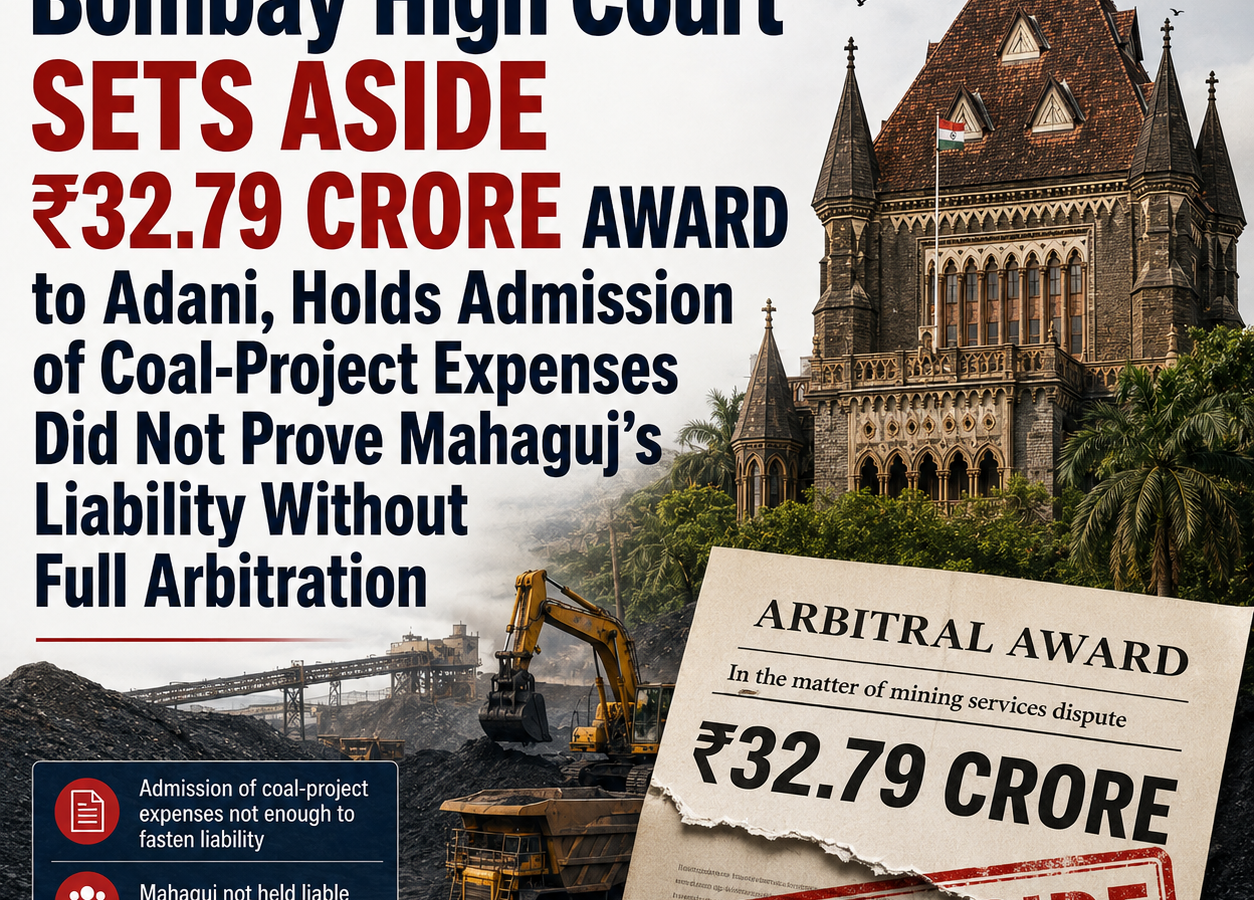
Adani’s Coal-Project Expenses Cannot Be Automatically Recovered from Mahaguj, Bombay High Court Quashes ₹32.79 Crore AwardFacts
Mahaguj Collieries Limited was incorporated as a joint venture between Maharashtra State Power Generation Company Limited and Gujarat State Electricity Corporation Limited for captive coal mining.
The Ministry of Coal allotted the Machhakata coal block in Odisha to Mahaguj. Mahaguj thereafter invited bids for appointment of a Mine Developer-cum-Operator to undertake exploration, development and mining of coal.
A consortium led by Adani Enterprises Limited was selected as the successful bidder. The parties executed a Coal Mining Services Agreement dated 6 May 2010, with retrospective effect from 30 November 2009.
Under the agreement, the Mine Developer-cum-Operator was required to undertake land acquisition, rehabilitation and resettlement and other project-development work. The agreement contemplated that the expenditure incurred by the operator would ultimately be recovered through the Coal Mining Service Fee.
In 2014, the Supreme Court cancelled the allocation of more than 200 coal blocks, including the coal block allotted to Mahaguj. Consequently, the Coal Mining Services Agreement became incapable of performance.
Adani thereafter invoked arbitration and filed an application under Section 17 of the Arbitration and Conciliation Act, seeking reimbursement of expenses allegedly incurred under the agreement.
During the hearing, Adani sought a partial award under Section 31(6) of the Act. It relied primarily on a letter dated 17 November 2014 issued by Mahaguj to the Union Ministry of Coal, which recorded expenditure incurred by the operator.
The Arbitral Tribunal treated the Section 17 application as an application for a partial award and directed Mahaguj to pay approximately ₹32.79 crore towards land-acquisition expenditure.
Mahaguj challenged the partial award under Section 34 of the Arbitration and Conciliation Act.
Issues
- Whether the Arbitral Tribunal could grant final monetary relief through a partial award without recording evidence on disputed contractual issues.
- Whether Mahaguj’s letter acknowledging that expenses had been incurred amounted to an admission of legal liability to reimburse those expenses.
- Whether the expenditure incurred by Adani constituted an “advantage” received by Mahaguj under Section 65 of the Indian Contract Act.
- Whether compensation could be awarded under Section 56 of the Contract Act without determining the contractual allocation of risk, knowledge of impossibility and actual loss.
- Whether the arbitral award was so cryptic, irrational or perverse as to justify interference under Section 34 of the Arbitration and Conciliation Act.
- Whether the Arbitral Tribunal’s jurisdiction was excluded by the Coal Mines (Special Provisions) Act, 2015.
Petitioner’s Arguments
Mahaguj argued that the Arbitral Tribunal had effectively granted final relief while deciding an interim application under Section 17.
It contended that the reimbursement claim involved serious disputed questions concerning:
- interpretation of the Coal Mining Services Agreement;
- allocation of financial risk between the parties;
- the mechanism for recovery of land-acquisition expenditure;
- whether Adani acted as an independent contractor or as Mahaguj’s agent;
- whether Mahaguj had received any legally recognisable advantage; and
- whether Adani had actually suffered a compensable loss.
Mahaguj submitted that these issues could not be decided summarily and required pleadings, evidence and a complete trial before the Arbitral Tribunal.
It further argued that the November 2014 letter merely acknowledged that expenditure had been incurred. It did not amount to an admission that the amount was immediately repayable by Mahaguj.
Mahaguj relied upon the contractual provisions showing that the operator was responsible for paying land-acquisition costs and was expected to recoup such expenditure through the Coal Mining Service Fee.
It also contended that the agreement expressly described the operator as an independent contractor and excluded any general agency relationship.
Accordingly, Mahaguj argued that the Tribunal could not simply treat all expenditure incurred by Adani as an advantage gained by Mahaguj.
Respondent’s Arguments
Adani argued that the fact of expenditure was admitted and supported by documentary proof.
It submitted that the cancellation of the coal-block allocation made the agreement impossible to perform and therefore void under Section 56 of the Contract Act.
According to Adani, the expenses had been incurred for Mahaguj’s project and on Mahaguj’s behalf. Consequently, Mahaguj had obtained an advantage which was required to be restored under Section 65 of the Contract Act.
Adani relied upon Mahaguj’s November 2014 letter to the Union Ministry of Coal, which recorded that substantial expenditure had been incurred by the operator.
It argued that this letter constituted a clear admission and justified a partial award without waiting for completion of the entire arbitration.
Adani also contended that Mahaguj had limited share capital and had undertaken no significant revenue-generating activity after cancellation of the coal-block allocation. It therefore expressed apprehension that Mahaguj might not satisfy a final arbitral award.
Analysis of the Law
Scope of Review Under Section 34
The High Court reiterated that proceedings under Section 34 are not an appeal and do not permit the court to reassess the entire dispute merely because another view may be possible.
An arbitral tribunal is ordinarily given considerable freedom in evaluating evidence and interpreting the contract.
However, interference is permissible where:
- the reasoning is irrational or perverse;
- material contractual provisions are ignored;
- the award contains no intelligible analysis;
- the conclusion is one that no reasonable person could reach; or
- the defect goes to the root of the award.
The Court held that the narrow scope of Section 34 did not prevent intervention in the present case because the partial award had been passed without examining the contractual framework or the ingredients of the statutory provisions relied upon.
Interim or Partial Awards Under Section 31(6)
Section 31(6) permits an arbitral tribunal to make an interim award on any matter on which it may make a final award.
The Court held that this power may be exercised where an issue is capable of final determination and nothing further remains to be adjudicated on that issue.
However, Section 31(6) does not authorise a tribunal to bypass disputed questions requiring evidence merely by describing the decision as a partial award.
A partial award is still an arbitral award and must withstand scrutiny under Section 34.
Effect of Impossibility Under Section 56 of the Contract Act
The Court accepted that the cancellation of the coal-block allocation made the Coal Mining Services Agreement impossible to perform.
The agreement therefore became void within the meaning of Section 56 of the Contract Act.
However, the Court held that the finding of impossibility did not automatically establish Adani’s entitlement to compensation.
For compensation to be awarded under Section 56, the tribunal was required to identify:
- the relevant promise;
- whether the promisor knew or ought to have known of the impossibility;
- whether the promisee lacked such knowledge;
- the loss actually suffered; and
- the proper amount of compensation.
These matters required evidence and could not be decided summarily.
Restitution Under Section 65 of the Contract Act
Section 65 requires a person who has received an advantage under an agreement that becomes void to restore that advantage or compensate the person from whom it was received.
The Court held that expenditure incurred by one party is not automatically equivalent to an advantage received by the other.
The Tribunal was required to determine:
- whether Mahaguj had in fact received any advantage;
- the nature and value of that advantage;
- whether the expenditure was contractually Adani’s responsibility;
- whether the expense was meant to be recovered through the Coal Mining Service Fee; and
- whether any amount was immediately payable upon termination or frustration.
Since the agreement required the operator to pay for land acquisition and contemplated recovery through the service-fee mechanism, evidence and contractual interpretation were necessary.
Admission of Expenditure Versus Admission of Liability
The Court held that Mahaguj’s November 2014 letter could reasonably be treated as an admission that Adani had incurred expenditure.
However, an admission that expenditure was incurred was not the same as an admission that Mahaguj was legally liable to reimburse it.
The Tribunal failed to explain how acknowledgement of expenditure became an admission of:
- loss suffered by Adani;
- advantage gained by Mahaguj; or
- an immediate obligation to repay ₹32.79 crore.
The Court therefore found that the Tribunal had improperly converted a limited factual admission into a conclusive admission of liability.
Contractual Interpretation and Need for Evidence
The agreement contained provisions suggesting that:
- Adani was responsible for land-acquisition expenditure;
- Mahaguj would hold title to the land;
- Adani would recoup its expenditure through the Coal Mining Service Fee;
- expenditure was to be independently audited;
- Adani was an independent contractor; and
- no general agency relationship existed between the parties.
The Court held that these provisions required reconciliation and interpretation.
The Tribunal had not analysed how the clause requiring payments “on behalf of” Mahaguj was to be reconciled with clauses excluding agency.
This omission went to the root of the award.
Jurisdiction Under the Coal Mines (Special Provisions) Act
The Court rejected Mahaguj’s jurisdictional objection.
It held that the statutory tribunal under the Coal Mines (Special Provisions) Act was intended to decide disputes between new allottees and prior allottees.
The present dispute was between Mahaguj, the former allottee, and the Mine Developer-cum-Operator, a third party.
Accordingly, the arbitral tribunal’s jurisdiction was not excluded by the special legislation.
Precedent Analysis
The High Court referred to established Supreme Court authorities on the limited scope of judicial review under Section 34.
Dyna Technologies Private Limited v. Crompton Greaves Limited
This decision recognises that courts must avoid excessive interference with arbitral awards and should attempt to understand the tribunal’s reasoning where it is discernible.
However, an award may be interfered with where the reasons are unintelligible, inadequate or reveal absence of a judicial approach.
The High Court applied this principle and found that the arbitral award contained no meaningful analysis of the contract or Sections 56 and 65 of the Contract Act.
Konkan Railway Corporation Limited v. Chenab Bridge Project Undertaking
This authority reinforces that courts cannot substitute their own contractual interpretation merely because another view is possible.
At the same time, a tribunal’s view must remain a plausible and reasonable interpretation of the contract.
The High Court held that the impugned award was not based upon any proper contractual interpretation at all.
OPG Power Generation Private Limited v. Enexio Power Cooling Solutions India Private Limited
This precedent reiterates the limited scope of review under Section 34 and the distinction between a mere legal error and a defect going to the root of the award.
The High Court found that the Tribunal’s failure to analyse the statutory requirements, contractual risk allocation and disputed liability was a fundamental defect rather than a minor legal error.
Manohar Lal Sharma v. Principal Secretary
The arbitral dispute arose because the Supreme Court’s decision in the coal-block allocation cases resulted in cancellation of the coal block allotted to Mahaguj.
The High Court accepted that this cancellation made performance of the mining agreement impossible.
However, it clarified that contractual impossibility did not automatically determine which party had to bear the expenditure already incurred.
Court’s Reasoning
The High Court found that the Arbitral Tribunal had adopted an excessively summary approach.
The Tribunal had merely stated that:
- the agreement had become impossible to perform;
- Adani had incurred expenditure;
- Mahaguj had acknowledged the expenditure; and
- Mahaguj had therefore received an advantage that had to be restored.
The High Court held that this reasoning omitted several essential steps.
The Tribunal did not examine:
- who contractually bore the land-acquisition cost;
- how the expenditure was intended to be recovered;
- whether Mahaguj received any actual advantage;
- whether Adani suffered a compensable loss;
- whether the relationship was one of agency or independent contracting;
- whether the amount required audit;
- whether the relevant contractual clauses survived frustration; or
- whether Sections 56 and 65 legally justified the full amount awarded.
The Court described the award as cryptic, summary and sweeping.
It held that every rupee spent by Adani had simply been directed to be repaid without any assessment of legal entitlement.
The Tribunal’s reliance on the November 2014 letter was also found to be misplaced. The letter established only the fact of expenditure and not Mahaguj’s liability to reimburse it.
The High Court therefore concluded that the award suffered from perversity and a fundamental failure of adjudication.
At the same time, the Court clarified that it was not deciding the merits of Adani’s reimbursement claim.
The parties remained free to pursue fresh arbitration on whether the expenditure represented a recoverable loss, an advantage gained by Mahaguj or an amount payable under the contractual risk-allocation mechanism.
Conclusion
The Bombay High Court allowed Mahaguj’s petition under Section 34 of the Arbitration and Conciliation Act.
It quashed and set aside the partial arbitral award directing Mahaguj to pay approximately ₹32.79 crore to Adani Enterprises Limited.
The Court held that the Arbitral Tribunal could not conclusively determine the reimbursement claim without interpreting the contract, recording evidence and examining whether Mahaguj had received an advantage or whether Adani had suffered a compensable loss.
The Court did not finally reject Adani’s underlying claim. It left the parties free to refer the dispute to arbitration afresh, if they so desired.
Case: Mahaguj Collieries Limited v. Adani Enterprises Limited
Court: High Court of Judicature at Bombay, Commercial Division
Case Number: Commercial Arbitration Petition No. 483 of 2018 with Notice of Motion No. 1066 of 2018
Judge: Justice Somasekhar Sundaresan
Date: 25 June 2026
Result: Petition allowed; partial arbitral award directing payment of approximately ₹32.79 crore set aside, with liberty to pursue fresh arbitration on the underlying reimbursement dispute.