Delhi High Court Stays Sujan Singh Park Decree Favouring Centre; Finds Government Grant Dispute Raises Substantial Questions and Protects 80-Year Possession Pending Appeal

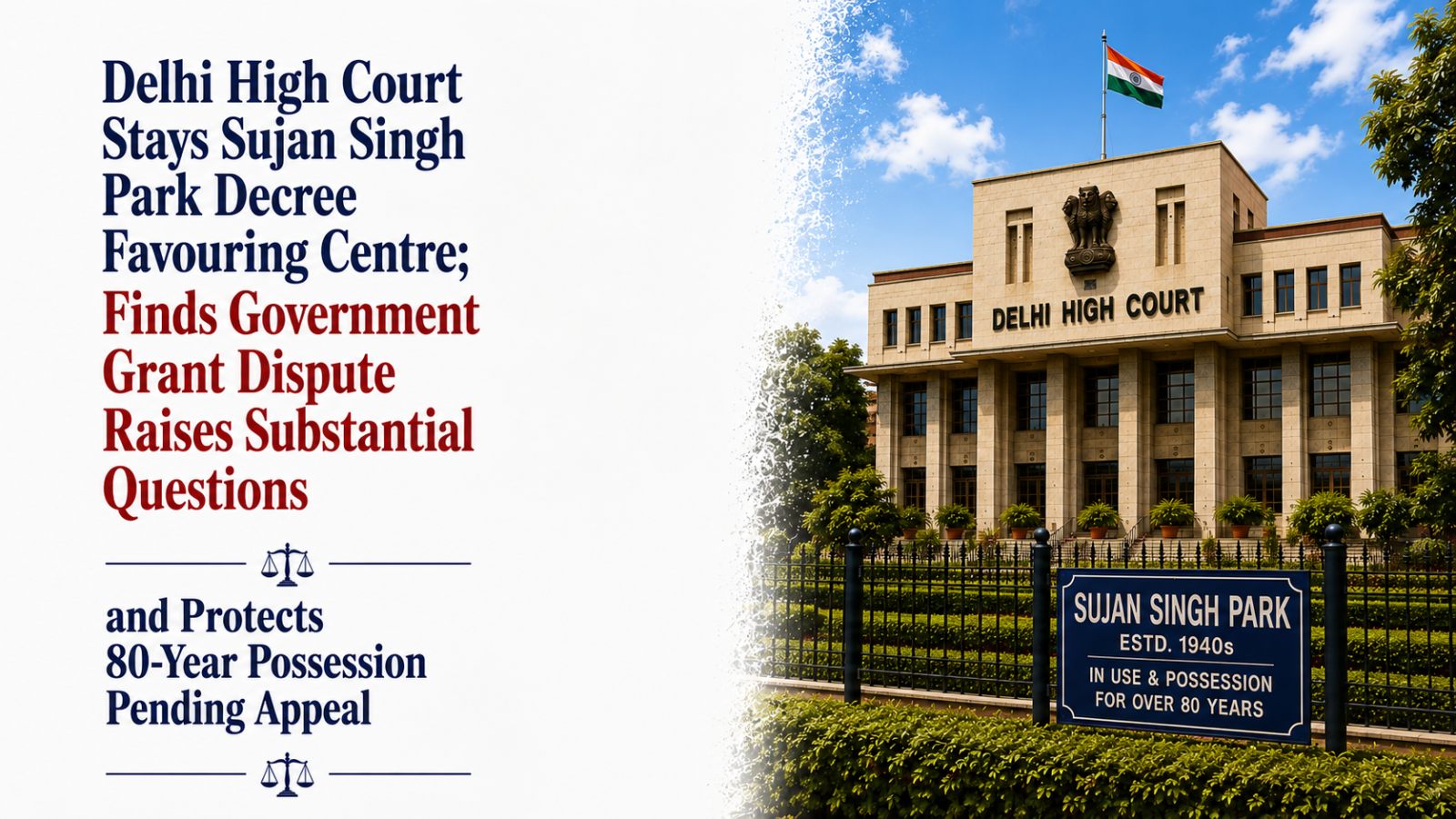
Delhi High Court Protects Sir Sobha Singh and Sons’ Possession of Sujan Singh Park; Stays Decree Upholding Government Re-Entry Pending Second Appeal
Facts
The dispute concerns approximately 7.58 acres of land known as Sujan Singh Park, New Delhi, governed by an Agreement for Lease dated 8 October 1945 between Sir Sobha Singh and Sons Pvt. Ltd. and the Government. The appellant had instituted a civil suit challenging the Government’s re-entry with effect from 29 July 1960, seeking a declaration that the re-entry was illegal, an injunction against dispossession, and specific performance requiring execution of the contemplated perpetual lease.
The Civil Judge decreed the suit on 31 August 2009, finding that the buildings had been constructed in accordance with the Government’s instructions, that the alleged misuse had not been established and that the re-entry notice was illegal. Specific performance of the 1945 Agreement for Lease was also granted.
However, on 9 June 2026, the First Appellate Court allowed the Union of India’s appeal, reversed the Trial Court’s decree and dismissed the suit, thereby upholding the Government’s re-entry.
Sir Sobha Singh and Sons Pvt. Ltd. thereafter filed a Regular Second Appeal before the Delhi High Court and sought a stay of the First Appellate Court’s judgment and protection against dispossession pending adjudication.
The appellant asserted that it had remained in continuous possession since 1943, with its possession judicially protected since 1960. It further pointed out that the property housed several long-standing occupants and establishments, including the Ambassador Hotel.
Issues
The principal issues arising at the interim stage were:
- Whether the appellant had established a prima facie case warranting stay of the First Appellate Court’s decree pending the Regular Second Appeal.
- Whether Section 3 of the Government Grants Act, 1895 excludes the jurisdiction of a civil court to interpret a Government Grant, determine whether its conditions were breached and examine the legality of Government action under the Grant.
- Whether the Government’s re-entry in 1960 had been validly effected in accordance with the terms of the Grant.
- Whether the First Appellate Court had reversed the Trial Court without adequately considering contemporaneous correspondence indicating Government knowledge and approval of the Hotel Block.
- Whether the appellant’s decades-long possession should be protected pending determination of the substantial questions of law.
- Whether the First Appellate Court’s decree could be relied upon as the basis for proceedings under the Public Premises (Eviction of Unauthorised Occupants) Act, 1971.
Appellant’s Arguments
The appellant contended that the First Appellate Court had itself held that the civil suit was “not competent” but nevertheless proceeded to determine the merits and validate the Government’s re-entry. According to the appellant, if the Civil Court lacked jurisdiction, the First Appellate Court could not simultaneously adjudicate the substantive dispute.
It argued that the Government Grants Act contained no express or implied bar upon civil court jurisdiction under Section 9 CPC.
The appellant further submitted that the First Appellate Court had ignored crucial documentary evidence and contemporaneous Government correspondence demonstrating that construction of the Hotel Block was undertaken with the Government’s knowledge, approval and supervision.
It emphasised that the Trial Court had considered this evidence while the Union of India had led no evidence during trial. Nevertheless, the First Appellate Court reversed the decree primarily by relying upon the terms of the 1945 Agreement for Lease.
The appellant also relied heavily upon its continuous possession since 1943 and the judicial protection enjoyed since 1960. Dispossession during the second appeal, it argued, would cause irreparable injury and could render the appeal itself infructuous.
Respondent’s Arguments
The Union of India opposed the stay application and contended that the Government Grant had been lawfully cancelled.
It submitted that proceedings under the Public Premises Act had already been initiated for recovery of possession and constituted the due process of law for resumption of Government property.
According to the Union, once the Grant stood cancelled, no vested right survived in favour of the appellant and there was consequently no justification for staying the appellate decree or protecting the appellant’s possession.
The Union further maintained that the Public Premises Act notice had been issued on independent grounds and was not based upon the impugned First Appellate Court judgment.
Analysis of the Law
Government Grants Are Governed by Their Own Terms
The High Court extensively examined Sections 2 and 3 of the Government Grants Act, 1895.
It held that the consistent principle emerging from Supreme Court precedent is that a transfer of Government land or an interest therein is not governed by the ordinary incidents of the Transfer of Property Act. Instead, the rights and obligations of the parties must be determined according to the tenor of the Government Grant itself.
The restrictions, conditions and limitations imposed by the Grant therefore operate according to their own terms notwithstanding contrary statutory provisions.
Government Can Resume Land, But Determination of Grant Must Be Valid
The Court distinguished between the Government’s right to recover possession following a valid termination and the antecedent question whether the Grant had actually been validly and lawfully terminated.
Once a Government Grant is validly terminated, the Government can seek possession through proceedings under the Public Premises Act rather than necessarily instituting a civil suit.
However, this presupposes a legally valid determination of the Grant.
The central question therefore remained whether the re-entry had been validly effected in accordance with the terms of the 1945 arrangement.
Government Grants Act Does Not Prima Facie Exclude Civil Court Jurisdiction
This formed one of the most important observations in the judgment.
The High Court observed that a prima facie reading of Section 3 of the Government Grants Act does not exclude the Civil Court’s jurisdiction to:
- interpret the Government Grant;
- determine whether its terms have been breached; or
- examine whether Government action was taken in accordance with the Grant.
The provision does not state that an aggrieved person is left without a civil remedy. The Court invoked the principle ubi jus ibi remedium—where there is a right, there is a remedy—and observed that civil jurisdiction cannot ordinarily be excluded unless expressly or by necessary implication barred.
The Court consequently found that a substantial question of law arose as to whether the suit for specific performance, declaration and injunction could properly have been held “not competent” merely by virtue of Section 3 of the Government Grants Act.
Precedent Analysis
Union of India v. Sir Sobha Singh and Sons Pvt. Ltd., 2026 INSC 406
The Court considered the Supreme Court’s recent decision involving another part of Sujan Singh Park governed by a separate perpetual lease.
The Supreme Court had held that a holding originating in and regulated by a Government Grant is not governed by conventional tenancy principles under the Delhi Rent Control Act. The High Court nevertheless distinguished that proposition from the separate question whether a Civil Court can interpret the Grant and examine the legality of its termination.
Collector of Bombay v. Nusserwanji Ratanji Mistri
The Supreme Court explained that Government Grants operate according to their own tenor and that Sections 2 and 3 of the Government Grants Act protect conditions and limitations that might otherwise conflict with general property law.
Hajee S.V.M. Mohamed Jamaluddin Bros. & Co. v. Government of Tamil Nadu
The decision was relied upon for the principle that the rights, privileges and obligations arising from a Government Grant are completely regulated by the terms of the Grant, even where those terms are inconsistent with other statutory law.
Chief Executive Officer v. Surendra Kumar Vakil
The Supreme Court held in the context of Old Grant land that the grantee may merely be an occupier/licensee without title to the land and that Government resumption must be considered according to the terms governing the Grant.
State of U.P. v. Zahoor Ahmad
The judgment reinforced that Sections 2 and 3 confer wide authority upon the Government to impose conditions and restrictions in its grants and that the rights and obligations of the grantee are governed by the Grant notwithstanding general statutory or common law.
Pradeep Oil Corporation v. Municipal Corporation of Delhi
The Supreme Court reiterated that Government transfers of land are not governed by the Transfer of Property Act and that rights and obligations must be determined from the Government Grant itself.
Azim Ahmad Kazmi v. State of Uttar Pradesh
This authority was important on the procedure for resumption. The Supreme Court recognised that Government possession must be recovered through the procedure established by law. The Delhi High Court relied upon it while distinguishing the Government’s substantive right to terminate a Grant from the procedure required for recovering possession.
Union of India v. Kamla Verma
The Supreme Court recognised the Government’s entitlement to resume land held on Old Grant terms and explained that such grants may constitute a self-contained regime concerning grant and resumption.
Court’s Reasoning
The High Court found that several serious questions required examination in the Regular Second Appeal.
Most importantly, contemporaneous correspondence appeared to show that the Hotel Block was contemplated from the early stages of the project and constructed with the knowledge and approval of Government authorities. The documentary record included references to Government officers supervising construction and an ex post facto sanction granted through Resolution No. 78 of 1951.
The First Appellate Court, however, had essentially relied upon the 1945 Agreement for Lease without adequately considering the multiple letters and subsequent sanction relied upon by the appellant.
The Court also considered it significant that much of the construction had already taken place in 1943–44, whereas the Agreement for Lease was executed only on 8 October 1945. Moreover, only an Agreement for Lease had been executed; the contemplated perpetual lease deed had not yet been executed. This raised a further question as to whether the 1945 Agreement alone finally crystallised all rights and obligations between the parties.
The divergent findings of the Trial Court and First Appellate Court, coupled with the alleged failure to consider material evidence, gave rise to substantial questions of law requiring determination.
The Court therefore found that the appellant had established a prima facie case for interim protection.
The balance of convenience also favoured preservation of the existing position. The appellant had remained in long and continuous possession, the litigation had been pending since 1960, and numerous persons occupying flats in the complex could be affected by dispossession.
Conversely, the Union had demonstrated no immediate public interest requiring possession to be disturbed while the appeal remained pending. The Court therefore found that both balance of convenience and irreparable injury supported interim protection.
On the Public Premises proceedings, the Court rejected, at least prima facie, the Union’s assertion that the eviction proceedings were wholly independent of the First Appellate Court judgment. The contents of the show-cause notice indicated that the cancellation of the Grant having been upheld by the First Appellate Court was itself relied upon as a basis for eviction.
Conclusion
The Delhi High Court allowed the stay application under Order XLI Rule 5 read with Section 151 CPC.
It stayed the operation of the First Appellate Court’s judgment and decree dated 9 June 2026 and restrained the Union of India from acting upon that judgment.
The Court clarified that the stayed judgment and decree could not form the basis for initiation or continuation of proceedings under the Public Premises Act. However, the Union of India remained free to pursue any remedies otherwise available to it under law, independently of the stayed judgment.
Most importantly, the Court directed the parties to maintain status quo in respect of Sujan Singh Park until disposal of the Regular Second Appeal. All observations in the interim judgment were expressly clarified to be confined to the stay application and not an expression on the ultimate merits of the appeal.
Case Details
Case: Sir Sobha Singh and Sons Pvt. Ltd. v. Union of India
Court: High Court of Delhi at New Delhi
Case Number: RSA 108/2026; CM APPL. 39009/2026; CNR No. DLHC010262162026
Judge: Justice Neena Bansal Krishna
Reserved On: 4 August 2026
Date: 10 August 2026
Result: Stay application allowed; First Appellate Court’s judgment and decree dated 9 June 2026 stayed, Union restrained from acting upon it, and status quo directed over the suit property until disposal of the second appeal.