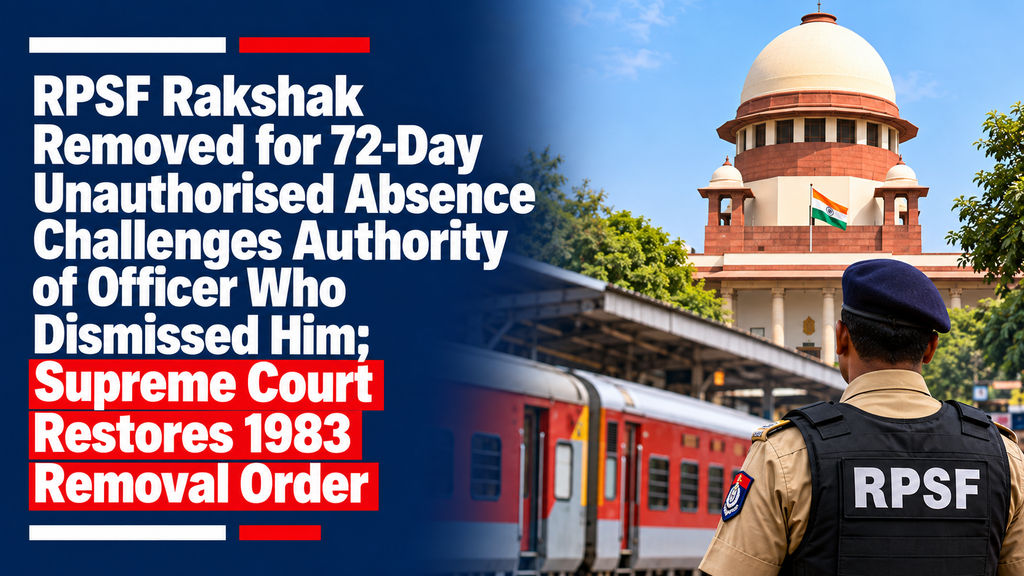
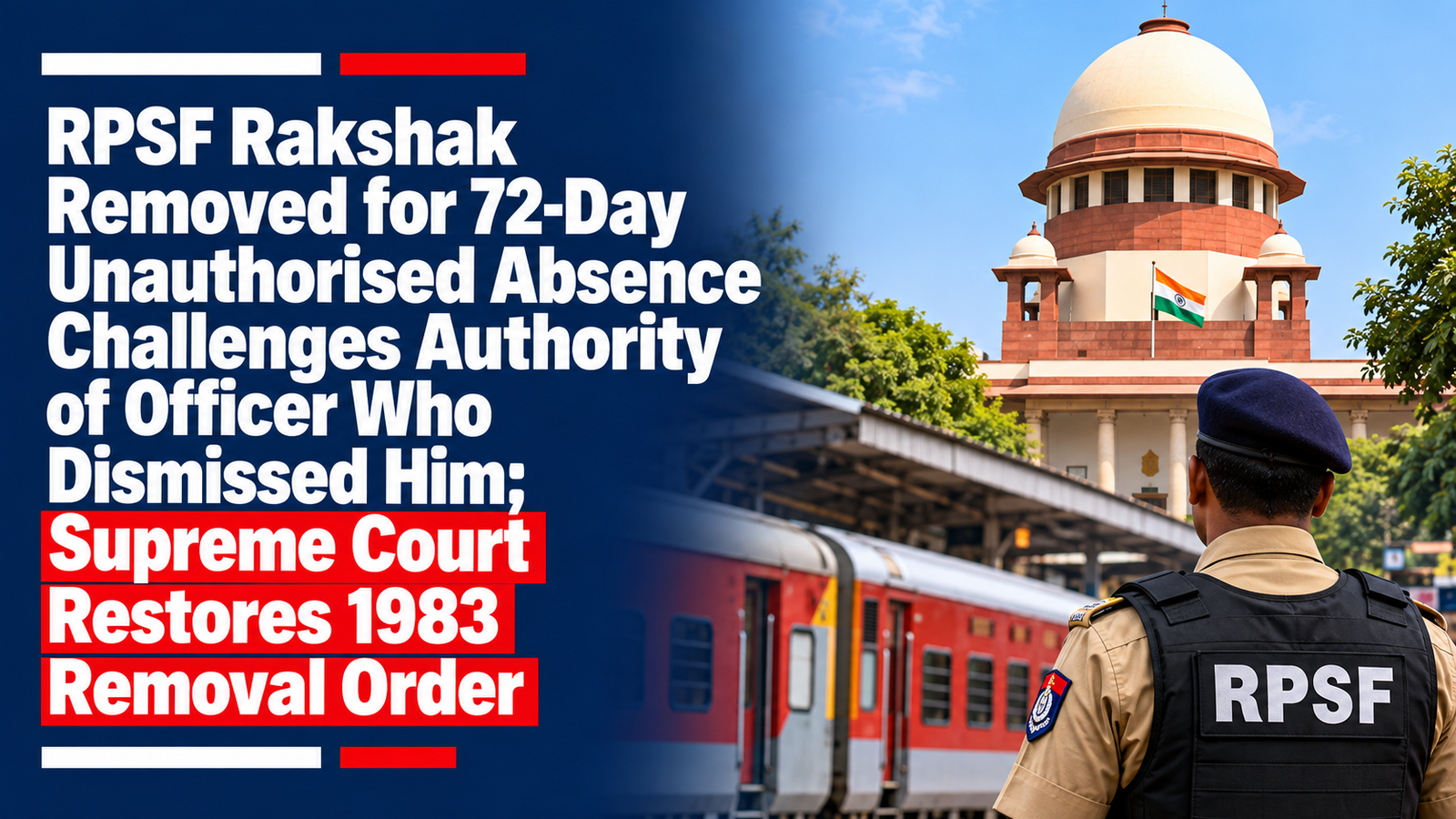
RPSF Rakshak Removed for 72-Day Unauthorised Absence Challenges Authority of Officer Who Dismissed Him; Supreme Court Restores 1983 Removal Order

Employee Misses Departmental Enquiry Citing Illness; Supreme Court Says Ex-Parte Proceedings Alone Do Not Violate Natural Justice
Facts
Ramdhani Prasad was selected for the post of Rakshak in the Railway Protection Special Force (RPSF). On 3 May 1979, the Commandant issued him a call letter requiring him to report for initial training. Importantly, the letter expressly stated that his appointment was conditional upon successful completion of the prescribed training.
After successfully completing training, an order dated 4 December 1979, issued by the Assistant Commandant, expressly appointed him as a Rakshak with effect from that date, allotted him personal number 2612 and posted him to the 7th Battalion.
While in service, Prasad was granted leave from 9 May to 26 May 1982 but did not resume duty on 27 May. He remained absent for approximately 72 days without intimation. A charge-sheet for gross negligence and breach of discipline followed.
The departmental enquiry proceeded ex parte after he failed to appear. The Enquiry Officer found the charges proved, and after a show-cause notice, the Adjutant removed him from service on 18 March 1983. His departmental appeal was rejected.
The Trial Court upheld the removal. The First Appellate Court reversed it, holding that the Commandant was the appointing authority while the Adjutant was subordinate to him, making the removal contrary to Article 311(1) of the Constitution. The Allahabad High Court affirmed that view.
The Union of India approached the Supreme Court. The case is Union of India & Ors. v. Ramdhani Prasad, 2026 INSC 1047.
Issues
The principal questions before the Supreme Court were:
- Whether the Commandant’s 3 May 1979 call letter itself appointed Prasad as a Rakshak, or whether his actual appointment occurred through the Assistant Commandant’s order dated 4 December 1979.
- Whether the Adjutant who removed him was subordinate to his actual appointing authority, thereby violating Article 311(1).
- Whether the ex-parte departmental enquiry violated the principles of natural justice.
Appellants’ Arguments
The Union of India argued that the High Court proceeded on an incorrect factual premise.
According to the Union, the Commandant’s letter dated 3 May 1979 was merely a direction to report for mandatory initial training. It expressly made appointment conditional upon successful completion of training. The operative appointment order was the 4 December 1979 Battalion Order issued by the Assistant Commandant.
Under Rule 20 read with Schedule I of the Railway Protection Force Rules, the Assistant Security Officer/Assistant Commandant was competent to appoint Rakshaks. Rule 43 read with Schedule II similarly empowered the appropriate Assistant Security Officer to impose the penalty of removal.
The Union further argued that Prasad had received the charge-sheet, submitted his defence and was informed about the enquiry, but nevertheless failed to participate. Therefore, the ex-parte enquiry did not violate natural justice.
Respondent’s Arguments
Prasad maintained that the Commandant had actually appointed him through the 3 May 1979 communication and that the subsequent 4 December order merely concerned his posting after training.
If the Commandant was the appointing authority, he argued, an Adjutant/Assistant Commandant subordinate in rank could not remove him because Article 311(1) prohibits removal by an authority subordinate to the authority that appointed the employee.
He also challenged the departmental enquiry on natural-justice grounds. He claimed he could not attend the enquiry on 1 January 1983 because he was undergoing medical treatment and remained under treatment until 7 March 1983. According to him, proceeding ex parte without granting another opportunity deprived him of a meaningful defence.
Analysis of the Law
1. The actual appointing authority matters under Article 311(1)
The Supreme Court reiterated that Article 311(1) requires the Court to determine which authority actually made the appointment and then compare its hierarchical status with that of the authority subsequently dismissing or removing the employee.
The Court therefore focused on the contemporaneous appointment documents rather than merely the fact that an earlier communication had been issued by a higher-ranking officer.
2. A conditional training call letter is not necessarily an appointment order
The Commandant’s 3 May 1979 letter expressly made appointment dependent upon successful completion of initial training. It referred to acceptance of an “offer” and warned that failure to report would result in cancellation of the candidate’s “candidature.”
The Court contrasted this language with the 4 December 1979 Battalion Order, which categorically stated that after successful training the recruits were “appointed as RK” with effect from that date.
The Supreme Court therefore held that the 3 May letter was not the operative appointment order.
3. One order can operate as both appointment and posting order
Prasad argued that the 4 December document was merely a posting order.
The Supreme Court rejected this. Relying upon Ramanand Singh v. State of Bihar, it held that an order can validly function as both an appointment order and a posting order. The express language of the document showed that appointment became effective on 4 December 1979.
4. Assistant Security Officer could appoint and remove a Rakshak
The statutory scheme was decisive.
Section 6 of the RPF Act did not vest appointment power exclusively in the Chief Security Officer. The proviso contemplated exercise of that power by other superior officers, while Rule 20 and Schedule I specifically empowered an Assistant Security Officer to appoint Senior Rakshaks and Rakshaks.
Similarly, Rule 43 and Schedule II authorised the Assistant Security Officer to impose the penalty of removal upon Senior Rakshaks and Rakshaks.
5. Article 311(1) was not violated
The evidence showed that the Adjutant who passed the removal order was of the same rank as the Assistant Commandant/Assistant Security Officer who had appointed Prasad.
Nothing was produced to establish that the Adjutant was hierarchically subordinate to the appointing authority. Accordingly, the essential condition for invoking Article 311(1) was absent.
Precedent Analysis
The Court discussed Krishna Kumar v. Divisional Assistant Electrical Engineer, Central Railway, reiterating that Article 311(1) protects a civil servant against removal by an authority subordinate to the authority that actually appointed him. Delegation of appointment powers does not by itself elevate the delegate’s hierarchical rank.
However, on the facts here, Krishna Kumar did not assist Prasad because the Supreme Court found that his actual appointing authority was the Assistant Commandant—not the Commandant.
The Court also relied on Union of India v. Chandra Pal Pandey, which had interpreted Sections 6 and 9 of the RPF Act. The expression that appointment “shall rest” with the Chief Security Officer denotes overall control and does not mean that only the Chief Security Officer can appoint members of the Force. The Rules can validly confer appointment powers upon other superior officers.
Court’s Reasoning
The Supreme Court held that the First Appellate Court and High Court had made their fundamental error at the very first stage: they treated the 3 May 1979 training call letter as the appointment order.
The documentary record demonstrated otherwise. Appointment became operative only after successful completion of training through the Assistant Commandant’s 4 December 1979 order.
Once that was established, the Article 311 challenge collapsed. The Adjutant who removed Prasad was not subordinate to the appointing authority and was independently competent under the Rules to impose removal.
The Supreme Court also rejected the natural-justice challenge. It found that Prasad had acknowledged the charge-sheet, submitted a response, knew of the departmental proceedings and had been informed of the enquiry date. His non-appearance did not, in these circumstances, make the ex-parte enquiry inherently invalid.
Conclusion
The Supreme Court allowed the Union of India’s appeal, set aside the Allahabad High Court judgment as well as the First Appellate Court judgment, restored the Trial Court’s dismissal of Prasad’s suit, and consequently restored the removal order dated 18 March 1983.
The central principle is that for Article 311(1), courts must identify the authority that actually made the appointment from the operative appointment order and governing statutory framework. An earlier conditional offer or training call issued by a superior officer does not automatically make that officer the appointing authority.
Case: Union of India & Ors. v. Ramdhani Prasad
Court: Supreme Court of India
Citation: 2026 INSC 1047
Case No.: Civil Appeal arising out of SLP (C) No. 13645 of 2023
Judges: Justice Aravind Kumar and Justice Vipul M. Pancholi
Date: 24 September 2026
Result: Union of India’s appeal allowed; High Court and First Appellate Court judgments set aside; 1983 removal from service restored.