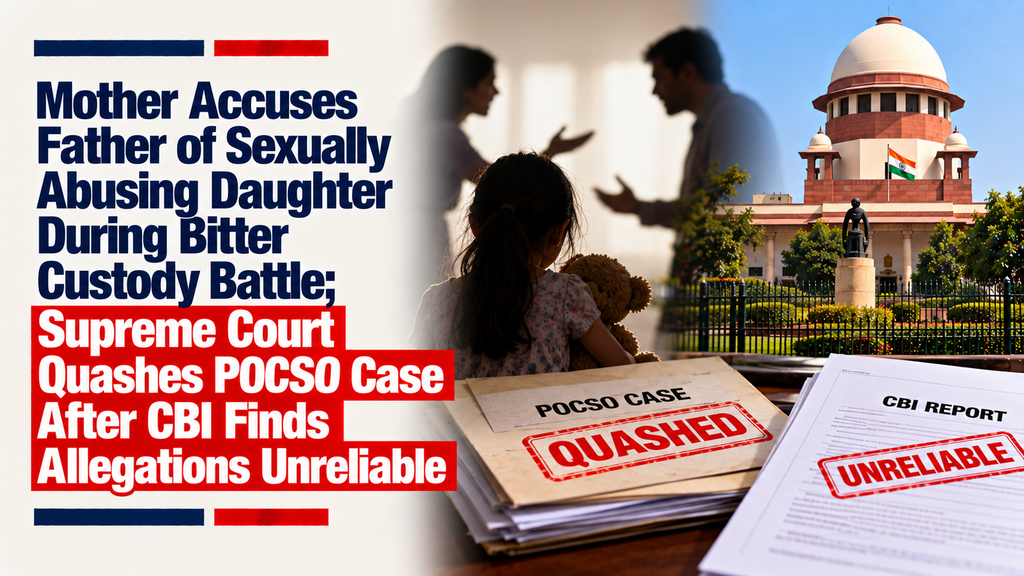
Mother Accuses Father of Sexually Abusing Daughter During Bitter Custody Battle; Supreme Court Quashes POCSO Case After CBI Finds Allegations Unreliable

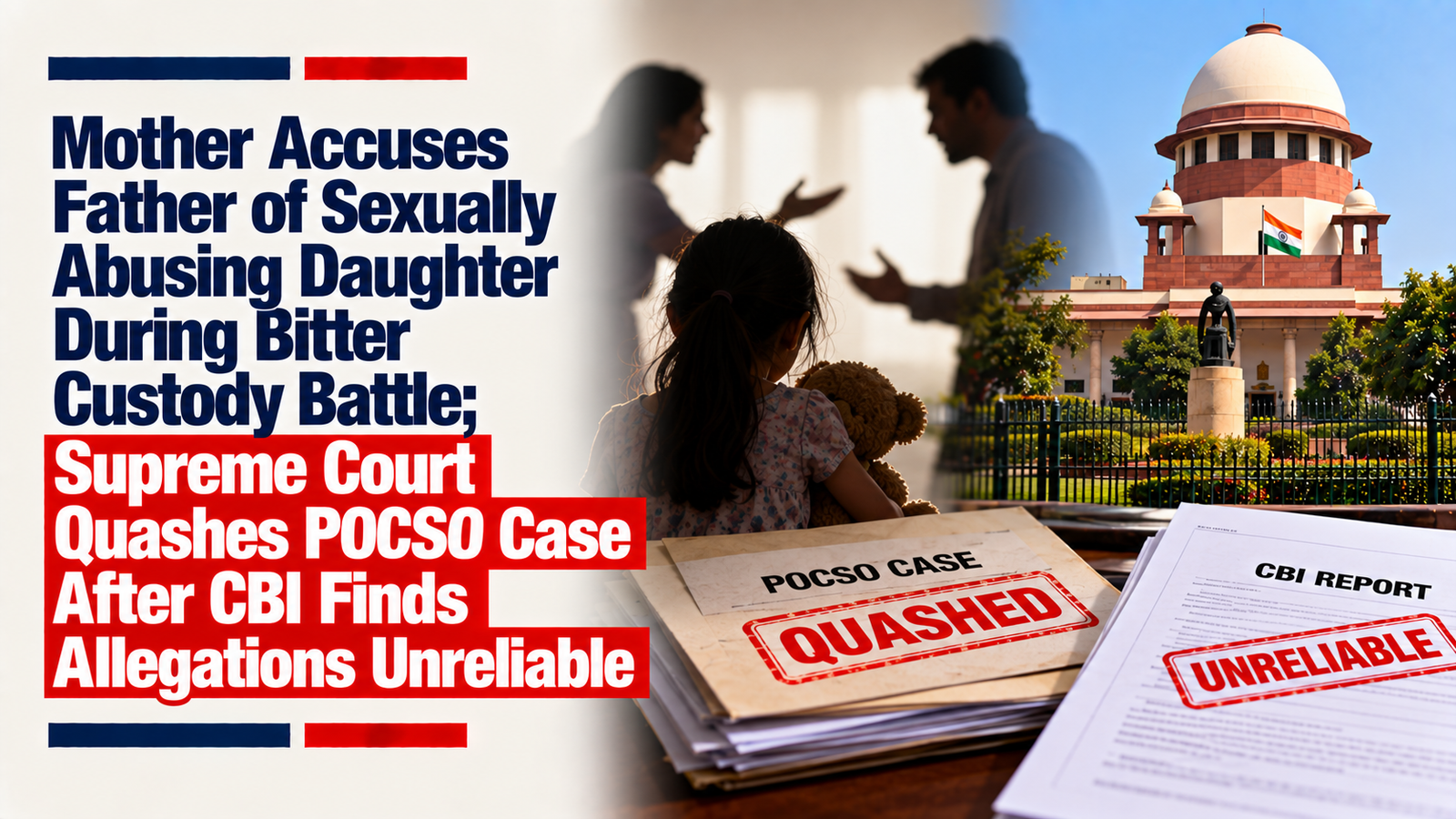
POCSO Case Filed Against Father After He Wins Child Custody; Supreme Court Quashes FIR, Says Continuing Prosecution Would Abuse Process
Facts
The case arose from an exceptionally acrimonious matrimonial and child-custody dispute between ‘R’ (father) and ‘E’ (mother). They married in 2011, both having been previously married, and their daughter ‘M’ was born in 2015. Serious matrimonial differences arose from 2017, and the mother left the matrimonial home with the child in April 2018.
The father instituted guardianship proceedings. On 3 March 2022, the Bengaluru Family Court granted him custody of the then seven-year-old child. The Karnataka High Court subsequently upheld the custody order while granting extensive visitation and communication rights to the mother.
The mother’s challenge ultimately failed before the Supreme Court, and on 7 June 2023, actual custody of the child was handed over to the father. Thereafter, several proceedings were initiated against him and his family members.
The controversy escalated dramatically when, on 28 March 2024, the mother lodged FIR No. 76/2024 against the father and his family members under the Protection of Children from Sexual Offences Act, 2012, Juvenile Justice Act and IPC. She alleged, among other things, that the father had sexually touched the child and compelled the child to touch him.
The Supreme Court eventually transferred the investigation to the CBI, directing constitution of a specialised committee headed by a senior CBI officer and involving psychological expertise.
Issues
The principal questions concerned whether the POCSO prosecution against the father and his family should survive after an independent CBI investigation; how the allegations affected the child’s custody and welfare; and how courts should deal with serious sexual-abuse allegations emerging in the middle of intensely contested matrimonial and custody proceedings.
A broader concern addressed by the Court was the potential misuse of stringent criminal provisions, particularly POCSO, as leverage in matrimonial and custody disputes.
Appellant’s Arguments / Father’s Case
The father’s case was that the allegations had to be viewed against the prolonged custody battle and the numerous proceedings initiated after custody was transferred to him.
The surrounding circumstances, independent evidence, CCTV footage, medical and psychological material and inconsistencies in the allegations were relied upon to contend that continuation of the criminal proceedings would amount to abuse of the judicial process.
Respondent’s Arguments / Mother’s Case
The mother’s allegations were that the child had been subjected to physical mistreatment and sexual harassment while residing with the father and his family.
According to the FIR, the child allegedly disclosed that her father had forcibly touched her private parts, pressured her to touch his private parts and threatened consequences if she disclosed the incidents.
Given the gravity of the allegations, the child was medically examined and her statements were recorded.
Analysis of the Law
CBI’s investigation became crucial
The Supreme Court did not decide the POCSO allegations merely on the basis of the matrimonial history.
The CBI conducted a wide-ranging investigation involving witnesses such as the child’s class teacher, tuition teacher, school counsellor, housemaid, neighbours and the parents’ co-employees. Importantly, CCTV footage from the father’s house, including footage covering crucial dates surrounding the alleged incidents, was forensically examined.
A detailed psychiatric and psychological assessment was also undertaken. The evaluation specifically examined disclosure history, witness statements, CCTV recordings, the child’s relationships with both parents and paternal family members, inconsistencies and the possibility of familial influence.
The assessment found no signs of anxiety or trauma consistent with the allegations and noted that prolonged parental conflict, continuing custody litigation, repeated discussions of the allegations, multiple psychological consultations and exposure to family narratives could have influenced the child’s perceptions and narrative.
CBI found allegations unfit for prosecution
The CBI concluded that the child’s testimony did not appear reliable or trustworthy when evaluated against the entire evidentiary record.
It identified contradictory accounts, lack of independent corroboration, CCTV footage suggesting a different sequence of events, and the psychiatric/psychological assessment. Taken cumulatively, the committee concluded that the allegations were not made out and the matter was not fit for prosecution.
Supreme Court quashed the POCSO proceedings
After independently considering the material and the CBI’s exhaustive report, the Supreme Court held that allowing the proceedings to continue would constitute a gross abuse of process.
Accordingly, FIR No. 76/2024—subsequently renumbered as CBI Case RC0352026S0003—was quashed against the father and three other family members.
Precedent Analysis
The Supreme Court used the case to examine a wider line of decisions concerning criminalisation of matrimonial disputes and misuse of POCSO allegations.
In Geddam Jhansi v. State of Telangana, the Court had cautioned that criminal proceedings in domestic disputes require specific allegations and credible supporting material; ordinary matrimonial discord should not automatically be converted into criminal prosecution.
In Achin Gupta v. State of Haryana, the Court had highlighted that children often become the principal sufferers when matrimonial disputes descend into retaliatory criminal litigation.
Particular reliance was placed on Ishwar Chand Sharma v. State of Uttar Pradesh (2026), where the Supreme Court had already expressed concern over false or vexatious POCSO allegations being deployed in matrimonial disputes and cautioned legal practitioners against encouraging concocted criminal complaints as settlement pressure.
The Court also referred to Suhara v. Muhammed Jaleel, where the Kerala High Court cautioned Family Courts that mere registration of a POCSO case against a biological parent does not establish that the allegation is true. Family Courts must examine the surrounding circumstances and investigation rather than treating the FIR itself as determinative of custody.
Court’s Reasoning
The judgment begins with a strong concern for the child rather than either parent.
The Supreme Court observed that a child caught in the crossfire between warring parents suffers enormously, and an unjustified sexual-abuse accusation against one parent can permanently damage the parent-child relationship while also causing humiliation and social consequences to the accused parent even after exoneration.
At the same time, the Court did not hold that allegations of sexual abuse made during custody litigation should automatically be disbelieved. Its discussion recognises that genuine cases require serious investigation and protection; the concern is with identifying cases where stringent criminal provisions are being invoked for collateral purposes.
On custody, the Court returned to the controlling principle: the welfare and best interests of the child.
The father had already succeeded before the Guardianship Court, the Karnataka High Court and the Supreme Court. The subsequent CBI findings reinforced the Court’s conclusion that the child’s welfare would presently be best served by remaining in the custody and guardianship of the father.
The Court also took judicial notice of what it described as an increasing tendency to misuse criminal proceedings to secure strategic advantage in matrimonial litigation.
Significantly, it discussed Section 22 of the POCSO Act, which penalises intentionally false complaints in specified circumstances. The Court observed that even though the statute contains such a deterrent, considerable reputational, liberty-related and custody-related damage may already occur by the time falsity is established.
Conclusion
The Supreme Court quashed the POCSO FIR and consequential CBI case against the father and three family members, finding that continuation of the prosecution on the material collected would amount to gross abuse of process.
The judgment is particularly significant because it goes beyond the individual prosecution and addresses the intersection between POCSO allegations, matrimonial warfare, child custody, psychological evaluation, criminal investigation and the welfare of the child.
The Court’s central caution is two-sided: genuine child sexual-abuse allegations must receive serious protection and investigation, but stringent child-protection legislation must not be converted into a weapon for gaining leverage in a custody or matrimonial dispute.
Case: ‘R’ v. ‘E’ & Anr.
Court: Supreme Court of India
Citation: 2026 INSC 1049
Civil Appeal: Civil Appeal No. 13119 of 2026, with connected criminal appeals and contempt proceedings
Judge: Justice K. V. Viswanathan (judgment authored)
Result: POCSO FIR against the father and three family members quashed; Court concluded that the child’s welfare would be best served in the father’s custody and guardianship.