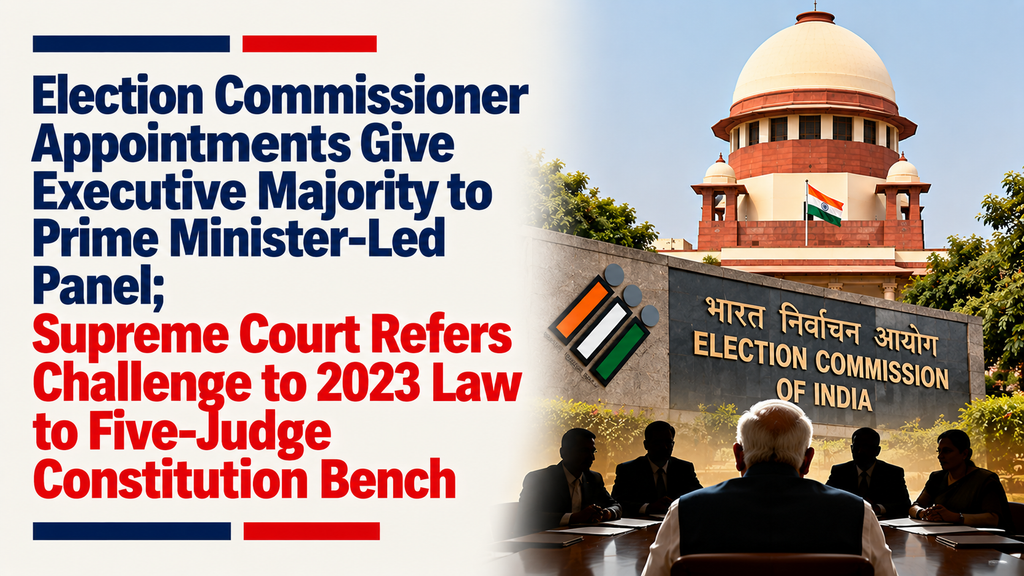
Election Commissioner Appointments Give Executive Majority to Prime Minister-Led Panel; Supreme Court Refers Challenge to 2023 Law to Five-Judge Constitution Bench

Chief Justice Removed From Election Commissioner Selection Panel Under 2023 Law; Supreme Court Refers Constitutional Validity Challenge to Five-Judge Bench
Facts
A batch of six writ petitions under Article 32 challenged provisions of the Chief Election Commissioner and Other Election Commissioners (Appointment, Conditions of Service and Term of Office) Act, 2023, principally Sections 7, 6 and 8(2), as unconstitutional under Article 14 read with Article 324. The petitions included those filed by Dr. Jaya Thakur, Association for Democratic Reforms, People’s Union for Civil Liberties and others.
The central controversy concerned Section 7, which provides that the Chief Election Commissioner and Election Commissioners are appointed on the recommendation of a Selection Committee comprising:
- Prime Minister — Chairperson;
- Leader of Opposition in the Lok Sabha — Member; and
- a Union Cabinet Minister nominated by the Prime Minister — Member.
The petitioners argued that this gives the executive a 2:1 numerical presence in the Selection Committee and compromises the institutional independence of the Election Commission.
The controversy arose against the background of the Constitution Bench decision in Anoop Baranwal v. Union of India (2023). In the absence of parliamentary legislation under Article 324(2), that judgment had temporarily directed that appointments be made on the advice of a committee consisting of the Prime Minister, Leader of Opposition and Chief Justice of India. Importantly, that arrangement was expressly temporary and was to operate only until Parliament enacted a law.
Parliament subsequently enacted the 2023 Act, under which the Chief Justice of India is not a member of the statutory Selection Committee.
During the hearing before the two-Judge Bench, the Attorney General and Solicitor General contended that the challenge raised a substantial question concerning interpretation of the Constitution and should therefore be considered by a Bench of at least five Judges under Article 145(3).
Issues
The immediate issue before the Court was not finally whether the 2023 Act is constitutional.
The threshold question was whether the challenges raised substantial questions of constitutional interpretation requiring adjudication by a Constitution Bench of at least five Judges under Article 145(3).
Underlying that question were significant issues concerning:
Article 324(2), the independence of the Election Commission, separation of powers, the effect of Anoop Baranwal, Parliament’s legislative power, and the constitutional permissibility of executive dominance in the appointment process.
Petitioners’ Arguments
The petitioners argued that the case did not require any fresh interpretation of the Constitution because the governing constitutional principles had already been settled by the five-Judge Constitution Bench in Anoop Baranwal.
According to them, that judgment recognised the necessity of insulating the Election Commission from exclusive executive control. Therefore, the present case merely required application of an already settled constitutional principle to the 2023 legislation.
They emphasised that their case was not necessarily that the Chief Justice of India must invariably sit on the Selection Committee. Their principal objection was to executive dominance in the statutory appointment mechanism.
They further argued that Parliament cannot simply legislatively overrule a binding constitutional principle declared by the Supreme Court. In their submission, the issue was whether Parliament had validly removed the basis of Anoop Baranwal, rather than whether Article 324 required reinterpretation.
The petitioners also objected to the Government seeking a Constitution Bench reference after substantial arguments had already taken place, describing it as a belated attempt that would delay adjudication.
Respondents’ Arguments
The Union argued that Anoop Baranwal did not permanently constitutionalise the three-member committee comprising the Prime Minister, Leader of Opposition and Chief Justice.
Rather, the committee prescribed there was an interim arrangement under Articles 32 and 142, expressly intended to operate only until Parliament enacted legislation under Article 324(2).
The Government argued that the presence of the Prime Minister and a Cabinet Minister alongside the Leader of Opposition does not automatically establish bias, partisanship or institutional unfairness.
According to the Union, Parliament had exercised its legislative judgment in establishing a collegial selection body comprising senior constitutional functionaries, and executive numerical superiority could not by itself invalidate the arrangement.
The Government maintained that the dispute raises deeper questions: whether judicially created interim norms can constrain subsequent legislation, whether Parliament can choose a different mechanism, and whether the legislation can be invalidated without evidence of an actual threat to Election Commission independence. It therefore sought consideration by at least five Judges.
Analysis of the Law
A crucial distinction in the judgment concerns what Anoop Baranwal actually decided.
The Constitution Bench had found that Article 324(2) contemplated parliamentary legislation governing appointments to the Election Commission. Because Parliament had failed to enact such legislation for more than seven decades, the Court identified a constitutional vacuum and prescribed an interim mechanism.
The 2023 Act has now filled that legislative vacuum.
Accordingly, the constitutional controversy is no longer simply whether the executive can appoint Election Commissioners in the absence of legislation. The new issue concerns the constitutional limits, if any, upon Parliament itself when designing the statutory appointment mechanism.
That distinction is central to why the present controversy raises substantial questions concerning Article 324, separation of powers, institutional independence and the legal effect of Anoop Baranwal.
Precedent Analysis
Anoop Baranwal v. Union of India
The Constitution Bench held that the prolonged absence of legislation under Article 324(2) had created a constitutional vacuum. Until Parliament enacted a law, appointments were to be made on the advice of a committee comprising the Prime Minister, Leader of Opposition and Chief Justice of India.
The present opinion stresses that this arrangement was expressly pro tem. It was designed to hold the field until Parliament acted and was not expressed as a permanent statutory formula Parliament was required to reproduce verbatim.
This creates the deeper constitutional question: although Parliament was free to enact a law different from the interim mechanism, what constitutional limitations govern the structure Parliament chooses?
Court’s Observations on Election Commission Independence
The opinion contains substantial observations on the constitutional importance of insulating the Election Commission from executive influence.
It noted that Article 324(2) was intended to address the institutional problem arising from executive control over the electoral arbiter and discussed the historical failure of successive governments to enact the legislation contemplated by the Constitution.
Significantly, the Court did not attribute this historical problem to any single political party or government. It described the concern as one extending across different political dispensations over decades.
The opinion observed that the 2023 Act represents Parliament’s first attempt to fill the constitutional vacuum. Whether that statute adequately insulates the Election Commission from the Government of the day, or instead recalibrates executive control, was identified as a question requiring adjudication on the merits.
Significant Observations on the Collegium
The Solicitor General had drawn a comparison with criticism that the judicial Collegium operates on a “Judges appoint Judges” model.
The Court responded at some length.
It acknowledged that the Collegium has faced criticism and has not been entirely free from imperfections, but observed that executive supremacy cannot be the cure for those deficiencies.
The opinion described the popular expression “Judges appoint Judges” as a myth, noting that the executive, intelligence agencies and ultimately the President all have roles in the judicial appointment process.
It further recorded concerns regarding instances where Collegium recommendations have remained pending or have been implemented selectively by the executive.
These observations are important parts of the opinion, although they arose in response to the Government’s analogy and are distinct from the core constitutional challenge concerning Election Commissioner appointments.
Conclusion
The central significance of the opinion is that the challenge to the 2023 Election Commissioner appointment regime raises foundational constitutional questions concerning Article 324, Election Commission independence, Parliament’s legislative authority, separation of powers and the precedential effect of Anoop Baranwal.
The Court’s consideration at this stage concerns whether those questions require adjudication by a Constitution Bench under Article 145(3) rather than finally deciding the validity of the statutory appointment mechanism itself.
Accordingly, the judgment should not be reported as the Supreme Court having struck down or upheld the 2023 Election Commissioner appointment law. The constitutional validity of the challenged provisions remains the substantive controversy to be adjudicated.
Case: Dr. Jaya Thakur & Ors. v. Union of India & Anr. with connected petitions
Court: Supreme Court of India
Citation: 2026 INSC 1040
Lead Case: Writ Petition (Civil) No. 14 of 2024
Judge authoring the opinion: Justice Dipankar Datta
Core controversy: Constitutional validity of Sections 6, 7 and 8(2) of the 2023 Election Commissioners Appointment Act, particularly the composition of the Selection Committee.