Delhi High Court Refuses DUSIB Licensees’ Continuation Until Fresh Tender; Holds Six-Month Extension Is Maximum and Investments Cannot Create Right to Remain in Possession

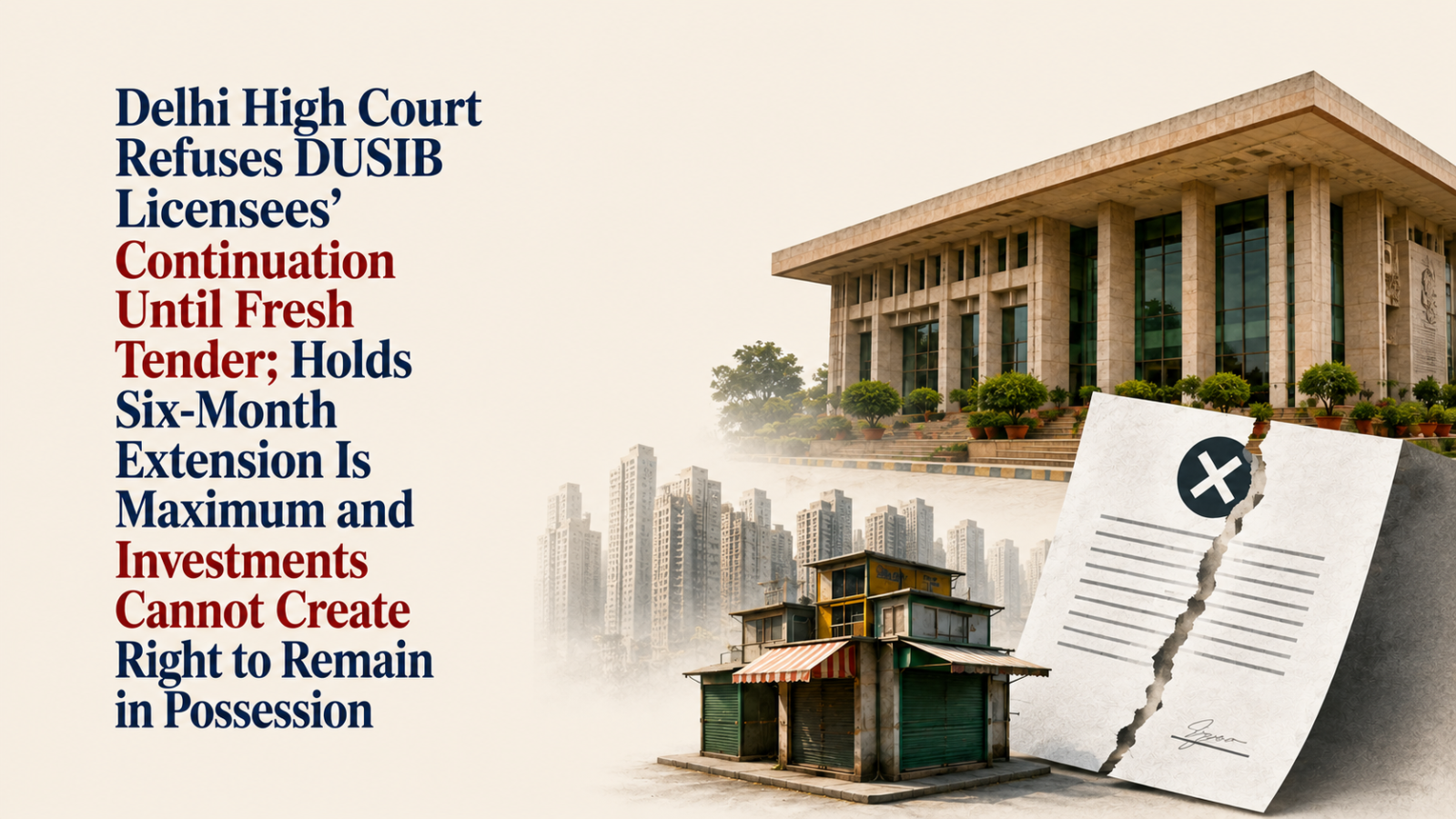
Delhi High Court Orders DUSIB Licensees to Vacate After Maximum Six-Month Extension; Holds Clause 6 Cannot Be Interpreted to Create Open-Ended Licence
Facts
The Delhi High Court decided three connected intra-court appeals filed by Kawatra Hospitality Pvt. Ltd., Kawatra Tent and Caterers Pvt. Ltd., and M/s Eswara Kamadhenu Restaurant Pvt. Ltd. against judgments dated 3 August 2026 dismissing their writ petitions against the Delhi Urban Shelter Improvement Board (“DUSIB”).
The appellants had entered into agreements with DUSIB for allotment of different land parcels/sites under its management. The agreements provided an initial tenure of two years. Clause 6 further contemplated that if DUSIB could not finalise the fresh auction process before expiry, it could extend the agreements quarterly for a period of up to six months on the same terms and conditions.
The original agreements expired on 26/27 December 2025. DUSIB initially granted a three-month extension and thereafter another three-month extension, meaning that the appellants received the entire six-month extended period contemplated under Clause 6.
Before expiry of the second extension, DUSIB directed the appellants to vacate the lands. The appellants requested that they be permitted to continue until DUSIB completed the fresh tender process. When DUSIB again directed them to vacate on 25 June 2026, they approached the High Court seeking continuation of possession until completion of the fresh tender.
The Single Judge dismissed their writ petitions, holding that the appellants were only licensees and possessed no contractual, statutory or vested right to continue after exhausting the maximum contractual tenure, including the six-month extension. They were granted one week to remove their structures and hand over possession. DUSIB undertook to complete the fresh tender process within six weeks.
The licensees challenged these orders before the Division Bench.
Issues
The principal issue before the Division Bench was whether the appellants were entitled to continue occupying the DUSIB lands beyond the maximum six-month extension until DUSIB completed the fresh tender process and executed new agreements.
The Court also considered:
- Whether the last sentence of Clause 6, stating that the old agreement would end upon execution of the new agreement, meant that existing licensees could continue indefinitely until a fresh agreement was actually executed.
- Whether DUSIB’s failure to complete the tender process within six months entitled the appellants to a further extension.
- Whether the use of the word “shall” regarding completion of the auction process created an enforceable right in favour of existing licensees.
- Whether substantial investments made by the appellants in developing the licensed lands created an equitable or legal right to continue.
- Whether the appellants were entitled to the same six-week period for vacation that DUSIB had been granted for completing the fresh tender process.
Appellants’ Arguments
The appellants argued that Clause 6 had to be read holistically.
According to them, the clause expressly stated that the old agreement would come to an end only from the date on which the new agreement was executed. Therefore, even though the express six-month extension had expired, the existing agreements continued until completion of the fresh auction and execution of agreements with successful bidders.
They further argued that substantial investments had been made in the lands to make them suitable for their licensed commercial activities. Requiring them to vacate before completion of the fresh tender would cause significant financial loss and, according to them, could also result in loss to the public exchequer.
The appellants expressed willingness to continue paying the existing licence fee and other applicable charges, or even a higher amount, until fresh agreements were executed.
They also contended that while DUSIB had been granted six weeks to complete the fresh tender, they had been given only one week to vacate, which they argued was inequitable.
The appellants particularly relied upon the word “shall” in Clause 6, contending that DUSIB was mandatorily required to complete the fresh tender process within the six-month extension.
Since DUSIB had failed to fulfil that obligation, they argued that DUSIB could not require them to vacate and that their existing agreements necessarily continued until fresh agreements were executed.
Respondent’s Arguments
DUSIB opposed the appeals and relied upon the plain contractual terms.
It submitted that the agreements provided for a fixed tenure and permitted extension only up to the expressly stipulated maximum period.
Once that period had expired, the appellants had no contractual entitlement to remain in possession merely because DUSIB had not yet completed the fresh tender.
DUSIB also reiterated its commitment, recorded before the Single Judge, to complete the fresh tender process within six weeks from the date of the impugned judgments.
Analysis of the Law
Fixed-Term Licence Cannot Become Indefinite
The Division Bench rejected the appellants’ interpretation of Clause 6.
The Court held that the agreements were fundamentally fixed-term licences. The initial period was two years and the contractual mechanism permitted an additional extension only up to six months.
Interpreting the final sentence of Clause 6 as allowing occupation until DUSIB eventually completed the fresh tender would transform a fixed-term agreement into an open-ended licence of indefinite duration. Such an interpretation would alter an essential contractual term and could not be accepted.
Last Sentence of Clause 6 Must Be Read Contextually
The appellants relied heavily upon the sentence stating that the old agreement would end from the date of execution of the new agreement.
The Court held that this sentence could not be read in isolation.
It operated in the context of a fresh tender being initiated and completed within the six-month extension period. If DUSIB completed the tender within that period, the existing agreement could continue until execution of the replacement agreement.
But if DUSIB failed to complete the process within those six months, the clause did not grant the incumbent licensee an unlimited extension until a new agreement was eventually executed.
DUSIB’s Tender Delay Does Not Create Continued Possessory Rights
The Court accepted that Clause 6 contemplated completion of the fresh tender during the extended period.
However, DUSIB’s inability to complete the process within that period did not automatically enlarge the contractual rights of the appellants.
The maximum extension remained six months, and failure to complete the auction could not be used to rewrite the contract and extend the licences indefinitely.
Investments Do Not Override Express Contractual Terms
The Court rejected the argument that substantial investments made by the licensees justified their continued possession.
The appellants had voluntarily entered into agreements knowing their duration and termination conditions.
Clause 5 expressly required them to return vacant and peaceful possession upon expiry.
Financial loss flowing from compliance with an agreed contractual term could therefore not create a legal entitlement to extend the licence beyond its stipulated duration.
Precedent Analysis
Kawatra Tent and Caterers Private Limited v. Director (R.P. Cell), Delhi Urban Shelter Improvement Board & Anr., 2023:DHC:7500-DB
The Single Judge had relied upon an earlier Division Bench decision involving substantially similar contractual clauses, and the present Division Bench endorsed its relevance.
In that case, the Court had held that the contractual relationship between DUSIB and the occupant was solely one of licensor and licensee.
No proprietary or vested right was created in favour of the licensee.
Most importantly, once the maximum contractual period expired, the licensee possessed no legal or inherent right to continue occupying the land.
The precedent also rejected the proposition that expenditure or investment by a licensee on the licensed land could create a special right to continuation.
The present Division Bench applied the same reasoning and held that commercial consequences arising from expiry cannot override express contractual stipulations.
Court’s Reasoning
The Division Bench agreed with the Single Judge that Clause 6 permitted an extension only up to six months.
The expression “can be further extended” demonstrated that the extension itself was within DUSIB’s discretion, while the six-month period constituted the outer contractual limit.
The appellants had already received the entire benefit of that extension.
Their interpretation of the clause would mean that whenever DUSIB failed to complete a fresh tender within six months, the existing licensee could remain indefinitely until DUSIB eventually executed a replacement agreement. The Court found that such an interpretation would fundamentally change the agreed duration of the licence.
The Court also rejected the investment argument because the appellants had entered into the agreements with full knowledge that the sites would have to be vacated after the contractual term.
Investments made for commercial use of the licensed sites could not convert temporary contractual possession into a vested or continuing right.
Finally, the Court rejected the appellants’ request for parity with the six weeks granted to DUSIB.
The one-week period granted by the Single Judge was merely a practical concession allowing dismantling of pandals and other structures. It did not flow from any legal right.
By contrast, the six-week direction to DUSIB arose from its undertaking concerning completion of the tender process. The two periods therefore served entirely different purposes and could not be equated.
The Division Bench consequently found no infirmity in the Single Judge’s judgments and no ground warranting appellate interference.
Conclusion
The Delhi High Court dismissed all three intra-court appeals.
It held that the appellants had no right to continue occupying the DUSIB lands after exhausting the maximum six-month contractual extension, merely because DUSIB had not yet completed the fresh tender process.
Clause 6 could not be interpreted so as to convert a fixed-term licence into an indefinite arrangement dependent upon execution of a future agreement.
The Court further held that substantial investments and potential financial losses did not confer any special or vested right upon the appellants to retain possession contrary to the contractual terms.
However, since the period earlier granted for vacation expired on the date of judgment, the Division Bench granted the appellants one additional week from 10 August 2026 to vacate the respective lands on the same terms imposed by the Single Judge.
The Court simultaneously reiterated that DUSIB must complete the fresh tender process within six weeks from 3 August 2026. The appeals were dismissed without any order as to costs.
Case Details
Case: Kawatra Hospitality Pvt. Ltd. v. Director (R.P. Cell), Delhi Urban Shelter Improvement Board & Anr. with connected appeals
Court: High Court of Delhi at New Delhi
Case Numbers: LPA 619/2026, LPA 620/2026 & LPA 621/2026
Judges: Chief Justice Devendra Kumar Upadhyaya and Justice Tejas Karia
Date: 10 August 2026
Result: Appeals dismissed; appellants granted one additional week to vacate DUSIB lands, while DUSIB was directed to conclude the fresh tender process within six weeks from the Single Judge’s judgments.