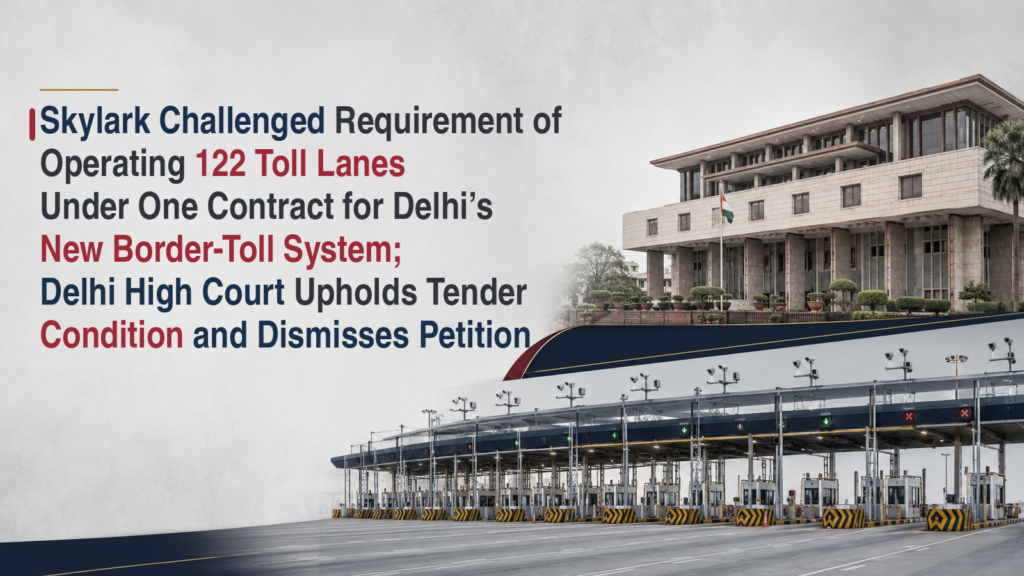
Municipal Corporation Required Experience of Managing Half of Delhi’s 244 Toll Lanes Under One Contract; Delhi High Court Finds Condition Rational, Not Anti-Competitive
Facts
The Municipal Corporation of Delhi issued a Notice Inviting Tender dated 5 June 2026 for:
“Engagement of a Contractor by the Municipal Corporation of Delhi for Toll Tax and Environment Compensation Charge Collection at Border Points from Specified Commercial Vehicles Entering Delhi and Upgrade of the Existing Radio-Frequency Identification System to Multi-Lane Free-Flow-Based Collection.”
The project covered 154 border points comprising 244 toll lanes. It proposed an integrated technology-driven system involving:
- Radio-Frequency Identification;
- Automatic Number Plate Recognition;
- Multi-Lane Free-Flow toll collection;
- Centralised monitoring;
- Real-time transaction processing;
- Toll-tax and Environment Compensation Charge collection;
- Revenue reconciliation; and
- A unified Management Information System.
The tender prescribed that a bidder must have experience of operating at least 50 per cent of the project’s total lanes. Since the project involved 244 lanes, the bidder was required to have experience of operating at least 122 toll lanes under a single contract for a total minimum period of two years, with each relevant contract having a minimum duration of one year.
For a bidding joint venture, the non-lead member was required to possess experience of operating at least 10 per cent of the total toll lanes under a single contract for the prescribed period.
Skylark Infra Engineering Private Limited did not independently satisfy the requirement of operating 122 lanes under a single contract. It therefore challenged the eligibility condition before the Delhi High Court under Article 226 of the Constitution of India.
Earlier Tender History
A similar 122-lane condition had previously been introduced in a tender dated 7 February 2024 concerning the Radio-Frequency Identification ecosystem.
Skylark participated in that tender as a 37 per cent joint-venture partner of Sahakar Global Limited. The joint venture was declared the highest-revenue bidder. However, no Letter of Intent was issued.
The joint venture consequently filed an earlier writ petition. In that proceeding, the Municipal Corporation of Delhi stated that it had reconsidered the matter and regarded the 122-lane condition as anti-competitive. The existing contractor was permitted to continue temporarily until a fresh tender was issued.
A fresh tender dated 14 May 2025 was issued without the 122-lane condition but was withdrawn before the bidding process commenced. The Municipal Corporation subsequently passed Corporate Resolution Number 32 dated 10 July 2025, omitting the requirement.
However, the condition was reintroduced in the tender dated 5 June 2026.
Skylark’s Previous Experience
Skylark claimed that it had successfully operated toll-tax and Environment Compensation Charge collection at the same 154 Delhi border points from 2021 to 2026 as a 37 per cent joint-venture partner of Sahakar Global Limited.
It also relied upon its wider experience of handling multiple toll projects:
| Financial Year | Toll Revenue | Toll Plazas | Toll Lanes |
| 2025–2026 | ₹3,422.97 crore | 53 | 656 |
| 2024–2025 | ₹2,683.71 crore | 71 | 937 |
| 2023–2024 | ₹2,678.98 crore | 61 | 756 |
| Total | ₹8,785.66 crore | 185 | 2,349 |
Skylark argued that its combined experience across multiple projects was substantially greater than the stipulated 122 lanes. Nevertheless, because that experience was not acquired under one contract in Skylark’s independent capacity, it was declared technically ineligible.
Participation in the 2026 Tender
Seven entities submitted bids. The Municipal Corporation informed the Court that:
- Inderdeep Infra India Limited qualified;
- Infrastructure Developers Limited qualified;
- Sahakar Global Limited qualified;
- Eagle Infra India Limited would have qualified but was rejected because it had been debarred by the Public Works Department, Maharashtra;
- Jaypee Infratech Limited submitted a non-responsive bid due to insufficient documents;
- Sri Sai Enterprises and Developers Private Limited did not qualify; and
- Skylark Infra Engineering Private Limited did not qualify.
Thus, three bidders satisfied the challenged requirement, while one additional bidder possessed the required experience but was rejected for an independent reason.
Issues
- Whether the condition requiring experience of operating at least 122 toll lanes under a single contract was arbitrary or irrational.
- Whether the condition had a rational connection with the scale and technological requirements of the project.
- Whether experience acquired through multiple independent contracts could be treated as equivalent to experience under one integrated contract.
- Whether Skylark’s earlier experience as a 37 per cent joint-venture partner entitled it to participate independently in the new tender.
- Whether reintroduction of the condition, after it had previously been described as anti-competitive and omitted from an earlier tender, violated Article 14 of the Constitution.
- Whether the requirement unduly restricted competition or created an entry barrier favouring a small class of established operators.
- Whether Skylark’s exclusion violated its right to carry on trade and business under Article 19(1)(g) of the Constitution.
- Whether the High Court could rewrite or dilute technical eligibility conditions prescribed by the tendering authority.
- Whether interference with the tender condition was warranted under the limited principles of judicial review governing government contracts.
Petitioner’s Arguments
Skylark Infra Engineering Private Limited
Skylark argued that the primary object of the tender was not conventional toll collection but implementation of a technology-driven Multi-Lane Free-Flow system.
The project required integration of Radio-Frequency Identification and Automatic Number Plate Recognition technology. Therefore, according to Skylark, prior experience of operating 122 conventional toll lanes under a single contract had no rational connection with the technological capability required for the project.
Skylark further submitted that:
- It had operated toll collection at the same 154 Delhi border points between 2021 and 2026.
- It possessed valuable site-specific experience relating to the exact locations covered by the tender.
- It had extensive experience of managing hundreds of toll lanes under multiple contracts.
- Simultaneously operating several separate projects required equal, if not greater, managerial and technical capability than operating a large number of lanes under one contract.
- The National Highways Authority of India and the Uttar Pradesh Expressways Industrial Development Authority ordinarily awarded shorter contracts covering fewer lanes.
- Skylark had been prequalified in Category One by the National Highways Authority of India after an assessment of its technical and financial capabilities.
- The Municipal Corporation had previously admitted that the 122-lane requirement was restrictive and anti-competitive.
- Corporate Resolution Number 32 dated 10 July 2025 had deliberately removed the requirement.
- No significant change justified the condition’s reintroduction.
- The condition artificially narrowed the number of eligible bidders.
- Restricting participation to established operators could promote cartelisation.
- Reduced competition could cause financial loss to the public exchequer.
- The condition violated the level-playing-field requirement under Article 14 of the Constitution.
- Excluding an otherwise competent and experienced contractor imposed an unreasonable restriction upon its right to conduct business under Article 19(1)(g).
Skylark asked the Court to quash the tender, direct the Municipal Corporation to permit its participation and require consideration of its bid.
Respondent’s Arguments
Municipal Corporation of Delhi
The Municipal Corporation first argued that Skylark was barred by the principle of estoppel.
It submitted that Skylark had participated in the 2024 tender containing the same eligibility condition as part of a joint venture. It had not challenged the condition at that time because the joint venture was declared the highest-revenue bidder.
The Municipal Corporation also pointed out that Skylark had submitted its bid in the present tender despite simultaneously challenging the eligibility criteria.
On the merits, the Municipal Corporation submitted that the new tender was fundamentally different from the previous Radio-Frequency Identification-based contract.
The new project involved:
- 154 Delhi border points;
- 244 toll lanes;
- Radio-Frequency Identification;
- Automatic Number Plate Recognition;
- Multi-Lane Free-Flow collection;
- Centralised monitoring;
- Real-time processing of transactions;
- A unified database;
- Revenue reconciliation;
- Toll-tax collection; and
- Environment Compensation Charge collection.
The tender was issued pursuant to recommendations of the Commission for Air Quality Management and directions passed by the Supreme Court in the M.C. Mehta v. Union of India proceedings.
The Multi-Lane Free-Flow system was required to be implemented by October 2026. Under Article 144 of the Constitution, all civil and judicial authorities were required to act in aid of the Supreme Court.
The Municipal Corporation stated that more than 4.12 crore commercial vehicles entered Delhi during 2025. The selected contractor would therefore be required to process millions of transactions within one integrated operational system.
It argued that:
- Managing multiple independent projects was not equivalent to managing one large integrated project.
- Separate projects may operate through different software systems, databases, reporting mechanisms and accountability structures.
- Experience of comparable scale under one contract reduced implementation risk.
- The condition was a legitimate technical safeguard rather than an arbitrary exclusion.
- Several projects across India involved more than 122 toll lanes.
- Several established contractors possessed the required experience.
- Three bidders had actually satisfied the eligibility condition.
- One additional bidder had the necessary experience but was disqualified because of debarment.
- The requirement was therefore neither tailor-made nor anti-competitive.
- Tender conditions are policy and commercial decisions belonging to the procuring authority.
- A bidder cannot dictate the eligibility criteria to suit its own experience.
- Courts can interfere only where tender conditions are mala fide, discriminatory, irrational or against public interest.
Analysis of the Law
Limited Judicial Review in Tender Matters
The High Court reiterated that the award of public contracts is principally a commercial and administrative function.
A court exercising jurisdiction under Article 226 of the Constitution does not sit as an appellate authority over:
- The commercial wisdom of the tendering authority;
- The technical suitability of eligibility conditions;
- The preferred operational model; or
- The authority’s assessment of the experience required for a project.
Judicial review is generally confined to examining whether the decision-making process is affected by:
- Arbitrariness;
- Mala fides;
- Bias;
- Discrimination;
- Irrationality;
- Favouritism; or
- Harm to public interest.
The authority framing a tender must be granted sufficient flexibility or “play in the joints” while making technical and commercial decisions.
Article 14 and Level Playing Field
Article 14 of the Constitution applies even to the State’s contractual dealings. Tender conditions must therefore be transparent, certain and uniformly applied.
Courts may intervene where:
- Conditions are deliberately designed to favour a particular bidder;
- Evaluation standards are changed during the process;
- Similarly situated bidders are treated differently;
- Criteria are vague or undisclosed; or
- The condition is so irrational that no reasonable authority would have adopted it.
However, a condition does not become discriminatory merely because some companies cannot satisfy it. A uniformly applicable experience requirement can lawfully distinguish between bidders who possess the required capacity and those who do not.
Single-Contract Experience Versus Multiple Contracts
The Court accepted the Municipal Corporation’s distinction between experience gained under one integrated contract and experience gained under several independent contracts.
Multiple contracts may involve different:
- Software platforms;
- Databases;
- Operating protocols;
- Reporting systems;
- Toll authorities;
- Accountability structures; and
- Revenue-reconciliation mechanisms.
Managing one integrated project across 244 lanes required unified control, centralised monitoring and coordinated processing of millions of transactions.
The Court therefore held that the Municipal Corporation was entitled to consider single-contract experience particularly relevant to the project.
Experience Through a Joint Venture
Skylark’s earlier experience was acquired as a 37 per cent partner in a joint venture led by Sahakar Global Limited. It had not independently executed the earlier Delhi toll contract.
Sahakar Global Limited, the former lead partner, decided to participate independently in the 2026 tender. As a result, the previous joint venture was no longer participating.
The Court held that Skylark’s inability to qualify resulted from:
- Discontinuation of the earlier joint venture; and
- Skylark’s inability to satisfy the condition independently.
It did not result from arbitrary treatment by the Municipal Corporation.
Permitting Skylark to rely upon the joint venture’s entire experience while bidding alone would amount to relaxing a uniformly applicable condition and could prejudice other bidders.
Articles 19(1)(g) and Public Tenders
Article 19(1)(g) protects the right to practise a profession or carry on an occupation, trade or business.
However, there is no fundamental right to obtain a government contract or to insist that a tender authority frame eligibility conditions suited to a particular bidder.
The challenged condition did not prevent Skylark from carrying on its infrastructure or toll-management business. It merely prescribed the experience necessary for participation in one particular public tender.
The inability to qualify for one contract did not amount to an unreasonable restriction on Skylark’s right to conduct business.
Public Interest
The Court rejected the argument that public interest always requires the widest possible participation.
Public interest in procurement includes:
- Meaningful competition;
- Timely completion;
- Technical competence;
- Protection of public revenue;
- Reliable infrastructure;
- Compliance with environmental directions; and
- Reduction of implementation risk.
The Court held that widening competition by diluting technical safeguards could itself harm public interest, particularly when the project had to be completed within a Supreme Court-mandated timeline and was connected with Delhi’s air-quality concerns.
Precedent Analysis
Tata Cellular v. Union of India
The Supreme Court held that courts should review the decision-making process rather than the commercial merits of a tender decision.
The Government must be allowed reasonable “play in the joints”, subject to the requirement that its decision should not be arbitrary, biased, mala fide or irrational.
This supported judicial restraint toward the Municipal Corporation’s technical assessment.
Michigan Rubber (India) Limited v. State of Karnataka
The Supreme Court held that formulating tender conditions and eligibility requirements ordinarily falls within the executive’s domain.
Courts should interfere only where a condition is arbitrary, discriminatory, mala fide, irrational or contrary to public interest.
The Delhi High Court found none of these defects in the 122-lane condition.
Jagdish Mandal v. State of Orissa
The Supreme Court formulated three principal questions for examining tender disputes:
- Was the process mala fide or intended to favour someone?
- Was the decision so arbitrary and irrational that no reasonable authority could have taken it?
- Was public interest adversely affected?
If the answers are negative, courts should ordinarily not interfere.
The High Court found no favouritism, irrationality or harm to public interest.
Reliance Energy Limited v. Maharashtra State Road Development Corporation Limited
The Supreme Court held that Article 14 applies to public procurement and requires legal certainty, transparency and a level playing field.
The Delhi High Court found that the eligibility condition was disclosed in advance and applied uniformly to all bidders. It did not involve any hidden criterion or shifting benchmark.
Vinishma Technologies Private Limited v. State of Chhattisgarh
This decision reiterated that courts do not sit in appeal over the merits of technical tender conditions. Judicial review examines only whether the decision-making process is arbitrary, discriminatory, irrational or mala fide.
Although Skylark relied upon this decision, the Court held that its principles did not justify interference because the Municipal Corporation had provided a rational explanation for the condition.
Raunaq International Limited v. I.V.R. Construction Limited
This decision emphasised the importance of public interest, timely project execution and restraint against unnecessary interference in public contracts.
Afcons Infrastructure Limited v. Nagpur Metro Rail Corporation Limited
The Supreme Court recognised that the author of a tender is ordinarily best placed to understand and interpret its technical requirements. Courts should defer to that understanding unless it is unreasonable or mala fide.
Meerut Development Authority v. Association of Management Studies
The Supreme Court reiterated that the terms of an invitation to tender belong primarily to the contractual domain. A bidder has no enforceable right to insist upon terms that favour its participation.
M/s Dhingra Constructions Company v. Municipal Corporation of Delhi
Skylark relied upon this judgment to challenge an allegedly restrictive tender condition. However, the High Court found the present requirement justified by the project’s scale, integrated nature and implementation deadline.
Sabre Global Incorporated v. Air India Limited
This decision was cited for the restricted scope of judicial intervention in complex commercial and technical procurement decisions.
Court’s Reasoning
The Delhi High Court held that the tender condition had a rational connection with the project’s requirements.
The following considerations were decisive:
- The project involved 154 border points and 244 toll lanes.
- It was not a conventional toll-collection contract.
- It required an integrated Multi-Lane Free-Flow system using Radio-Frequency Identification and Automatic Number Plate Recognition.
- The contractor would be responsible for centralised monitoring, real-time transactions, data integration and revenue reconciliation.
- More than 4.12 crore commercial vehicles had entered Delhi during 2025.
- The Municipal Corporation was entitled to require experience comparable with the project’s scale.
- Experience under several independent contracts was not necessarily equivalent to experience under one integrated contract.
- Skylark’s earlier experience had been acquired as a 37 per cent joint-venture partner and not as an independent contractor.
- The former lead partner, Sahakar Global Limited, was independently participating and had qualified.
- Skylark’s ineligibility arose because the earlier joint venture had ended and Skylark could not satisfy the condition on its own.
- The new project was technologically different from the earlier Radio-Frequency Identification-only tender.
- The Municipal Corporation was entitled to revise its earlier policy in response to changing technology and operational requirements.
- The system had to be implemented within the timeline fixed pursuant to the Supreme Court’s directions.
- The Municipal Corporation was not required to take implementation risks merely to allow a wider class of bidders to participate.
- Three bidders qualified, while one additional bidder possessed the required experience but was rejected for debarment.
- The condition was therefore not tailor-made for one bidder and did not eliminate meaningful competition.
- Skylark’s financial strength and National Highways Authority of India prequalification could not replace the tender-specific experience condition.
- Inability to satisfy a tender requirement does not make that requirement unconstitutional.
- The condition did not prevent Skylark from carrying on its business and therefore did not violate Article 19(1)(g).
- The High Court could not rewrite or dilute the eligibility conditions framed by the Municipal Corporation.
Conclusion
The Delhi High Court held that the requirement of having experience of operating at least 122 toll lanes under a single contract was neither arbitrary nor irrational.
The condition had a direct connection with:
- The project’s scale;
- Its integrated technological structure;
- The volume of commercial vehicles entering Delhi;
- The need for centralised operations;
- The Supreme Court-mandated implementation timeline; and
- The larger public and environmental interest.
The Court held that the condition did not violate Article 14 or Article 19(1)(g) of the Constitution and was not affected by mala fides, discrimination or irrationality.
Accordingly:
- Skylark’s writ petition was dismissed;
- The 122-lane technical eligibility requirement was upheld; and
- All pending applications were closed.
Case Details
Case: Skylark Infra Engineering Private Limited v. Municipal Corporation of Delhi, 2026:DHC:5745-DB
Court: High Court of Delhi at New Delhi, Division Bench
Case Number: Writ Petition (Civil) Number 8368 of 2026
Applications: Civil Miscellaneous Application Numbers 39327 and 39328 of 2026
Judges: Justice Anil Kshetrapal and Justice Shail Jain
Reserved On: 7 July 2026
Date of Judgment: 20 July 2026
Result: Petition dismissed; the requirement of prior experience of operating at least 122 toll lanes under a single contract was upheld as rational, non-discriminatory and consistent with Articles 14 and 19(1)(g) of the Constitution.