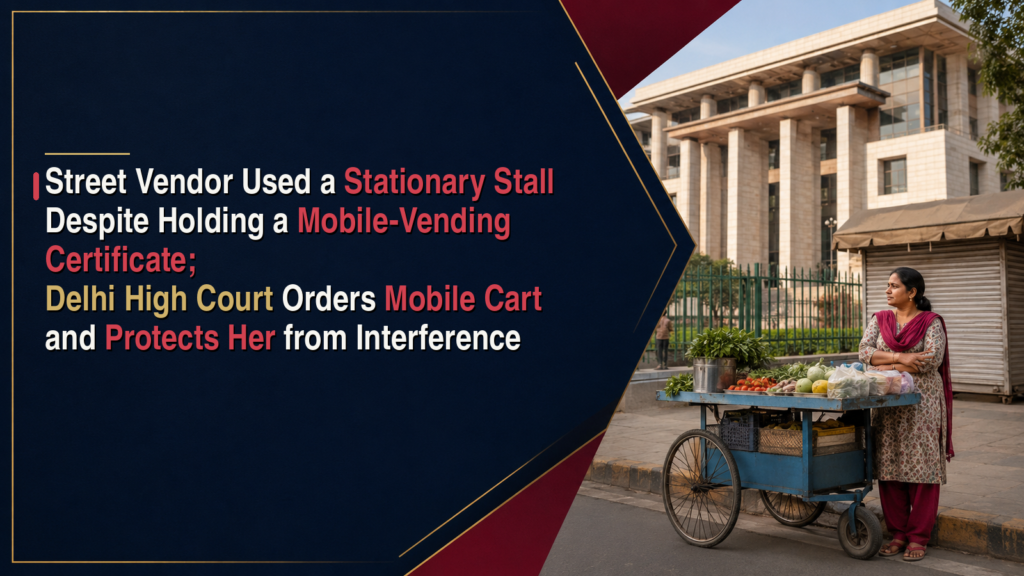
Woman Vendor Alleged Police and Municipal Obstruction; Delhi High Court Allows Vending Subject to Certificate Conditions
Facts
Sunita Devi stated that she had been working as a street vendor for several years in the open space at Gandhi Market Chowk, opposite the police booth, West Sagarpur, Najafgarh Zone, Ward S-31, New Delhi.
She possessed a valid Certificate of Vending, bearing Unique Reference Identifier Number 2459556. The certificate placed her in the category described as “Others.”
The petitioner sold clothes, apparel and similar items through a small vend. She alleged that officials of the Delhi Police and the Municipal Corporation of Delhi repeatedly obstructed her vending activities despite her possessing a valid Certificate of Vending.
She therefore filed a petition under Article 226 of the Constitution of India, seeking protection against interference with her livelihood.
The Municipal Corporation of Delhi produced photographs of the vending site. These photographs showed that the petitioner had placed a temporary stationary stall near the entrance of Gandhi Market.
The Municipal Corporation of Delhi submitted that it had not interfered with the petitioner’s activities. According to it, any obstruction faced by the petitioner appeared to have been caused by the local Market Association.
Issues
- Whether the petitioner’s Certificate of Vending under the category “Others” permitted her to operate a stationary stall.
- Whether the petitioner was required to operate only as a mobile vendor.
- Whether the authorities could interfere with her vending activities despite her possessing a valid Certificate of Vending.
- How the petitioner’s right to earn a livelihood could be balanced against the need to keep the entrance of Gandhi Market unobstructed.
Petitioner’s Arguments
Sunita Devi argued that:
- She had been vending at Gandhi Market Chowk for several years.
- She possessed a valid Certificate of Vending issued for Najafgarh Zone, Ward S-31.
- Despite the certificate, officials of the Delhi Police and the Municipal Corporation of Delhi repeatedly prevented or obstructed her from carrying on her business.
- Such interference affected her ability to earn a livelihood.
- She should be permitted to carry on her vending activities peacefully in accordance with her certificate.
When the Court explained that her certificate required mobile vending, the petitioner stated that she was willing to convert her temporary stationary stall into a mobile vend.
Respondents’ Arguments
The Municipal Corporation of Delhi contended that:
- Its officials had not interfered with the petitioner’s vending activities.
- The obstruction complained of by the petitioner appeared to have come from the Market Association.
- The photographs of the site showed that the petitioner had set up a temporary stationary stall at the entrance of Gandhi Market.
- Such a stationary stall was inconsistent with the category mentioned in her Certificate of Vending.
- The entrance to Gandhi Market could not be obstructed by the petitioner’s vending activities.
Analysis of the Law
The petition was filed under Article 226 of the Constitution of India, which empowers High Courts to issue appropriate directions to public authorities for protecting legal and constitutional rights.
The Court recognised that the petitioner possessed a valid Certificate of Vending. However, her entitlement to vend was governed by the conditions and category recorded in that certificate.
The petitioner’s certificate described her category as “Others.” The Court interpreted this category as requiring her to operate as a mobile vendor rather than from a stationary stall.
Consequently, the existence of a Certificate of Vending did not give the petitioner an unrestricted right to occupy a fixed location or construct a temporary stationary stall. She was required to conduct her business in the manner authorised by the certificate.
At the same time, once the petitioner complied with the certificate and operated through a mobile cart or another mobile form, her lawful vending activities could not be unnecessarily disturbed.
The Court thus balanced:
- The petitioner’s right to carry on her livelihood;
- Her obligation to comply with the Certificate of Vending; and
- The public requirement that the entrance of Gandhi Market remain unobstructed.
Precedent Analysis
The Court did not cite or analyse any earlier judicial precedent in this short oral order.
Its decision was based primarily on:
- The wording and category mentioned in the petitioner’s Certificate of Vending;
- The photographs showing the temporary stationary stall;
- The location of the stall near the entrance of Gandhi Market;
- The Municipal Corporation’s statement that it had not interfered with the petitioner; and
- The petitioner’s willingness to convert her stall into a mobile vend.
Therefore, the order was a fact-specific resolution rather than a detailed declaration of a broader legal principle.
Court’s Reasoning
The Delhi High Court observed that the petitioner’s Certificate of Vending placed her in the category “Others.” According to the Court, this meant that she had to operate as a mobile vendor.
The photographs showed that the petitioner was using a temporary stationary stall. The Court held that operating such a stall was contrary to the conditions of her Certificate of Vending.
The petitioner, through her counsel, expressed her willingness to convert the stationary stall into a mobile vend.
The Court consequently directed that:
- The petitioner must operate as a mobile vendor.
- She may conduct her business through a mobile cart or another mobile form.
- Her vending activities must not obstruct the entrance of Gandhi Market.
- She must comply with all the terms and conditions of her Certificate of Vending.
- Subject to these conditions, the petitioner’s vending activities shall not be disturbed.
The Court therefore protected the petitioner’s lawful vending activity while preventing her from occupying the market entrance through a fixed stall.
Conclusion
The Delhi High Court did not permit Sunita Devi to continue operating from a temporary stationary stall because her Certificate of Vending authorised mobile vending.
However, the Court allowed her to continue selling clothes through a mobile cart or another mobile arrangement.
Her vending activities were made subject to two principal conditions:
- She must comply with the terms of her Certificate of Vending; and
- She must not obstruct the entrance of Gandhi Market.
Subject to these conditions, the authorities were directed not to disturb her vending activities. The petition and pending applications were accordingly disposed of.
Case Details
Case: Sunita Devi v. Municipal Corporation of Delhi and Others
Court: High Court of Delhi at New Delhi
Case Number: Writ Petition (Civil) Number 6429 of 2026
Judges: Justice Prathiba M. Singh and Justice Vikas Mahajan
Date: 20 July 2026
Result: Petition disposed of; petitioner permitted to operate as a mobile vendor without obstructing Gandhi Market’s entrance, and compliant vending activities protected from interference.