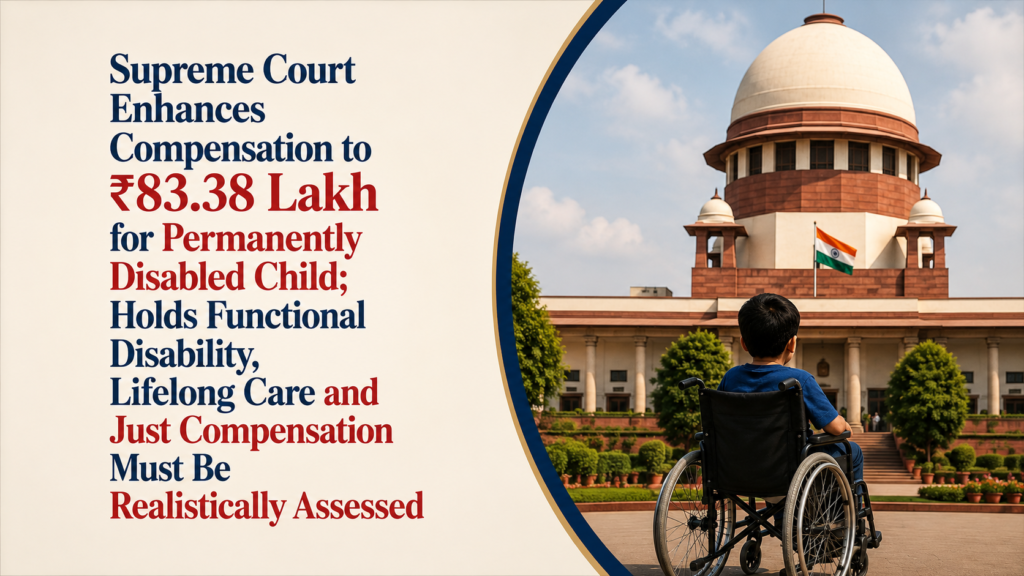
Supreme Court Enhances Motor Accident Compensation; Says Just Compensation Must Restore Dignity and Future Security of Disabled Child
Facts
The appeal arose from a motor accident that occurred on 16 June 2015, when Shreejita Pattnaik, a six-month-old infant, was travelling with her parents. A tanker, driven rashly and negligently, collided head-on with their car.
The accident left the child with devastating spinal cord and neurological injuries. She was diagnosed with post-traumatic myelopathy with paraplegia, resulting in 90% permanent locomotor disability. She underwent prolonged treatment at multiple specialised hospitals, including Apollo Hospital, AIIMS Bhubaneswar, NIMHANS Bengaluru and rehabilitation institutes. Medical evidence established that she would require lifelong treatment, assistance and support.
The Motor Accident Claims Tribunal (MACT) awarded ₹30,12,960 with 6% interest. On appeal, the Orissa High Court enhanced the compensation to ₹45,40,800 but retained interest at 6%. Dissatisfied, the claimant approached the Supreme Court seeking further enhancement.
Issues
- Whether the compensation awarded by the High Court constituted “just compensation” under Section 168 of the Motor Vehicles Act, 1988.
- Whether a child suffering catastrophic permanent disability should be assessed on the basis of functional disability rather than merely physical disability.
- Whether the compensation under various heads, including future earnings, attendant charges, medical expenses and non-pecuniary damages, required enhancement.
- Whether the rate of interest awarded should be increased.
Petitioner’s Arguments
The claimant contended that:
- The child suffered irreversible spinal injuries causing lifelong dependence.
- The High Court failed to appreciate the devastating impact of the injuries on every aspect of her future life.
- The multiplier of 18, as applied by the MACT, ought to have been retained instead of reducing it to 15.
- Future attendant charges awarded were wholly inadequate despite medical evidence showing lifelong dependence.
- Compensation should reflect loss of amenities, marriage prospects, future treatment, lifelong care and complete destruction of normal childhood.
- Interest should be enhanced from 6% to 9%.
- Reliance was placed upon Kajal v. Jagdish Chand, R. Halle v. Reliance General Insurance Co. Ltd., and other decisions emphasising liberal assessment of compensation for permanently disabled children.
Respondent’s Arguments
The insurer submitted that:
- The High Court had already substantially enhanced compensation from ₹30.12 lakh to ₹45.40 lakh.
- The High Court had carefully examined the medical evidence and granted enhanced amounts under several non-pecuniary heads.
- Assessment of compensation necessarily involves judicial discretion and approximation.
- Unless the award was shown to be manifestly inadequate, further enhancement was unwarranted.
Analysis of the Law
The Supreme Court reiterated that the Motor Vehicles Act is a beneficial legislation and must receive a liberal and purposive interpretation.
Interpreting Section 168 of the Motor Vehicles Act, the Court held that “just compensation” means compensation that is fair, reasonable and realistic, neither a windfall nor a token amount.
The Court emphasised that claims involving catastrophically injured children stand on a different footing because such injuries permanently alter every stage of the child’s future life, dignity, independence and opportunities.
The Court explained the distinction between:
- Physical disability — medically assessed bodily impairment; and
- Functional disability — the actual impact of the disability on earning capacity and normal life.
Where functional disability completely destroys earning capacity, compensation must be assessed on that basis rather than the medical percentage alone.
Precedent Analysis
The Court extensively relied upon earlier Supreme Court decisions, including:
- Kajal v. Jagdish Chand — compensation for permanently disabled children must account for lifelong deprivation, attendant care and destruction of normal life.
- Raj Kumar v. Ajay Kumar — explained the distinction between physical disability and functional disability and laid down principles for assessing future earning capacity.
- National Insurance Co. Ltd. v. Pranay Sethi — “just compensation” must be based on fairness, reasonableness and equity.
- R.D. Hattangadi v. Pest Control (India) Pvt. Ltd. — classified compensation into pecuniary and non-pecuniary heads.
- Master Ayush v. Reliance General Insurance Co. Ltd.
- Baby Sakshi Greola v. Manzoor Ahmed Simon
- Divya v. National Insurance Co. Ltd.
- Hitesh Nagjibhai Patel v. Bababhai Nagjibhai Rabari
- Hansraj v. Mukesh Nath
The Court held that these authorities consistently require a compassionate and realistic approach while assessing compensation for permanently disabled children.
Court’s Reasoning
The Supreme Court held that although the child had been medically certified with 90% permanent disability, her functional disability was effectively 100% because the evidence established that she would never be able to independently earn a livelihood.
The Court further held that:
- the appropriate multiplier was 18, not 15;
- notional income should be assessed on the basis of minimum wages payable to a skilled worker, rather than an unskilled worker;
- lifelong attendant charges must be calculated using the multiplier method;
- compensation for pain, suffering, loss of amenities and marriage prospects required further enhancement considering the child’s permanent deprivation of a normal life;
- future medical expenses also required substantial enhancement.
The Court observed that a catastrophically injured child loses not merely physical ability but an entire future, including childhood experiences, independence, dignity, social life and opportunities that ordinary children enjoy. Therefore, compensation must realistically reflect these lifelong consequences.
Conclusion
The Supreme Court partly allowed the appeal and enhanced the compensation from ₹45,40,800 to ₹83,38,360, together with interest at 9% per annum from the date of filing of the claim petition until realisation.
The Court directed the insurer to deposit the enhanced compensation within six weeks before the Motor Accident Claims Tribunal for disbursement in accordance with law.
Case Details
Case: Gayatree Pattnaik for Shreejita Pattnaik v. Arundhati Sahoo & Anr.
Court: Supreme Court of India
Case Number: Civil Appeal No. 7067 of 2026
Judges: Hon’ble Justice Ujjal Bhuyan and Hon’ble Justice N.V. Anjaria
Date: 03 August 2026
Result: Appeal Allowed. Compensation enhanced from ₹45,40,800 to ₹83,38,360 with interest enhanced from 6% to 9% per annum