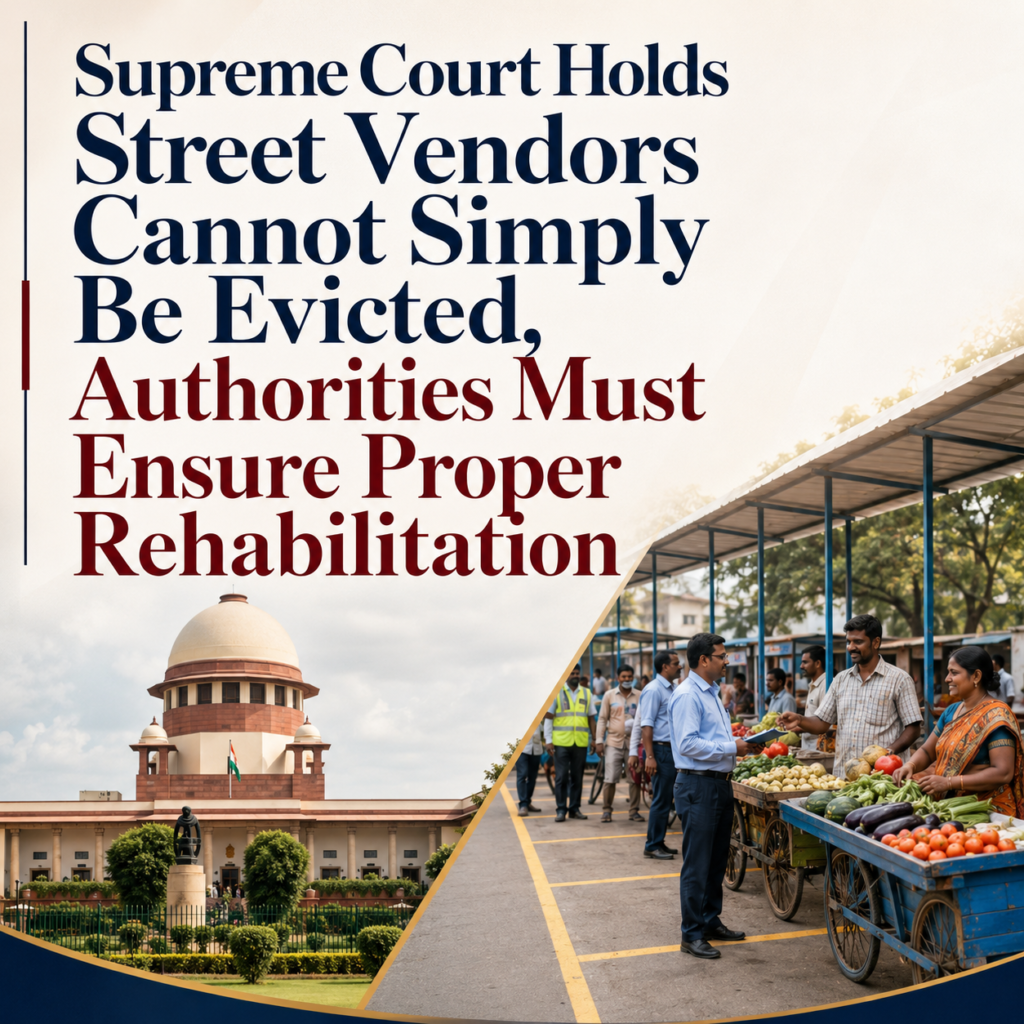
Supreme Court Quashes Chandigarh’s 2020 Expansion of “Essential Service Providers” and Directs Proper Rehabilitation and Regulation of Street Vendors
Facts
The proceedings concerned the regulation and relocation of street vendors in Chandigarh and the need to balance removal of unauthorised encroachments with protection of vendors’ livelihoods.
In an earlier order dated 9 April 2026, the Supreme Court observed that State action concerning street vending must cause minimum disruption to livelihoods. It directed that vendors should receive adequate assistance when shifted to designated vending zones, since relocation could affect both their established customer base and residents’ access to nearby services.
On 5 May 2026, the Court interacted with senior Chandigarh officials, including representatives of the Town Vending Committee, the Grievance and Dispute Redressal Committee and the Chandigarh Administration.
The Municipal Corporation informed the Court that Chandigarh had 10,939 registered vendors, divided into:
- 3,563 Essential Service Providers;
- 1,139 mobile vendors; and
- 6,237 non-Essential Service Providers.
The Corporation stated that around 5,400 challans had been issued during anti-encroachment drives, including approximately 1,150 in the Manimajra area. It also stated that basic amenities were generally available at vending zones and that mobile toilet vans were being deployed where permanent facilities were unavailable.
The licences of 6,881 vendors had been cancelled for failure to deposit the required instalments. Of these, 1,346 vendors filed appeals, while 5,535 neither appealed nor paid their outstanding dues. Several appeals and applications remained pending before the appellate authority and the Grievance and Dispute Redressal Cell.
The Court-appointed amicus curiae questioned whether the Corporation’s enforcement measures had produced meaningful results. He contended that merely issuing challans did not establish that encroachments had been permanently removed or that displaced vendors had actually been rehabilitated.
The Court also examined a notification dated 17 July 2020, issued during the COVID-19 period, which expanded the definition of “Essential Service Providers” to include vendors selling items such as tandoori food, chhole bhature, kulche chhole, parathas, fruits and vegetables, and florists operating outside religious places. It also permitted vending between 6 a.m. and 10 p.m.
Issues
- Whether Chandigarh’s anti-encroachment measures sufficiently addressed both removal of encroachments and rehabilitation of affected street vendors.
- Whether the identified vending zones were operational, accessible and equipped with essential public amenities.
- Whether pending appeals and applications concerning vendors’ licences and entitlements were being decided within a reasonable period.
- Whether the notification dated 17 July 2020, which expanded the definition of “Essential Service Providers” during the COVID-19 period, should continue to operate.
- What directions were necessary to balance urban regulation, public convenience and the statutory protection of street vendors’ livelihoods.
Petitioner’s Arguments
The concerns raised by the original writ petitioners, and subsequently reinforced by the amicus curiae, were that enforcement should not be limited to issuing challans or conducting temporary anti-encroachment drives.
It was argued that the Municipal Corporation had not produced sufficient evidence to demonstrate:
- how many sites had been permanently cleared;
- whether those sites remained free from re-encroachment;
- how many displaced vendors had actually shifted to designated vending zones;
- whether fresh vending certificates had been issued after relocation; and
- whether vendors had received meaningful guidance and assistance in shifting.
It was submitted that large-scale cancellation of licences could severely affect the livelihoods of vendors. The fact that 5,535 affected vendors had neither appealed nor paid their dues indicated that many might continue vending without licences due to lack of alternative employment.
The amicus further contended that:
- pending appeals and applications should be decided within a fixed time;
- ward-wise and sector-wise information regarding vacant vending sites should be publicly disclosed;
- dedicated enforcement teams should monitor cleared areas to prevent re-encroachment;
- the definition of “Essential Service Providers” should be narrowed to prevent misuse; and
- similar coordinated measures should be considered for the wider Chandigarh–Mohali–Panchkula urban region.
The 2020 notification was specifically challenged on the ground that it had been issued during the exceptional circumstances of the COVID-19 pandemic and had outlived its purpose.
Respondent’s Arguments
The Municipal Corporation submitted that removal of encroachments was necessarily a recurring exercise undertaken under the applicable municipal legislation and the Street Vendors Bye-Laws, 2018.
It argued that the Corporation was taking several measures to regulate vendors and facilitate their relocation, including:
- issuing smart identity cards containing the geo-coordinates of allotted vending sites;
- appointing nodal officers to assist vendors in shifting;
- directing daily inspections of vending zones;
- maintaining basic amenities at designated sites; and
- deciding appeals against cancellation of vending licences.
The Corporation maintained that cancellation of licences was a measure of last resort. According to it, affected vendors had received adequate opportunities, including a 30-day period after publication of notices, to deposit outstanding dues.
It stated that a substantial number of appeals had already been decided and that the remaining matters would be disposed of at the earliest.
The Corporation also submitted that smart identity cards would help establish the genuineness of vendors and ensure that they operated only from officially allotted sites.
Analysis of the Law
The Court approached the matter by balancing two competing public interests.
The first was the obligation of municipal authorities to remove unauthorised encroachments, regulate public streets and ensure free movement for residents and commuters.
The second was the protection of the livelihoods of street vendors under the Street Vendors (Protection of Livelihood and Regulation of Street Vending) Act, 2014 and the corresponding Chandigarh bye-laws.
The Court made it clear that enforcement could not be assessed merely through the number of challans issued. Effective compliance required demonstrable outcomes, including:
- actual relocation of licensed vendors;
- functioning and accessible vending zones;
- continuing monitoring;
- adequate public amenities;
- public awareness regarding the new vending locations; and
- expeditious adjudication of vendors’ grievances.
The Court recognised that relocation affects not only vendors but also their customers. A vendor may lose an established customer base after being shifted, while residents may lose convenient access to nearby goods and services. Therefore, relocation must be supported through signage, publicity, infrastructure and administrative assistance.
The Court also considered the statutory grievance-redressal framework important. Delays in deciding appeals and applications could prolong uncertainty and potentially push affected vendors into unauthorised vending.
Regarding the 2020 notification, the Court considered the exceptional circumstances in which it had been issued. Since its expansion of the Essential Service Provider category was linked to the unique conditions of the COVID-19 period, its continued operation was found unjustified.
Precedent Analysis
The order does not undertake a separate analysis of any named judicial precedent.
Instead, it proceeds primarily on:
- the Street Vendors (Protection of Livelihood and Regulation of Street Vending) Act, 2014;
- the Chandigarh Street Vendors Bye-Laws, 2018;
- the Court’s earlier orders in the same proceedings; and
- the constitutional requirement of fairness in State action affecting livelihood.
The Court’s approach reflects the principle that regulation of public spaces must be accompanied by procedural fairness and meaningful rehabilitation where livelihood rights are affected.
Court’s Reasoning
The Supreme Court found that the dispute could not be resolved merely by recording the number of enforcement drives or challans issued. The authorities had to ensure that the designated vending zones became practically usable and that vendors were effectively shifted to those locations.
Accordingly, the Court directed that:
- Newly identified vending zones must be made operational and licensed vendors shifted there at the earliest.
- City officials must monitor the vending zones daily to ensure their smooth functioning.
- Adequate road signage, in languages commonly used in Chandigarh, must direct members of the public to the vending zones.
- Drinking water, toilets and other public amenities must be installed wherever absent and properly maintained thereafter.
- Regular advertisements must be issued in print and electronic media informing the public about vending-zone locations and operating timings.
- Smart identity cards must be issued expeditiously to all vendors.
- Vendor details and smart-card numbers must be supplied to the concerned police stations and the District Administration.
- CCTV cameras must be installed in the vending zones within six months, with adequate arrangements for storing recordings.
- The authorities should consider establishing a helpline for vendors and customers.
- All currently pending appeals and applications must be decided within 60 days after giving affected parties a proper hearing.
- Fresh appeals and applications should ordinarily be decided within an outer limit of 30 days, subject to the governing Act and bye-laws.
The Court separately considered the 17 July 2020 notification. Following deliberations between the Court, the amicus and the concerned officials, a consensus emerged that the notification had outlived the special circumstances for which it was introduced.
The Court therefore quashed the notification and restored the earlier legal position governing Essential Service Providers and vending hours.
Conclusion
The Supreme Court directed the Chandigarh authorities to move beyond challan-based enforcement and establish a result-oriented street-vending system that combines removal of unauthorised encroachments with meaningful relocation and livelihood protection.
The Court ordered the expeditious operationalisation of vending zones, provision of amenities, issuance of smart cards, installation of CCTV cameras, public-awareness measures and time-bound disposal of vendors’ appeals and grievances.
It also quashed the notification dated 17 July 2020 that had expanded the definition of Essential Service Providers during the COVID-19 period. The earlier notification was restored as the governing framework.
The Chandigarh Administration was directed to file a compliance affidavit by 22 July 2026, and the matter was directed to be listed on 24 July 2026.
Case: Malkit Singh and Another v. State of U.T., Chandigarh and Others
Court: Supreme Court of India
Case Number: 2026 INSC 663; Civil Appeal No. 4400 of 2026
Judge: Justice Sanjay Karol and Justice Nongmeikapam Kotiswar Singh
Date: 1 July 2026
Result: Chandigarh’s notification dated 17 July 2020 quashed; comprehensive directions issued for relocation, regulation and rehabilitation of street vendors; compliance affidavit directed to be filed.