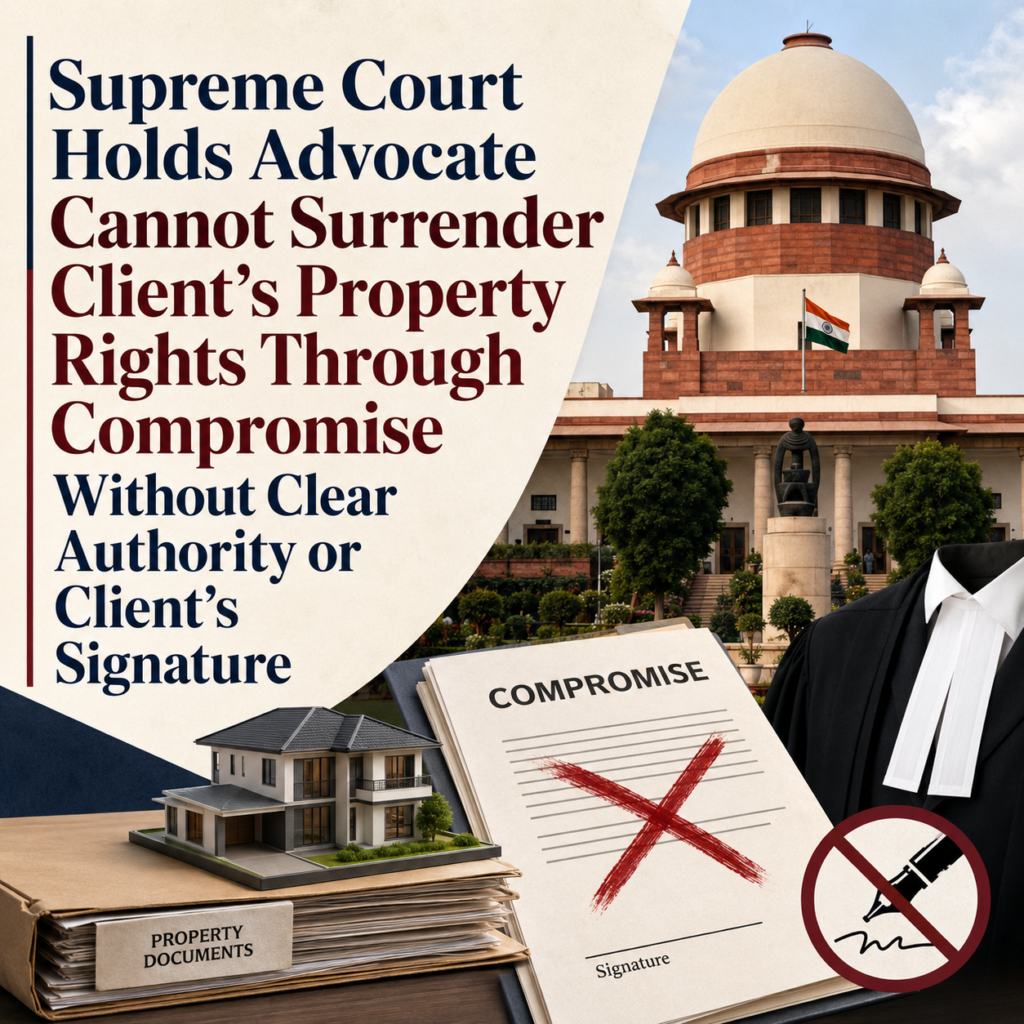
Supreme Court Holds Advocate Cannot Surrender Client’s Property Rights Through Compromise Without Clear Authority or Client’s Signature


Supreme Court Upholds Setting Aside of 25-Year-Old Compromise Decree Where Party Had Neither Signed Nor Authorised Counsel to Settle Property Rights
Facts
Dinbandhu Ojha, the original plaintiff, instituted a partition suit seeking a one-fourth share in the properties of the common ancestor, Thakur Ojha. Chaturbhuj Chaudhary was impleaded as Defendant No. 5 and was shown as having appeared through an advocate.
During the pendency of the suit, a compromise petition was purportedly filed jointly by the plaintiffs and defendants. The Civil Court accepted the compromise on 22 February 1994 and subsequently prepared a final decree on 27 May 1997.
Nearly 25 years later, the legal representatives of Defendant No. 5 filed Miscellaneous Case No. 7 of 2022, seeking recall of the compromise decree. They alleged that the decree had been obtained fraudulently, that Defendant No. 5 had never signed the compromise and that his advocate had no authority to surrender his rights in the properties.
The applicants claimed that they first became aware of the compromise decree in April 2022, when the opposite parties allegedly attempted to dispossess them from the lands covered by R.S. Khata Nos. 77 and 78.
On 7 February 2024, the Sub-Judge-I (East), Muzaffarpur, allowed the recall application and set aside the compromise decree. The Patna High Court dismissed the civil revision challenging that order.
The legal heirs of the original plaintiffs and other co-sharers thereafter approached the Supreme Court.
Issues
- Whether the compromise accepted by the Civil Court on 22 February 1994 satisfied the mandatory requirements of Order XXIII Rule 3 of the Code of Civil Procedure, 1908.
- Whether an advocate could validly consent to a compromise affecting substantial property rights without the party’s signature or express authorisation.
- Whether the recall application could be entertained after a delay of approximately 25 years.
- Whether the disputed rights of the parties could be determined on the basis of the compromise decree or required adjudication through a full trial.
Petitioner’s Arguments
The appellants contended that Defendant No. 5 had participated in the partition suit through his advocate and had filed a written statement acknowledging that the lands under Khata Nos. 77 and 78 belonged to the plaintiffs’ family.
They maintained that Defendant No. 5 was fully aware of the proceedings and had joined the compromise after understanding its terms.
According to the appellants, the advocate representing Defendant No. 5 had recorded “no objection” to the compromise pursuant to instructions received from his client. The compromise decree was therefore valid and binding.
The appellants also relied upon the prolonged delay in challenging the decree. They argued that the compromise had remained unchallenged for approximately 25 years and that the recall application filed in 2022 was barred by limitation and laches.
They further asserted that Defendant No. 5 was related to the plaintiffs’ family and had earlier acknowledged that the disputed lands had wrongly been recorded in his name in the survey records.
Respondent’s Arguments
The respondents, being the legal representatives of Defendant No. 5, contended that no notice of the partition suit had ever been served upon their predecessor.
They alleged that Defendant No. 5 had neither engaged the advocate concerned nor signed the written statement, vakalatnama or compromise petition. The documents purportedly bearing his signatures were alleged to have been fabricated in collusion with the other parties.
The respondents submitted that the compromise petition did not contain the signature of Defendant No. 5 and that the endorsement of “no objection” made by an advocate could not substitute the mandatory requirement of the party’s consent.
They maintained that the advocate had no express authority to compromise or surrender Defendant No. 5’s substantial rights in the properties.
The respondents claimed that they discovered the decree only in April 2022 when the appellants allegedly attempted to dispossess them on its basis. The recall application was filed immediately after inspection of the court record.
Analysis of the Law
Order XXIII Rule 3 CPC permits a court to record a compromise only where it is established that the suit has been adjusted through a lawful agreement or compromise:
- reduced to writing;
- signed by the parties;
- voluntarily accepted; and
- proved to the satisfaction of the court.
The Supreme Court explained that, before the 1976 amendment to the CPC, a compromise could be oral or written. After the amendment, the requirement that it must be in writing and signed by the parties became mandatory.
Although an advocate or authorised representative may sign a compromise on behalf of a party, such authority cannot ordinarily be presumed where substantial legal or property rights are being surrendered.
An advocate may make procedural or tactical decisions in the conduct of litigation. However, a decision that directly concludes, relinquishes or compromises the client’s substantive rights ordinarily requires express instructions or authorisation.
The Court also emphasised that a civil court is not merely a passive recorder of a settlement. Before passing a compromise decree, it must apply its judicial mind and satisfy itself that the compromise is lawful and has been voluntarily entered into by the parties.
A decree based on an unlawful or unauthorised compromise may be challenged through an application for recall before the court that recorded it. A separate suit or regular appeal against a consent decree is ordinarily not maintainable.
Precedent Analysis
Gurpreet Singh v. Chatur Bhuj Goel
The Supreme Court held that, after the 1976 amendment, a compromise under Order XXIII Rule 3 must be in writing and signed by the parties. The amendment was intended to prevent false and frivolous claims that an oral settlement had been reached.
Som Dev v. Rati Ram
The Court reiterated that the statutory requirements of a written and signed compromise must be satisfied before a compromise decree can be passed.
Banwari Lal v. Chando Devi
The decision established that a compromise must be voluntarily accepted. Once lawfully recorded, it acquires the sanctity of a judicial order. The court must independently examine whether the settlement is lawful and cannot act merely as a recording authority.
Byram Pestonji Gariwala v. Union Bank of India
The Court recognised that an advocate may, in appropriate circumstances, enter into a compromise on behalf of the client. However, such authority cannot be presumed without limitation, particularly where the settlement substantially affects the client’s rights.
Pushpa Devi Bhagat v. Rajinder Singh
The Supreme Court recognised that a duly authorised counsel or representative may sign a compromise, provided the authority to do so is established.
M.P. Rajya Tilhan Utpadak Sahakari Sangh Maryadit v. Modi Transport Service
The Court reiterated that an advocate should not act merely on implied authority in the absence of express instructions or exceptional circumstances.
Himalayan Cooperative Group Housing Society v. Balwan Singh
A three-judge Bench held that an advocate must not exceed the authority conferred by the client. A lawyer ordinarily has no implied or apparent authority to make an admission or concession that directly surrenders the client’s substantial legal rights.
Prasanta Kumar Sahoo v. Charulata Sahoo
Referring to the Madras High Court’s decision in Govindammal v. Marimuthu Maistry, the Court stressed that prudence requires specific consent or a special vakalatnama before an advocate enters into a compromise affecting the client’s rights.
Baldevdas Shivlal v. Filmistan Distributors (India) Pvt. Ltd.
The Court observed that a consent decree does not operate as res judicata in the same manner as a decision rendered after adjudication on merits.
Navratan Lal Sharma v. Radha Mohan Sharma
The Court held that the appropriate remedy against a compromise decree is an application for recall before the same court. A fresh suit or appeal against such a decree is not maintainable.
Court’s Reasoning
The Supreme Court found that the compromise petition did not bear the signature of Defendant No. 5.
Although his advocate had recorded that Defendant No. 5 had no objection to the compromise, there was no material demonstrating that the advocate had been expressly authorised to surrender or finally determine his client’s rights in the entire property.
There were also no exceptional or urgent circumstances that could justify the advocate acting without obtaining the client’s specific consent.
Consequently, the essential requirement of voluntary consent under Order XXIII Rule 3 was not established. The compromise was therefore contrary to law.
On the question of delay, the Court acknowledged that the interval between the 1994 decree and the 2022 recall application was exceptionally long. Nevertheless, dismissing the application solely on the ground of delay would perpetuate a decree that did not comply with the mandatory requirements of law.
The respondents had claimed that they discovered the decree only in April 2022 when an attempt was made to dispossess them. The dispute also involved serious allegations concerning:
- non-service of summons;
- fabrication of signatures;
- absence of authority given to the advocate;
- competing claims of title and possession;
- the relationship between the parties; and
- the circumstances in which the compromise was recorded.
The Court held that these foundational facts were disputed and could not be conclusively determined on the basis of the compromise decree.
The law of limitation, although important, could not be applied mechanically to defeat substantial property rights and preserve an unlawful compromise. The Court clarified, however, that a delay of this magnitude would not be condoned in every case; each matter must be determined after examining its particular facts and record.
The underlying partition suit was therefore required to proceed to a full trial, despite the practical difficulty of trying a suit instituted in 1989 after nearly 37 years.
Conclusion
The Supreme Court held that a compromise affecting substantial property rights cannot bind a party unless it is signed by the party or entered into by an advocate possessing clear and express authority.
Since Defendant No. 5 had not signed the compromise and no express authority in favour of his advocate was established, the requirements of Order XXIII Rule 3 CPC were not satisfied.
The Court upheld the setting aside of the compromise decree and directed that the rights of the parties be determined through a full trial in the original partition suit.
The appeal was dismissed without costs.
Case: Krishna Kumar Ojha and Others v. Jitendra Chaudhary and Others
Court: Supreme Court of India
Case Number: 2026 INSC 662; Civil Appeal arising out of SLP (C) No. 13671 of 2025
Judge: Justice Sanjay Karol and Justice Nongmeikapam Kotiswar Singh
Date: 1 July 2026
Result: Appeal dismissed; order setting aside the compromise decree upheld and partition dispute directed to be adjudicated through a full trial.
Read Also: Supreme Court Holds Two-Judge Bench Could Not Override Larger Bench on Haryana Remission Policy