


Court’s decision
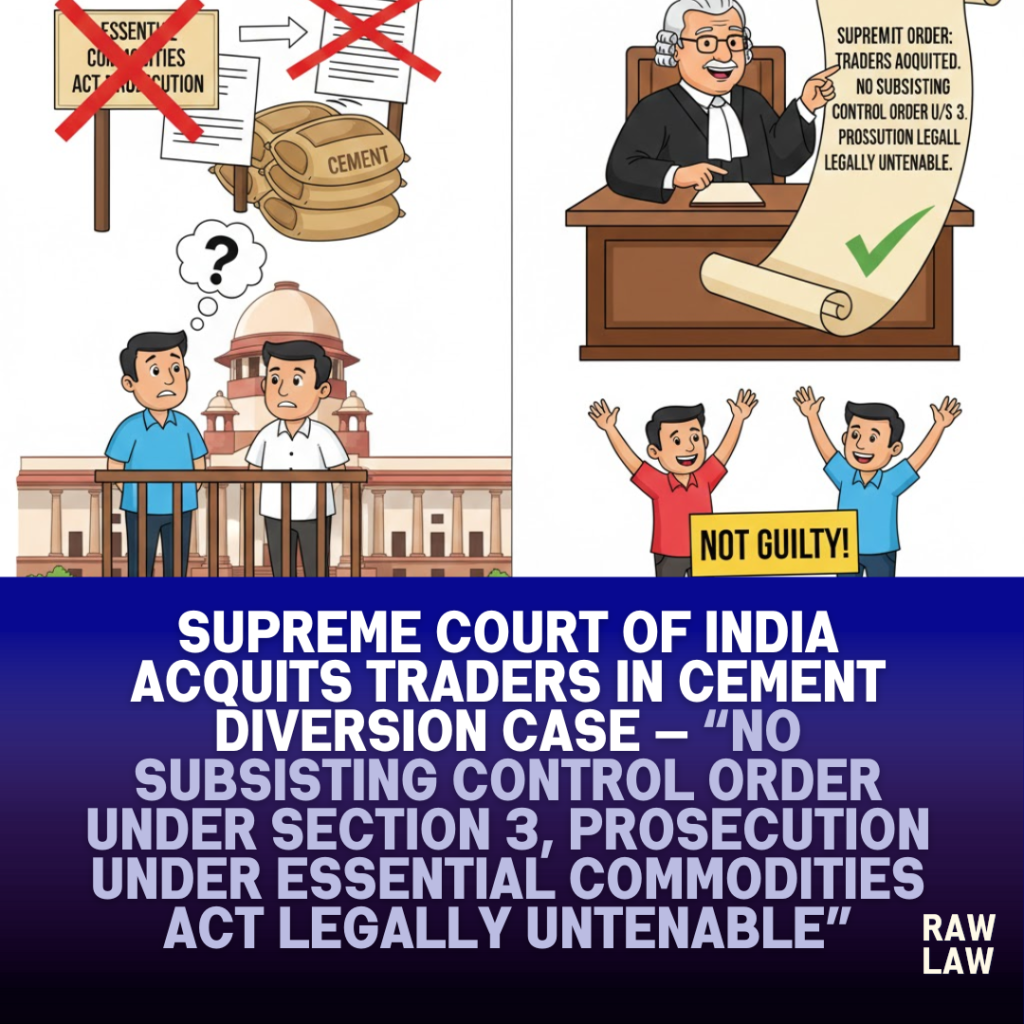
The Supreme Court allowed the criminal appeals and set aside the conviction of two traders under Sections 3 and 7 of the Essential Commodities Act, 1955. The Court held that by 24 March 1994—the date of the alleged offence—statutory control over cement had already been withdrawn by the Cement Control (Amendment) Order, 1989 and subsequent notifications rescinding State-level licensing powers. In the absence of any subsisting control order under Section 3 of the Act, prosecution under Section 7 was legally impermissible. The convictions recorded by the trial court and affirmed by the High Court were quashed.
Facts
The case arose from an alleged diversion of government quota cement supplied by the Public Works Department (PWD) for construction work on the Kannad–Bahirgaon Road in Maharashtra. The work had been awarded to a cooperative society, which allegedly sublet it to another contractor.
According to the prosecution, 400 bags of cement released from the PWD godown did not reach the work site. Acting on secret information, police intercepted two trucks near shops connected to the appellants and allegedly recovered 365 bags of cement. An additional 25 bags were later recovered from a nearby shop.
The appellants were charged with purchasing and storing cement meant exclusively for government work, allegedly with intent to sell at higher prices, in violation of the Maharashtra Cement (Licensing and Control) Order, 1973, issued under Section 3 of the Essential Commodities Act.
They were convicted by the Special Judge in 2000 and sentenced to one year’s rigorous imprisonment with fine. The High Court affirmed the conviction in 2014, leading to the present appeals.
Issues
The principal issue before the Supreme Court was whether, on the date of the alleged offence (24 March 1994), there existed any operative control order under Section 3 of the Essential Commodities Act regulating sale, storage, or distribution of cement.
A related question was whether, in the absence of such a subsisting statutory order, conviction under Section 7 of the Act could be sustained.
Appellants’ arguments
The appellants contended that statutory control over cement had been substantially withdrawn by the Cement Control (Amendment) Order, 1989, which removed price and distribution control with effect from 1 March 1989.
They further argued that by notification dated 7 August 1990, the Central Government rescinded delegation of powers to State Governments to regulate retail cement distribution through licensing. Consequently, the Maharashtra Cement (Licensing and Control) Order, 1973 ceased to operate insofar as cement distribution was concerned.
It was submitted that the prosecution failed to produce any subsisting notification or operative order under Section 3 in force on 24 March 1994. In the absence of such an order, there could be no contravention attracting penal liability under Section 7.
Reliance was placed on Kolhapur Canesugar Works Ltd. v. Union of India, which held that omission of a statutory provision without saving clause extinguishes pending proceedings unless expressly preserved.
Respondent’s arguments
The State argued that possession of large quantities of government quota cement by the appellants was established through evidence and that the burden shifted to them to explain lawful possession.
It was contended that cement supplied for government works at concessional rates was diverted and found in premises connected to the appellants, and that such unauthorised storage attracted penal provisions.
The State maintained that the High Court had correctly appreciated evidence and upheld the conviction.
Analysis of the law
The Supreme Court examined the statutory framework governing cement control. Cement had been declared an “essential commodity” under the Essential Commodities Act, and the Cement Control Order, 1967 regulated production, supply, distribution, and pricing.
However, by notification dated 1 March 1989, the Central Government removed price and distribution control over cement and omitted several operative clauses of the 1967 Order. Subsequently, on 7 August 1990, delegation of powers to State Governments to regulate retail cement distribution was rescinded.
The Court emphasized that penal liability under Section 7 arises only upon contravention of a valid and subsisting order issued under Section 3. Once such control orders were withdrawn, there remained no statutory foundation for prosecution.
Precedent analysis
The Court relied on Kolhapur Canesugar Works Ltd. v. Union of India (2000) 2 SCC 536, which held that when a statutory provision is omitted without a saving clause, proceedings under that provision lapse unless protected.
Applying this principle, the Court concluded that by 1994 there was no operative control order regulating cement storage or sale under the Essential Commodities Act.
Thus, prosecution under Sections 3 and 7 lacked legal basis.
Court’s reasoning
The Court observed that both the trial court and the High Court failed to consider the effect of statutory decontrol and proceeded solely on appreciation of evidence.
While factual findings suggested diversion of government cement, absence of a subsisting order under Section 3 was fatal to prosecution under the Essential Commodities Act.
The Court clarified that although regulatory control stood rescinded, acts such as diversion of government property might attract penal consequences under the Indian Penal Code. However, such provisions were neither invoked nor adjudicated in the present case.
The Court noted that investigating authorities failed to invoke appropriate penal provisions and that such lapse could not be cured at the appellate stage.
Conclusion
The Supreme Court allowed the appeals and set aside the convictions and sentences imposed by the courts below. Bail bonds were cancelled and any fine paid was directed to be refunded.
The judgment underscores that criminal liability under Section 7 of the Essential Commodities Act cannot arise in the absence of a valid and operative order under Section 3 on the date of the alleged offence.
Implications
This ruling reiterates a foundational principle of criminal law: penal consequences must rest on clear statutory authority existing at the time of the alleged offence.
The judgment serves as a caution to investigative agencies to verify the subsistence of control orders before launching prosecution under regulatory statutes.
It also reinforces that decontrol or omission of statutory provisions without saving clauses can render pending or future prosecutions legally unsustainable.
Case law references
- Kolhapur Canesugar Works Ltd. v. Union of India (2000) 2 SCC 536 — Omission of statutory provision without saving clause extinguishes proceedings.
- Prakash Babu Raghuvanshi v. State of Madhya Pradesh (2004) 7 SCC 490 — Conviction under Section 7 requires proof of operative order under Section 3.
- Salekh Chand v. State of Uttar Pradesh (AIR 1960 SC 283) — Prosecution must prove existence of controlled price/order.
FAQs
1. Can a person be convicted under Section 7 of the Essential Commodities Act without a valid control order?
No. Penal liability arises only upon contravention of a valid and subsisting order issued under Section 3.
2. What happens if a statutory control order is withdrawn before the alleged offence?
If the control order is rescinded and no saving clause applies, prosecution under that order is legally untenable.
3. Does decontrol of a commodity eliminate all criminal liability?
Not necessarily. While prosecution under the Essential Commodities Act may fail, other penal provisions, such as under the Indian Penal Code, may apply depending on facts.