


1. Court’s decision
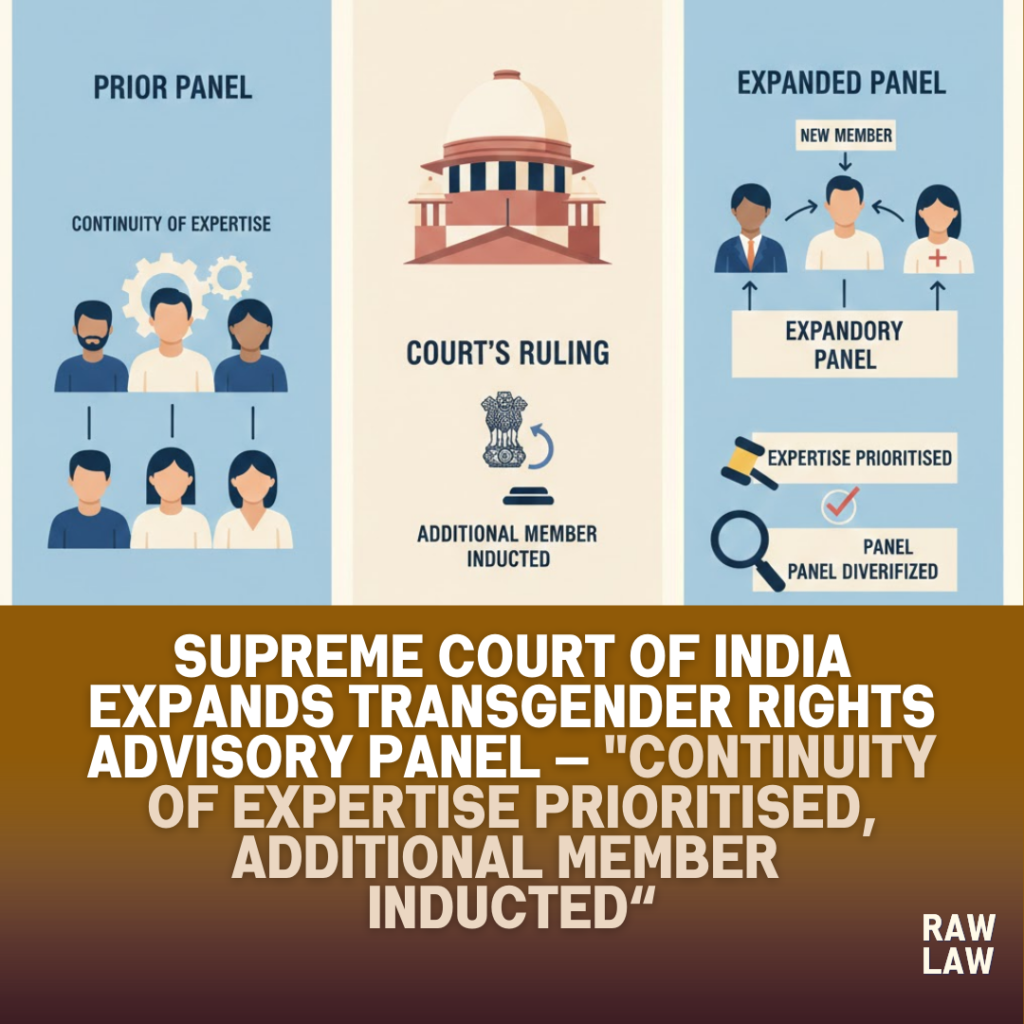
The Supreme Court of India disposed of a miscellaneous application by modifying the composition of an Advisory Committee constituted earlier in a writ petition concerning transgender rights. The Court held that continuity of subject-matter expertise was essential for the effective functioning of the Committee and therefore directed that an outgoing representative would continue as a member, while also inducting an additional expert to represent the concerned research institution.
2. Facts
In an earlier judgment dated 17 October 2025, the Supreme Court had constituted an Advisory Committee in a pending writ petition addressing issues relating to transgender rights. One of the members was included to represent the Centre for Law and Policy Research. Subsequently, a miscellaneous application was moved by the Amicus Curiae seeking modification of the Committee’s composition on the ground that the earlier nominee was no longer formally associated with the Centre. The application requested inclusion of another senior researcher from the same institution.
3. Issues
The limited issue before the Court was whether the change in professional affiliation of a Committee member warranted her removal from the Advisory Committee, and whether an additional member should be appointed to ensure proper institutional representation and effective functioning of the Committee.
4. Petitioner’s arguments
Through the Amicus Curiae, it was submitted that since the originally nominated member was no longer an Associate with the Centre for Law and Policy Research, the Committee required an alternative representative from the institution. It was argued that appointing a senior associate currently working with the Centre would ensure continuity of institutional input, scholarship, and administrative coordination in the Committee’s work on transgender rights.
5. Respondent’s arguments
The respondents did not seriously oppose the limited relief sought. The matter was treated as an administrative and facilitative issue concerning the composition of a court-appointed advisory body rather than an adversarial dispute requiring elaborate contest.
6. Analysis of the law
The Court exercised its inherent powers in proceedings under Article 32 to issue ancillary and procedural directions necessary for effective implementation of its earlier orders. It reiterated that advisory committees constituted by constitutional courts are flexible mechanisms meant to aid adjudication and policy formulation, and their composition can be modified to meet functional requirements, provided such modifications advance the objectives of the original judgment.
7. Precedent analysis
While the order did not rely on external precedents, it is consistent with the Supreme Court’s established practice of periodically reconstituting or expanding court-appointed committees, monitoring bodies, and expert groups in public interest and rights-based litigation to ensure continuity, expertise, and effective assistance to the Court.
8. Court’s reasoning
The Court noted that the earlier member had undertaken extensive work in the field of transgender rights and possessed valuable experience directly relevant to the mandate of the Advisory Committee. Merely because she was no longer formally associated with the Centre did not diminish her contribution or relevance. At the same time, the Court recognised the need for current institutional representation from the Centre. Balancing both considerations, it held that the existing member should continue, while an additional senior associate from the Centre should be appointed to the Committee.
9. Conclusion
The Supreme Court clarified that the earlier member would continue as part of the Advisory Committee notwithstanding her change in affiliation. It further appointed an additional senior associate from the Centre for Law and Policy Research as a member of the Committee. With these directions, the miscellaneous application was disposed of.
10. Implications
This order underscores the Supreme Court’s pragmatic and inclusive approach in structuring advisory mechanisms in rights-based litigation. It affirms that expertise and past contribution are as significant as formal institutional affiliation, particularly in sensitive areas such as transgender rights. The decision also highlights the Court’s willingness to adapt committee structures to ensure both continuity of knowledge and robust institutional participation.
Case Law References
- Present miscellaneous order in transgender rights writ petition – Clarified that advisory committee membership can be expanded or modified to preserve expertise and ensure effective institutional representation.
FAQs
Q1. Can the Supreme Court modify the composition of an advisory committee it has constituted?
Yes. The Supreme Court can modify or expand the membership of advisory committees through ancillary or miscellaneous orders to ensure effective functioning.
Q2. Does change in institutional affiliation automatically disqualify a committee member?
No. The Court held that subject-matter expertise and prior contribution can justify continuation of a member despite a change in formal affiliation.
Q3. Why was an additional member appointed to the Advisory Committee?
To ensure continued representation of the Centre for Law and Policy Research and strengthen the Committee’s work on transgender rights.