Supreme Court of India: Landowners in joint development not liable for delay compensation— “Developer alone responsible for construction delay; consumer appeals dismissed”

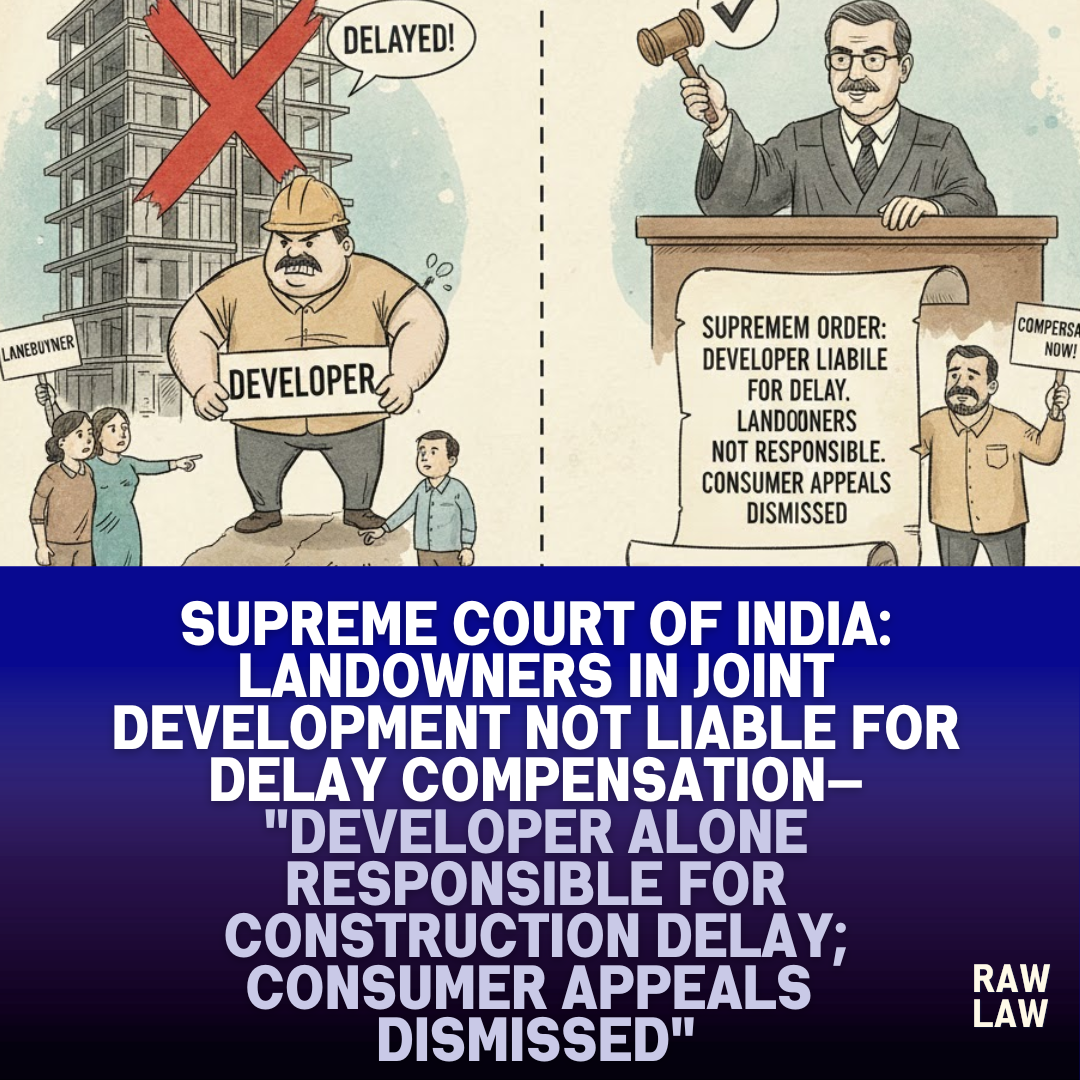
Court’s decision
The Supreme Court of India dismissed civil appeals filed by flat buyers seeking to fasten joint and several liability on landowners for delay in handing over possession under a Joint Development Agreement (JDA). The Court held that where the obligation to construct and deliver flats rests exclusively with the developer, landowners cannot be held liable for deficiency in service arising from construction delay.
While affirming that landowners and developer must jointly execute sale deeds and transfer title, the Court ruled that delay compensation is payable only by the developer.
Facts
The landowners had entered into a Joint Development Agreement on 24 February 2012 with a developer and executed a General Power of Attorney authorising the developer to undertake construction and enter into sale agreements.
The sanctioned plan was obtained in February 2013. Thereafter, from July 2013 onwards, sale agreements were executed with flat buyers, promising possession within 36 months, with a six-month grace period.
The possession period expired in February 2017, but construction remained incomplete. The flat buyers filed a complaint before the National Consumer Disputes Redressal Commission alleging deficiency in service due to prolonged delay.
The Commission found deficiency in service and directed completion of construction and payment of interest at 6% per annum for delay. In review proceedings, landowners were initially held jointly liable, but that order was set aside by the Supreme Court for lack of hearing. Upon reconsideration, the Commission held that landowners were not jointly and severally liable for delay compensation. The buyers appealed.
Issues
The central issue before the Supreme Court was whether landowners who execute a Joint Development Agreement and General Power of Attorney can be held jointly and severally liable with the developer for delay in construction and delivery of possession.
The Court also examined whether a principal-agent relationship arose between landowners and developer, making landowners vicariously liable for construction delay.
Appellants’ arguments
The flat buyers argued that execution of a General Power of Attorney created a principal-agent relationship between landowners and developer. They contended that under settled agency principles, a principal is liable for acts of the agent performed within authority.
Reliance was placed on clauses in the Sale Agreement and certain Supreme Court precedents to argue that landowners and developer were jointly responsible for delivering possession and compensating delay.
The appellants urged that since landowners benefitted from the project and authorised the developer to transact with purchasers, they should be jointly liable for deficiency in service.
Respondents’ arguments
The landowners contended that under Clause 7 of the Joint Development Agreement, construction responsibility rested solely with the developer, who also indemnified the landowners against liabilities arising from construction.
They emphasized that they were not signatories to the Sale Agreements executed between the developer and purchasers. Clauses 2 and 3 of the General Power of Attorney only authorised the developer to sell its share and complete conveyancing formalities.
It was argued that delay occurred exclusively in flats falling under the developer’s share and was not attributable to any act or omission of the landowners.
Analysis of the law
The Court undertook a conjoint reading of the Joint Development Agreement and General Power of Attorney. It found that the developer had exclusive authority and obligation to undertake construction, receive consideration, and deliver possession.
The indemnity clauses in the JDA expressly protected landowners from liability arising out of breach between developer and purchasers.
The Court held that mere execution of a General Power of Attorney does not automatically create liability for acts beyond the landowners’ contractual obligations. The delay in handing over possession was attributable solely to the developer’s failure to complete construction within time.
Precedent analysis
The appellants relied on decisions including Syed Abdul Khader v. Rami Reddy, Bangalore Development Authority v. Syndicate Bank, and Santhosh Narasimha Murthy v. Mantri Castles Pvt. Ltd. to argue agency liability.
However, the Court distinguished those precedents and observed that liability must be determined based on contractual allocation of obligations.
The Court noted that in Akshay v. Aditya, this Court had upheld findings that the developer alone was liable for delay compensation. The cited decisions did not establish a universal rule of joint liability in all joint development arrangements.
The Supreme Court clarified that joint and several liability depends on facts and contractual terms of each case.
Court’s reasoning
The Court emphasized that the delay pertained to flats forming part of the developer’s allocation under the JDA.
There was no allegation that delay occurred due to any act or omission of the landowners. The liability to pay delay compensation could not be fastened merely on the ground of an alleged principal-agent relationship.
The Court observed that landowners and developer were jointly responsible only to the extent of transferring title and executing sale deeds, which the Commission had already directed.
Since the developer had indemnified the landowners and retained exclusive control over construction, the deficiency in service was attributable solely to the developer.
Conclusion
The Supreme Court found no merit in the appeals and dismissed them. The developer alone remains liable for delay compensation, while both landowners and developer must execute sale deeds and transfer title to purchasers.
The judgment reaffirms that liability in joint development projects flows from contractual allocation of responsibilities and cannot be imposed mechanically.
Implications
This ruling clarifies the legal position in consumer disputes involving joint development projects:
- Landowners are not automatically liable for construction delays.
- Agency principles do not override clear contractual allocation of obligations.
- Indemnity clauses in Joint Development Agreements carry significant weight.
- Joint liability depends on facts and specific contractual terms.
The decision provides certainty to landowners in development arrangements and underscores the need for purchasers to scrutinize contractual structures before invoking joint liability.
Case law references
- Syed Abdul Khader v. Rami Reddy (1979) 2 SCC 601
Discussed principles of agency and authority under power of attorney. - Bangalore Development Authority v. Syndicate Bank (2007) 6 SCC 711
Examined liability in development-related disputes. - Akshay v. Aditya (Civil Appeal No. 3642 of 2018)
Upheld developer’s exclusive liability for delay compensation. - Union of India v. Rina Devi (2019) 3 SCC 572
Reiterated beneficial interpretation in compensation statutes (cited contextually in consumer law discussions).
FAQs
1. Are landowners always jointly liable with developers in delayed housing projects?
No. Liability depends on contractual terms. If construction responsibility rests solely with the developer, landowners are not automatically liable.
2. Does a General Power of Attorney make landowners liable for developer’s delay?
Not necessarily. A GPA authorising sale transactions does not by itself create liability for construction defects or delay.
3. Can buyers still enforce transfer of title against landowners?
Yes. Where landowners retain title, courts can direct them to execute sale deeds along with developers.