


Court’s decision
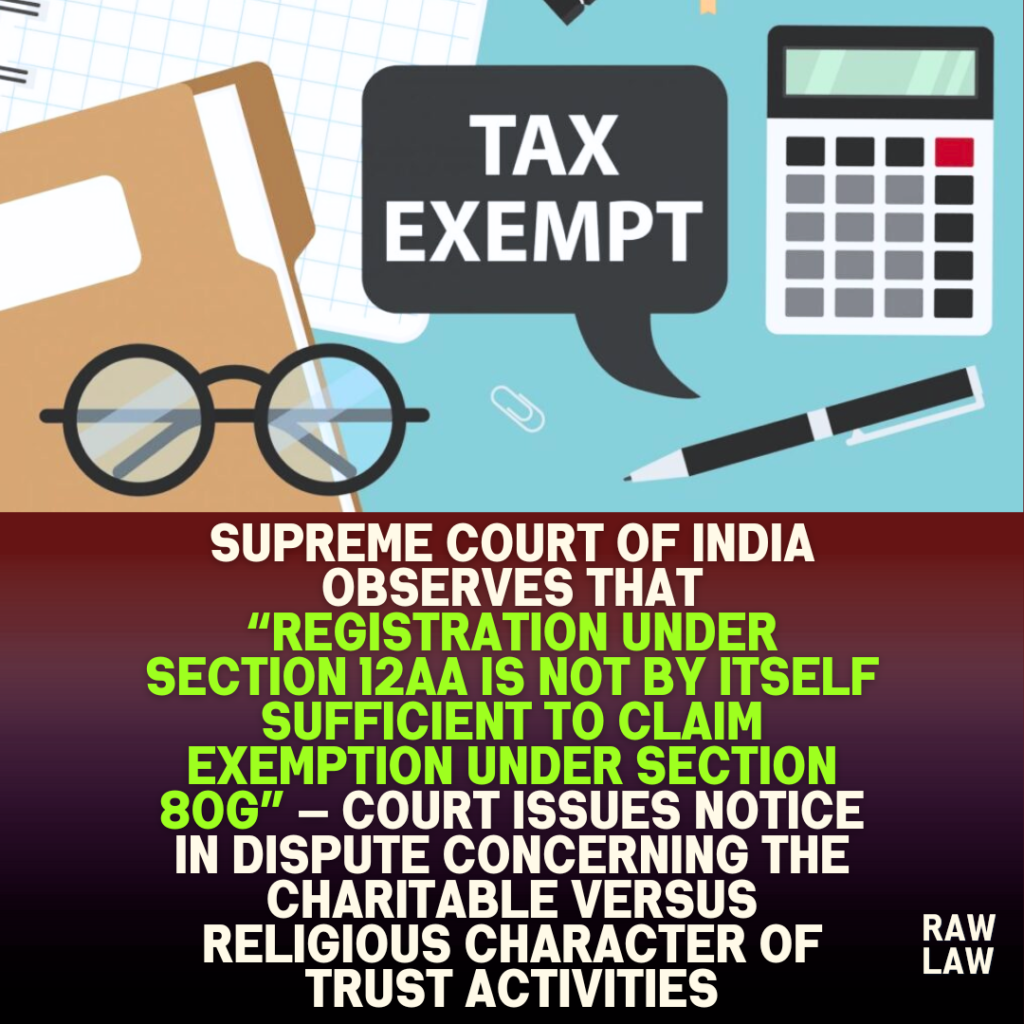
The Supreme Court of India condoned the delay in filing the petition and issued notice to the Respondent Trust in a matter arising from a High Court judgment that held that registration under Section 12AA of the Income Tax Act is sufficient, by itself, to grant approval under Section 80G. The Appellant authority challenged this interpretation, contending that Section 80G approval requires deeper scrutiny into the nature of the activities undertaken by the Trust. The Supreme Court found the matter significant enough to warrant examination and therefore issued notice, returnable within four weeks, and permitted dasti service in addition to ordinary process. The Court did not decide the merits at this stage but noted the core legal controversy concerning the charitable or religious nature of the activities for which exemption was sought. The order reflects the Court’s inclination to reconsider the High Court’s reasoning, particularly the automatic link drawn between Section 12AA registration and Section 80G approval.
Facts
The dispute arose when the Respondent, a registered Trust, sought approval under Section 80G of the Income Tax Act to avail tax exemptions for its donations. The Trust already possessed registration under Section 12AA, which establishes eligibility for certain forms of income tax exemption for charitable entities. The High Court, while deciding the appeal filed by the Trust, held that the registration under Section 12AA was sufficient to warrant approval under Section 80G. This view was grounded in the understanding that once charitable status is recognized through 12AA registration, further scrutiny is unnecessary. The Appellant authority, responsible for income tax administration, challenged this approach before the Supreme Court. It argued that the High Court conflated two separate statutory requirements and wrongly assumed that the nature of activities was conclusively established merely on the basis of Section 12AA registration. The Supreme Court, upon examining the impugned judgment and submissions, decided to issue notice to reconsider the matter in detail.
Issues
The central issues arising in the present proceedings include whether Section 12AA registration automatically entitles a Trust to approval under Section 80G; whether the Assessing Authority retains the power to examine the nature of activities independently for purposes of 80G; whether activities undertaken by a Trust must be scrutinized to determine whether they are charitable or religious; and whether the High Court erred in holding that registration under Section 12AA alone satisfies the statutory conditions for 80G approval.
Petitioner’s arguments
The Appellant authority argued that the High Court’s interpretation undermines the statutory distinctions embedded in the Income Tax Act. It was submitted that Section 12AA registration merely recognizes that a Trust exists for charitable purposes for the purpose of exemption of its own income, whereas Section 80G specifically concerns exemption for donors and therefore requires a different and more stringent inquiry. The Appellant contended that the Assessing Authority is obligated to examine each activity for which exemption is claimed, particularly to verify whether such activity is charitable or religious in nature. The Appellant argued that in the present case, the activity for which the Trust sought 80G approval was predominantly religious, falling outside the charitable character mandated under the statute. It was also submitted that the High Court’s blanket view would result in automatic approvals without assessing statutory compliance.
Respondent’s arguments
The Respondent maintained before the High Court that once a Trust has been granted registration under Section 12AA, it stands recognized as pursuing lawful charitable purposes under the Act. According to the Respondent’s stance before the High Court, there is no further need for the Assessing Authority to conduct additional verification under Section 80G because the core nature of the Trust’s activities stands validated through 12AA registration. The Respondent argued that Section 80G operates as an extension of the charitable recognition provided under Section 12AA and therefore the High Court’s reasoning was consistent with the legislative intention of encouraging charitable contributions. The Respondent’s view supported the High Court’s approach that administrative authorities should not conduct repeated inquiries.
Analysis of the law
The Supreme Court’s decision to issue notice indicates that the statutory framework requires a more nuanced analysis than that adopted by the High Court. Section 12AA, as interpreted across several judgments, grants registration to entities whose objects are prima facie charitable. However, Section 80G approval is governed by an independent statutory mechanism that requires the authority to examine not only the objects but also the actual activities undertaken. The Court implicitly recognized that the statutory language of Section 80G mandates exclusion of institutions engaged in activities that are substantially religious. The distinction between charitable and religious expenditure under the Act necessitates a factual analysis at the time 80G approval is sought.
The Court’s order signals that the separation between Section 12AA eligibility and Section 80G approval is deliberate, ensuring that the latter remains subject to stricter scrutiny. The Supreme Court, through issuance of notice, has chosen to revisit this legal framework to preserve the statutory differences that regulate tax exemptions.
Precedent analysis
While the Supreme Court order is brief, its reasoning aligns with broader jurisprudence recognizing the separate functions of Section 12AA and Section 80G. Previous decisions have held that 12AA registration does not immunize an institution from further inquiry regarding compliance with conditions specific to 80G. Courts have repeatedly emphasized the distinction between recognition of charitable objects and evaluation of whether particular activities conform to statutory requirements. By issuing notice, the Supreme Court signaled the possibility of reaffirming or refining past rulings that caution against automatic approval mechanisms.
Court’s reasoning
The Court noted that the High Court adopted the view that registration under Section 12AA is conclusive for purposes of 80G approval. The Supreme Court did not endorse this conclusion and instead found merit in the Appellant’s submission that Section 80G requires an independent examination. The Court acknowledged that in certain cases, activities may be characterized as predominantly religious even when the Trust’s objects appear charitable. As such, automatic linkage between 12AA registration and 80G approval may not be consistent with the statutory structure. By issuing notice, the Court expressed its willingness to scrutinize both the factual matrix and the High Court’s legal conclusions.
Conclusion
The Supreme Court condoned the delay, issued notice to the Respondent, and permitted dasti service. While the merits remain to be adjudicated, the Court’s order clearly indicates that the automatic inference drawn by the High Court concerning Section 12AA and Section 80G is open to reconsideration. The proceedings will now continue with fuller scrutiny of statutory interpretation and the factual nature of the Trust’s activities. The Court’s intervention underscores the importance of maintaining the structural distinction between charitable recognition and approval for donor-based exemptions.
Implications
This order has significant implications for trusts seeking relief under tax-beneficial provisions. It signals that 12AA registration should not be assumed to automatically qualify an institution for 80G approval and that tax authorities may examine the nature of activities independently. Institutions undertaking activities with a religious component may face closer scrutiny. The case also highlights the need for Trusts to maintain clear documentation demonstrating charitable activity while ensuring compliance with both provisions separately. The forthcoming hearing may lead to a more authoritative ruling on the interrelationship between these two statutory benefits.