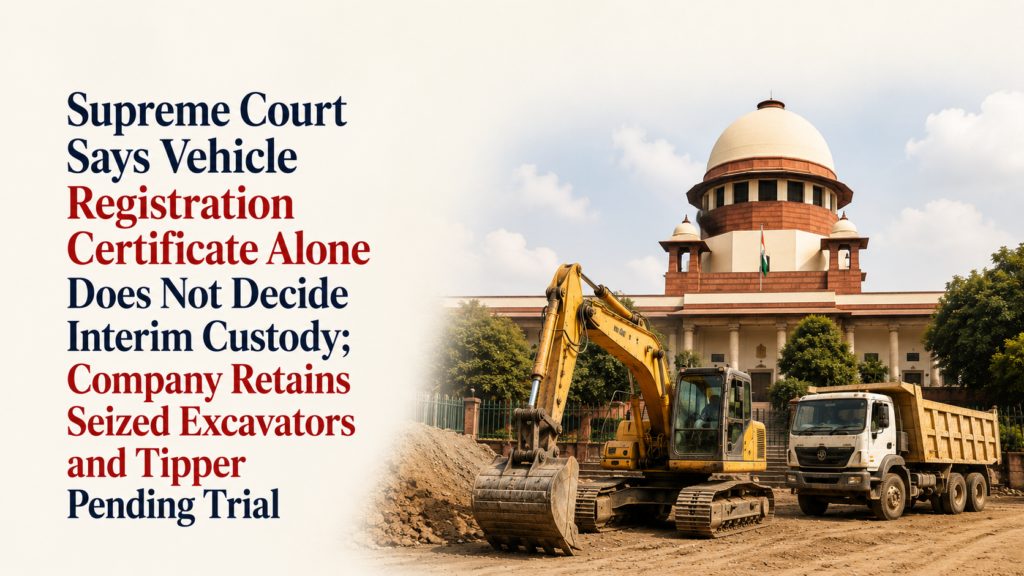
Director Claimed Ownership of Quarry Vehicles Registered in His Company’s Name; Supreme Court Grants Interim Custody to Company in Possession
Facts
The appellant, a director of M/s Pure Minerals, was also a director and majority shareholder in the respondent company. Several quarry vehicles, including a Bolero pick-up, three excavators and an Ashok Leyland tipper, were purchased in the name of M/s Pure Minerals between 2014 and 2022.
The appellant alleged that he was forced to sign blank papers, which were later used to forge his resignation from the respondent company. He further alleged that the respondents unlawfully entered the granite factory and removed the vehicles, leading to registration of an FIR.
The respondent company, however, alleged that the appellant had misappropriated ₹1.73 crore belonging to the company and used those funds to purchase the vehicles in the name of his own company. A counter-FIR was registered. During investigation, the police seized the vehicles from the respondent company’s operational site.
Both parties sought interim custody of the seized vehicles. The Trial Court rejected both applications, but the High Court ultimately granted interim custody to the respondent company, prompting the present appeal.
Issues
- Whether interim custody of the seized vehicles should be granted solely on the basis of the registration certificates.
- Whether the respondent company or the appellant was better entitled to interim possession under Sections 451 and 457 of the Code of Criminal Procedure.
- Whether questions relating to ownership, alleged forgery, resignation and misappropriation could be decided while considering interim custody.
Appellant’s Arguments
- The vehicles were registered in the name of M/s Pure Minerals and therefore should be released to the appellant.
- The High Court wrongly assumed that the closure report had attained finality despite subsequent investigation.
- The resignation letter and undertaking relied upon by the respondents were forged and fraudulently obtained.
- The Supreme Court’s decision in Sunder Bhai Ambalal Desai v. State of Gujarat required release of seized vehicles to the registered owner.
Respondent’s Arguments
- The appellant had diverted company funds amounting to approximately ₹1.73 crore to purchase the vehicles in his own company’s name.
- The appellant voluntarily resigned, transferred his shares, accepted consideration and encashed the cheque issued towards the share transfer.
- The appellant had executed an undertaking allowing the respondent company to retain and operate the vehicles until settlement of accounts.
- The respondent company had remained in possession of the vehicles and had paid the loan instalments to the finance company.
- Registration certificates alone could not determine entitlement to interim custody.
Analysis of the Law
The Supreme Court examined:
- Section 451 CrPC (Custody of property pending trial).
- Section 457 CrPC (Custody of property seized by police).
The Court reiterated that these provisions empower criminal courts to determine interim possession, not ownership.
The object of these provisions is:
- to prevent deterioration or misuse of seized property;
- to preserve its value;
- to ensure availability during trial.
While registration certificates are relevant evidence, they are not conclusive. Courts must consider all surrounding circumstances to determine who is prima facie best entitled to interim possession.
Precedent Analysis
The Court relied upon:
- Sunder Bhai Ambalal Desai v. State of Gujarat — Courts should promptly release seized property where appropriate to avoid deterioration, but custody is not governed by an inflexible rule favouring the registered owner.
- N. Madhavan v. State of Kerala — The discretion under Sections 451 and 457 CrPC must be exercised judicially based on the nature of the property and surrounding circumstances.
Court’s Reasoning
The Supreme Court held that the registration certificates standing in the appellant’s company’s name were only one relevant circumstance and not decisive.
Several factors favoured the respondent company:
- the vehicles were seized from its operational premises;
- they had remained in its continuous possession and use;
- the appellant had executed an undertaking permitting the respondent company to retain the vehicles pending settlement of accounts;
- the respondent company had paid the hypothecation instalments to the finance company;
- the appellant had accepted payment for transfer of his shares by encashing the cheque, which weakened his allegation that all documents had been obtained by coercion.
The Court declined to decide disputed questions regarding ownership, alleged forgery, resignation or misappropriation because those issues required evidence and would be decided in appropriate proceedings.
Conclusion
The Supreme Court dismissed the appeal.
It upheld the High Court’s order granting interim custody of the seized vehicles to M/s Earth Stein Private Limited, holding that continued possession, payment of loan instalments and the appellant’s undertaking outweighed the mere fact that the registration certificates stood in another company’s name.
The Court clarified that its observations were confined solely to interim custody and would not affect the final adjudication of ownership or other pending disputes.
Case Details
Case: Krishnan Narayana v. State of Andhra Pradesh & Others
Court: Supreme Court of India
Case Number: Criminal Appeal Nos. of 2026 (Arising out of SLP (Criminal) Nos. 19205–19206 of 2025)
Judges: Justice Sanjay Karol and Justice Augustine George Masih
Date: 27 July 2026
Result: Appeals dismissed. The Supreme Court upheld the High Court’s order granting interim custody of the seized vehicles to the respondent company, while clarifying that ownership and other disputed issues would be decided independently in the pending proceedings.